Ether.fi shipped a bank this week. Almost nobody noticed what the documentation quietly admitted at the same time: the business that made the protocol famous had already lost three quarters of its money.
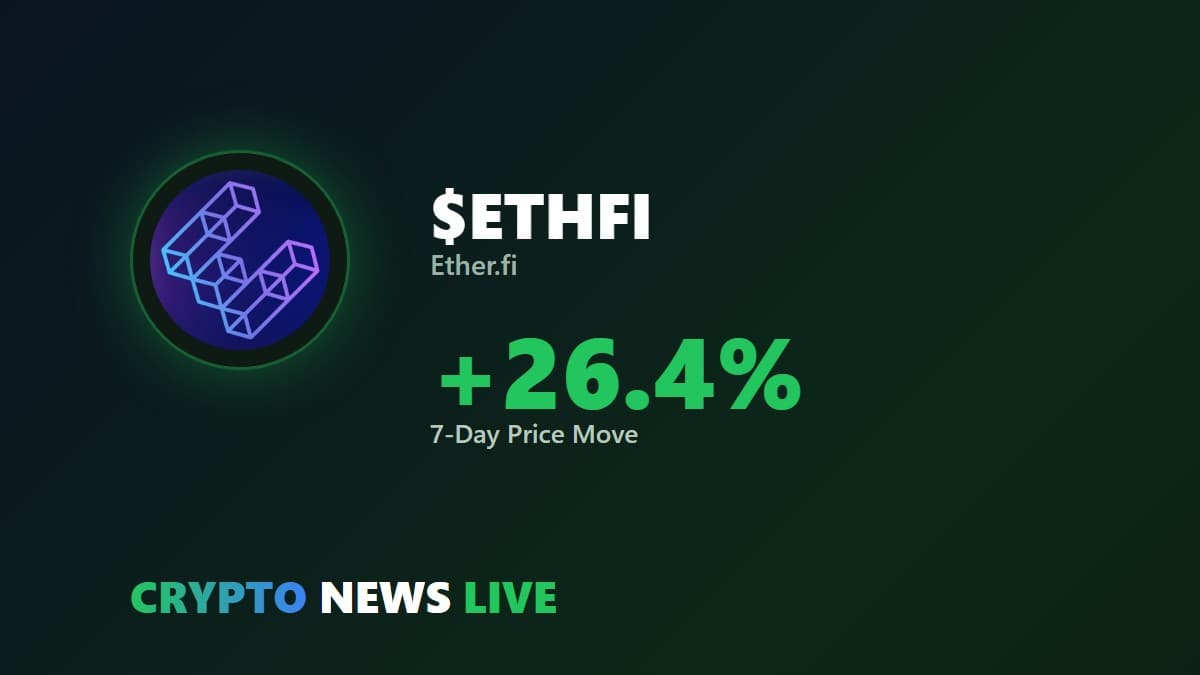
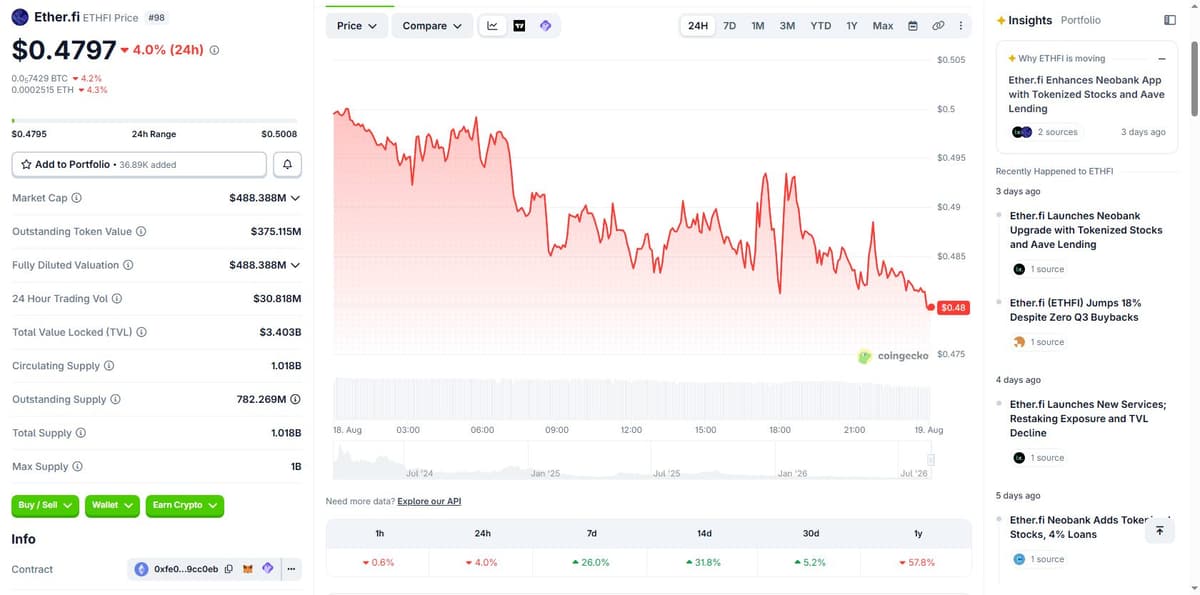
$ETHFI is up 26% over seven days, one of the only green names on a mostly red board when the rally started. It is down 4% in the past 24 hours, pulling back from a $0.52 high hit August 17. The token now sits near $0.48, testing whether the top of its old trading range holds as new support.
What Actually Shipped
The trigger has a clean timestamp. On August 13, 2026, ether.fi pushed a “Summer” release across web, iOS and Android, per Blockchain Reporter’s reconstruction of the company’s own announcement. Tokenized stock and metals trading landed next to crypto. An Aave market built on Optimism now lets users borrow against their whole portfolio. Fiat on and off ramps cover more than thirty currencies, Apple Pay and Cash App included.
CEO Mike Silagadze called it a bridge between DeFi and everyday finance. Ether.fi Cash also moved its credit backend onto Aave V4, replacing an in house system, with capacity targets in the hundreds of millions. That is real infrastructure, not a press release dressed up as one.
Tokenized stocks and metals are not available to United States users. That detail sits several paragraphs into most coverage. It should not.
The Number Nobody Put Next To The Launch
Less than 1%. That is how much of ether.fi’s assets remain restaked with EigenLayer today, down from roughly half in early 2026, according to the protocol’s own slashing risk documentation cited by Blockchain Reporter. The same page says the remaining share goes to zero by Q3 2026, and that ether.fi plans to strip EigenPod withdrawal credentials from its validators by Q4, cutting the last structural link to EigenLayer.
Ether.fi built its name as the largest business running on EigenLayer’s restaking model. weETH bundled staking yield with restaking exposure, and that bundle is why growth was so fast through 2024. That bundle no longer exists. weETH is now a plain liquid staking token. Anyone who still wants restaking exposure has to opt into a separate token, weETHs, built on Symbiotic instead.
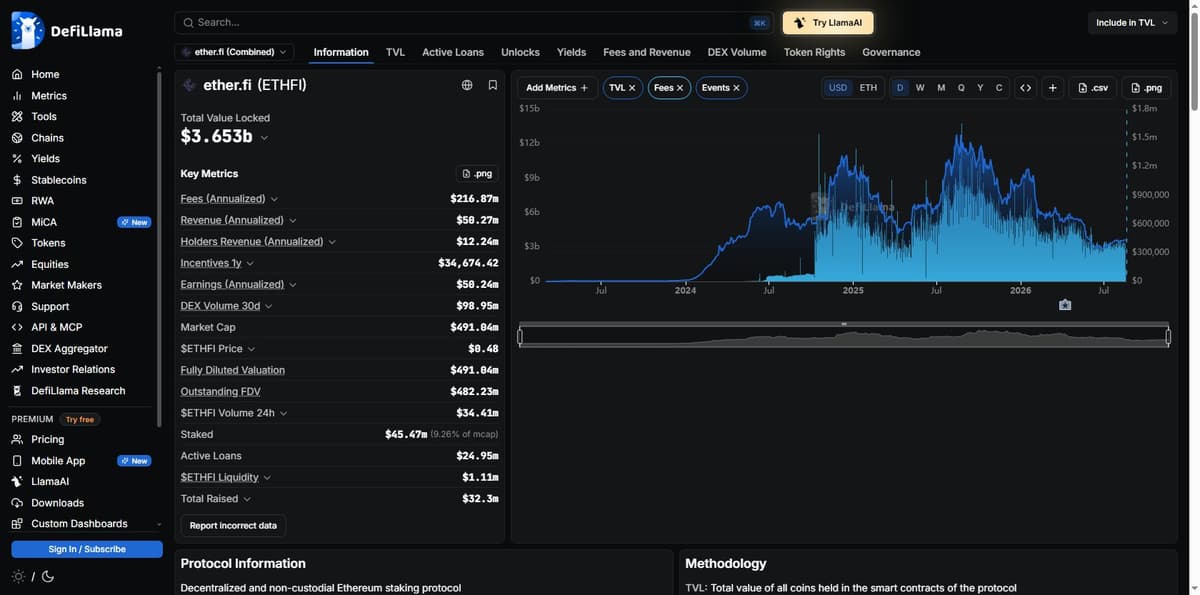
I pulled ether.fi’s own numbers on DeFiLlama independently rather than trusting the citation secondhand. Total value locked sits at $3.65 billion as of this check, still the third largest liquid staking or restaking protocol behind Lido and Binance staked ETH. It peaked near $13.8 billion in mid 2025. That is a decline of roughly 73%, and the wind down happened on chain before any blog post explained it.
Two True Stories, Only One Made The Press Release
The charitable read comes first because it is the fair starting point. A management team watching restaking demand and staking yields compress could reasonably build a second business, a consumer app riding a card product and fiat rails, before the first one turns into a real problem. Plenty of protocols instead ride a fading thesis straight into irrelevance. Building something new ahead of that is competent, not desperate.
The skeptical read deserves equal space. Consumer fintech is brutal. Ether.fi is now competing with actual banks and actual brokerages, geofenced out of the largest market on earth for its new stock trading feature, funded by a staking business that just shrank by nearly three quarters.
There is a draft Ethereum proposal in the background worth naming. EIP-8363, sometimes called Tapered Issuance Burn, would burn a portion of validator rewards as the network’s staking ratio rises, a mechanism that could push net staking yield toward zero at high participation. Nothing in the public record ties the Summer release directly to that proposal. A company stepping away from validator economics at the exact moment validator economics face a structural threat is still worth flagging.
The Buyback Wired Into The App, Funded By What Exactly
Ether.fi’s DAO has authorized up to $50 million in open market ETHFI buybacks below $3 per token, funded from protocol revenue, and the Summer release wires that mechanism directly into the app. Against a market cap sitting in the low $490 millions, that authorization is large in relative terms, well above the roughly 1.2% of market cap per year Chainlink spends on its own reserve buys.
An authorization is a ceiling, not a schedule. AMBCrypto’s own reporting, cited on AMBCrypto, flagged zero buybacks executed during Q3 as of four days before the Summer release, with protocol performance cited by the team as the differentiator instead. The mechanism is live in the app now. Whether it actually fires depends on revenue that mostly came from a staking business that just lost 73% of its size, replaced for now by a consumer app that launched six days ago.
What The Chart And The Positioning Say
ETHFI spent months boxed between roughly $0.30 and $0.48 before the Summer release broke it clean out of that range to a $0.52 high on August 17.
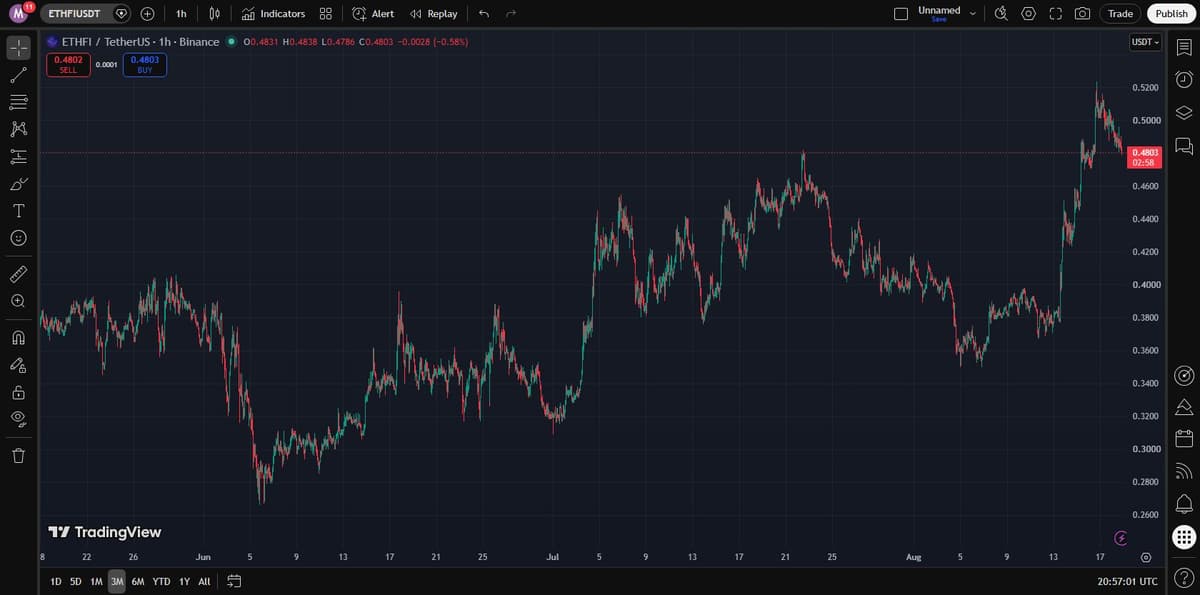
Price is now back at the top of that old range, the level that used to cap every rally attempt. Whether $0.48 holds as support or gives way back into the old box is the actual technical question right now, not the size of last week’s move.
Coinglass data shows funding stayed positive through nearly the entire rally, longs paying shorts the whole way up, a crowded positioning signature. Open interest expanded from around $45 million to roughly $50 million at the August 17 peak and has since eased back to $47.6 million alongside the price pullback, with long and short positioning now close to even at 48.77% versus 51.23%. That pattern reads as a margin driven push that is now partially unwinding, not a fresh wave of conviction buying.
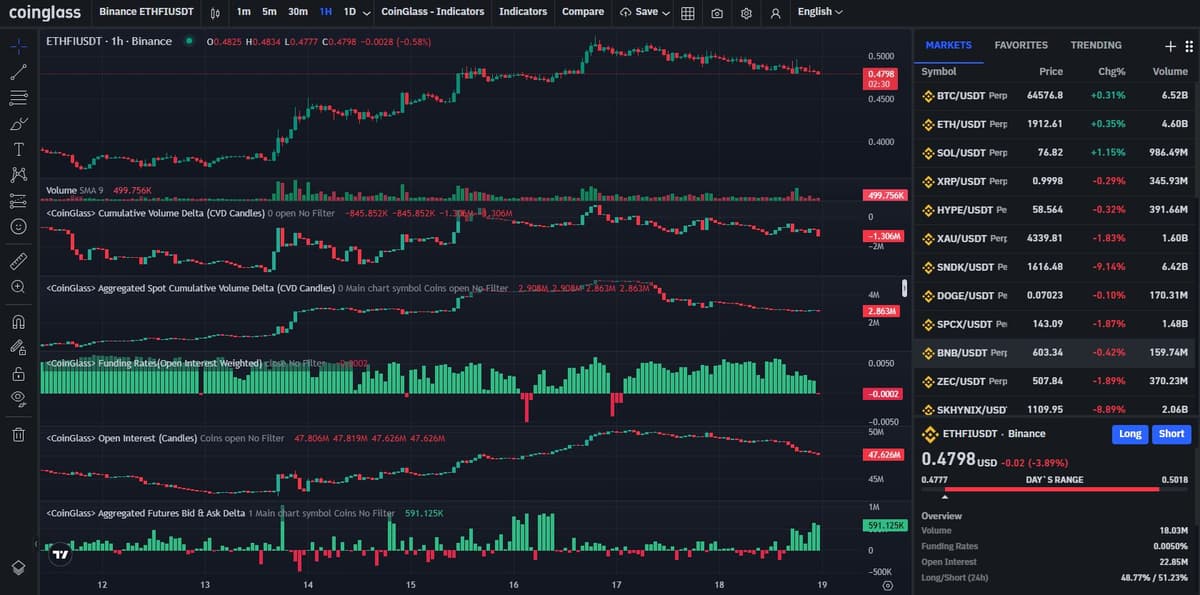
Nearly all of ETHFI’s real volume clears on centralized exchange order books rather than on chain pools. Binance alone moved roughly $2.4 million in the pair checked here, and the token carries genuine listings across all ten of the major venues tracked for this check, Binance included. On chain pools account for close to 1% of total reported volume, thin enough that DEX side theories carry little weight for this move.
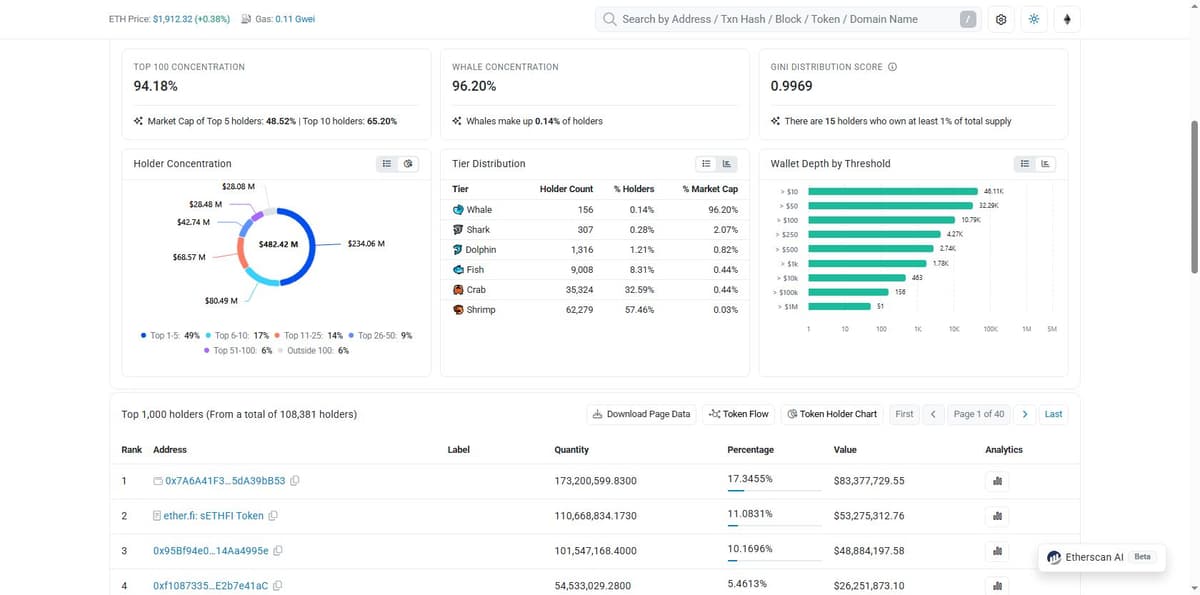
Holder concentration sits on the heavy side for a token this size. The top five wallets hold 48.52% of supply, the top ten hold 65.2%, and Etherscan’s own Gini score reads 0.9969. The second largest holder is ether.fi’s own staking contract, not an anonymous wallet, which softens the read somewhat. It is background risk rather than today’s trigger, since none of that concentration moved during the rally or the pullback.
The move was not a sector story. EigenLayer’s own token fell 0.95% over the same 24 hours, Lido was flat, Rocket Pool fell 1.15%, and Ethereum itself barely moved. Whatever pushed ETHFI happened to this one token alone.
The Part That Outlasts The Launch Candle
Ether.fi did what it said it would do, on the day it said it would do it, and the product itself is genuinely ambitious. It also ended, quietly and before any announcement explained it, the arrangement that built the company in the first place, while its core business shrank from $13.8 billion to $3.65 billion in about a year.
Both facts are true at once. Only one of them made the headline this week.