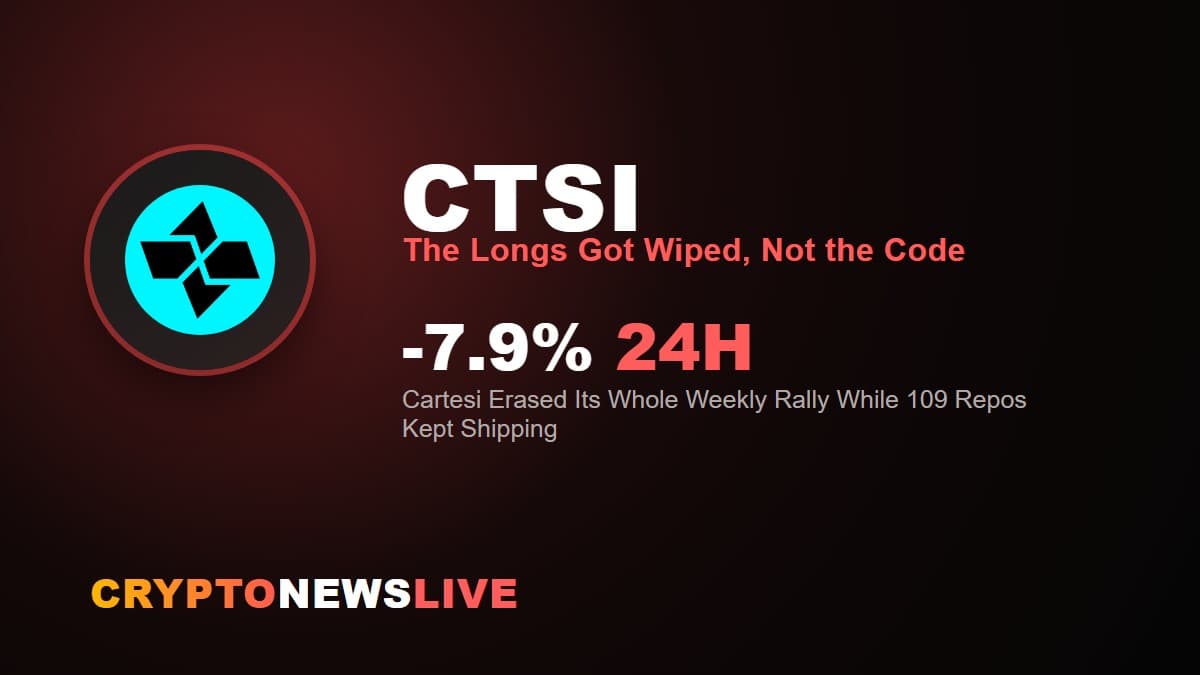
Cartesi spent the first days of August climbing toward $0.039, a seven-day high nearly 90 percent above where CTSI started the week. By Sunday morning most of that gain was gone.
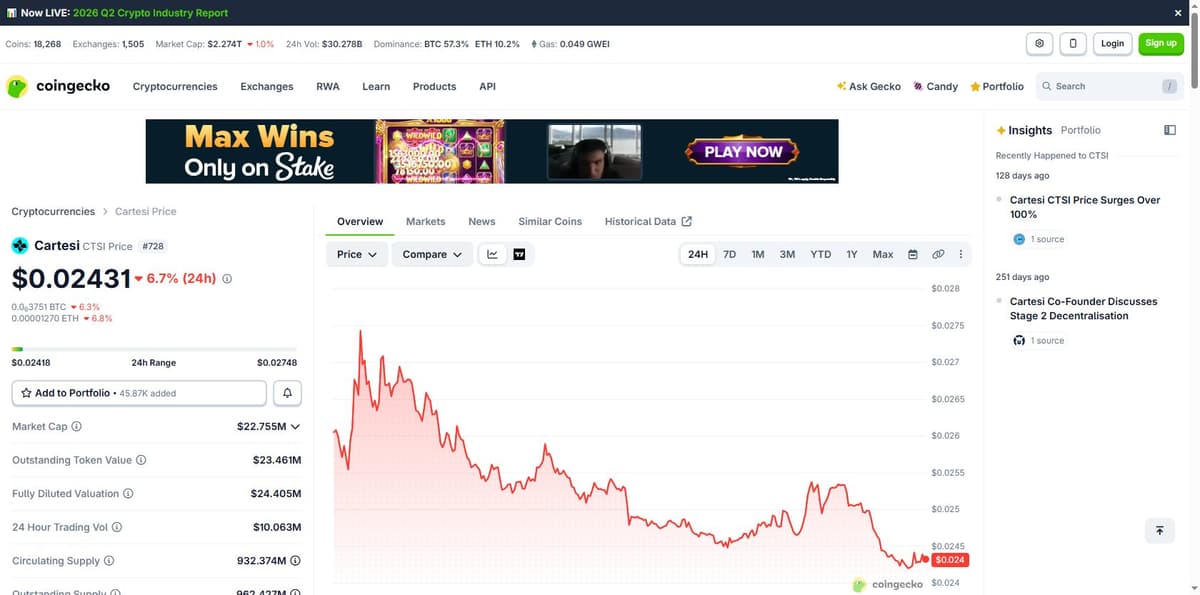
The token traded at $0.02415 as of this writing, down roughly 7% in 24 hours and sitting barely above the $0.02038 low it printed on July 29, a level CTSI had not touched since 2021. Whatever pushed the price up earlier in the week pushed just as hard in reverse, and CoinGecko’s own market page confirms the round trip in real numbers: a 24-hour range of $0.02418 to $0.02748, a seven-day range stretching all the way to $0.03915, and a market cap of $22.4 million against a fully diluted value of just $24.4 million.
A Clean Range Break, Not a Slow Bleed
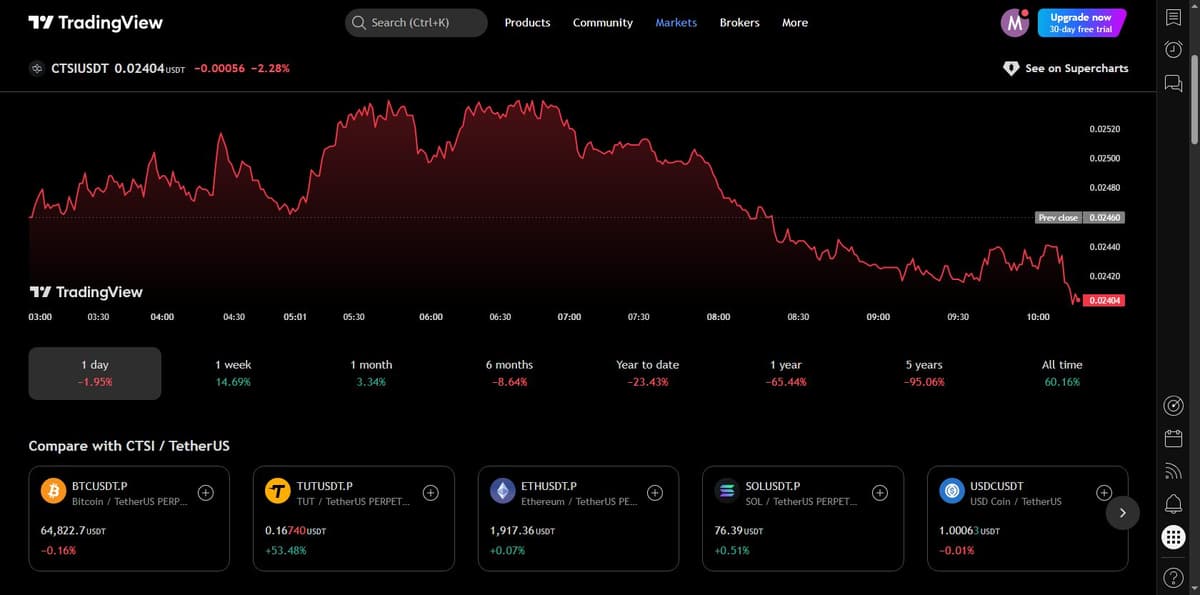
The intraday chart on Binance tells a tighter story than the daily numbers do. CTSI held a narrow band between $0.0248 and $0.0252 for roughly five hours through the morning. Then, close to 08:00 UTC, it broke.
No chop. No retest that held. The price just kept sliding, printing lower lows every twenty minutes until it settled near $0.0240 into the early afternoon. That is a textbook range breakdown, the kind that shows up on a chart before it shows up in any headline.
Longs Paid For the Break
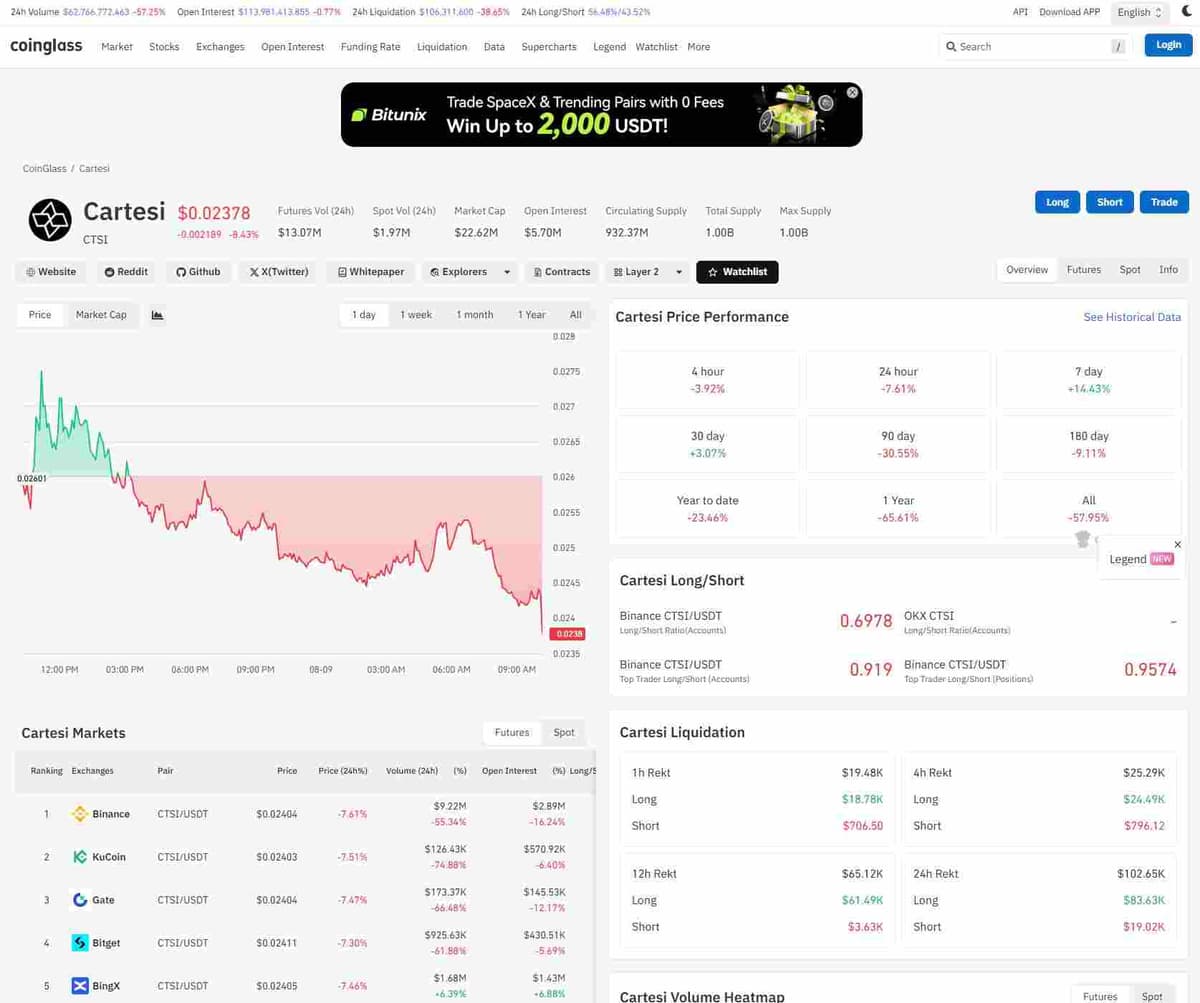
Coinglass data pulled the same afternoon shows futures volume on CTSI running at $13.04 million against just $1.95 million in spot, meaning almost all of today’s real price discovery happened on margined books, not on people actually buying and holding the token.
On Binance alone, $54,820 in long positions were liquidated over 24 hours against only $13,930 in shorts. Four times the damage landed on the bulls. Almost none on the bears. Open interest sits at $5.7 million, a quarter of the entire market cap, which is a lot of borrowed exposure riding on a $22 million token. When a crowded long book meets a broken range, the liquidations do a chunk of the selling on their own, and Sunday looks like exactly that mechanism at work.
Bitcoin Was Basically Flat
Rule out the obvious excuse first. Bitcoin moved less than a quarter of a percent on the day. Ethereum was flat. Arbitrum was down about a point, Optimism was actually up. Running CTSI’s own price history against Bitcoin’s produces a 30-day correlation coefficient of 0.024 and a seven-day figure that rounds to zero, computed straight from CoinGecko’s price-history API rather than eyeballed off a chart.
That number matters because it kills the easy story.
This was not beta, not a sector rotation dragging every Layer 2 and rollup token down together. Whatever happened to CTSI happened to CTSI specifically, on a day the rest of the market shrugged.
No Announcement, Just a Repo That Keeps Moving
CoinGecko’s own news feed for Cartesi has nothing newer than 128 days old, and DeFiLlama’s hack database has no entry for the project at all, clean on both counts. There was no delisting notice, no exploit, no founder tweet walking anything back.
Which leaves the harder, less satisfying answer: a margined, thinly-traded token gave back a speculative pump with no story attached to either the rise or the fall.
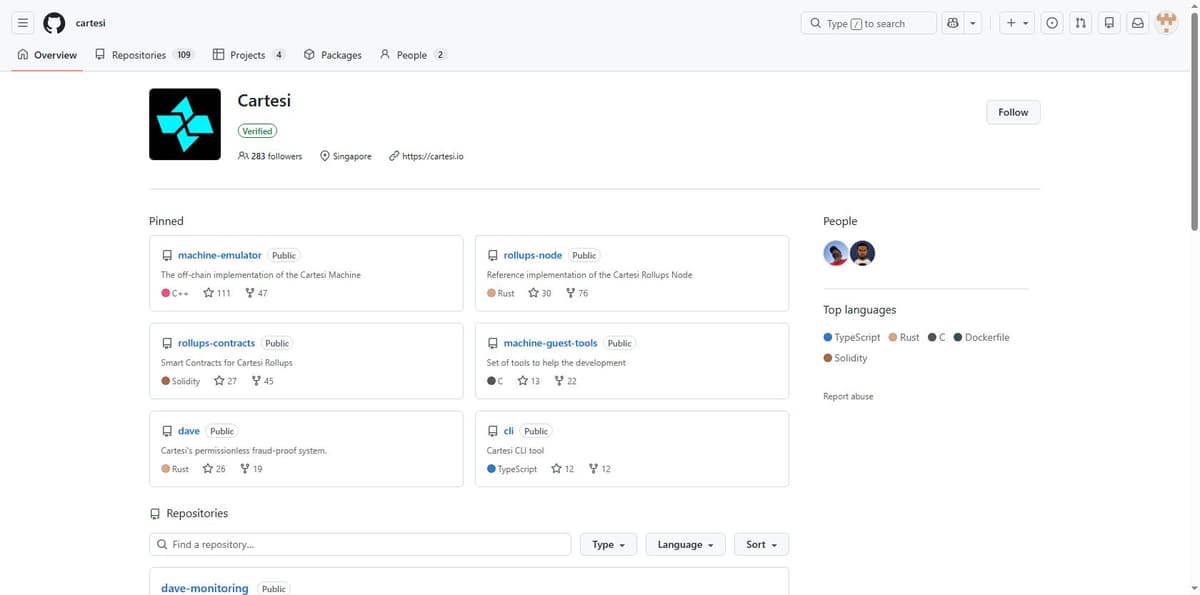
What did not stop is the building. Cartesi’s GitHub organization carries 109 repositories, and the core ones are not sitting idle; the machine-emulator repo, the rollups-node reference client, and a fraud-proof system called Dave all show recent, active commits. A team that had quietly given up would not still be shipping a sequencer prototype the same month its token sits 95% below where it traded five years ago.
Supply is not the culprit either. Circulating supply already sits at 932 million of a 1 billion max, leaving almost nothing left to unlock and pushing fully diluted value within 8% of the actual market cap. Trading is spread across more than fifty venues with no single exchange clearing even 20% of volume, which rules out a thin, wash-traded pool doing the damage on its own.
Put together, the honest read is a crowded, margined bet that unwound itself on a quiet news day, not a project unraveling. The chart broke before anyone found a reason. The reason may simply be that there wasn’t one.