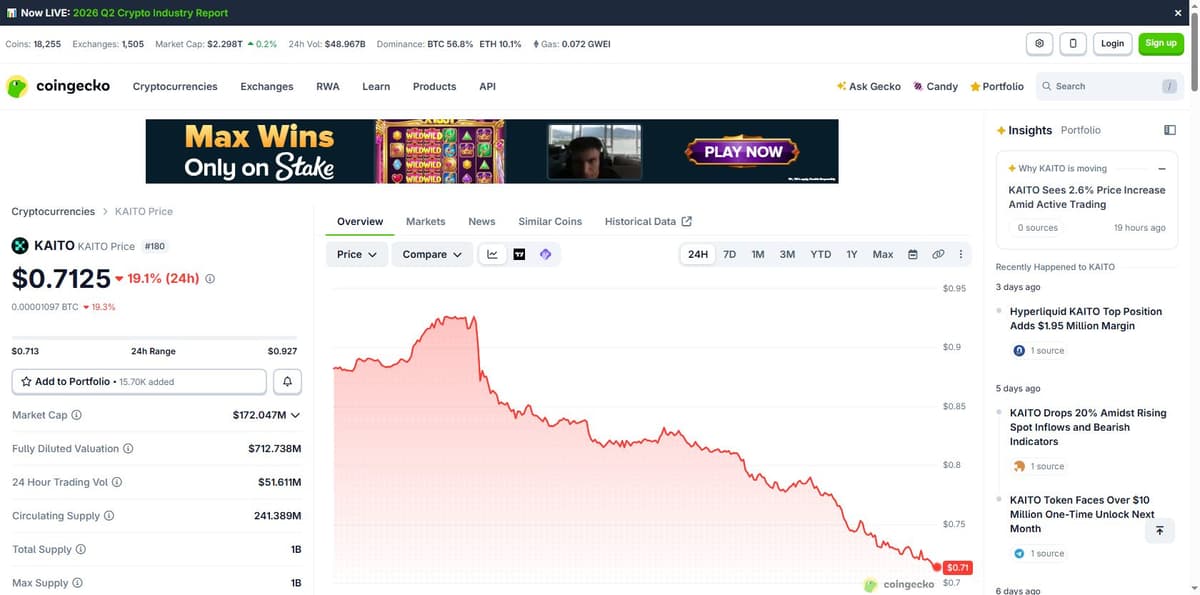
Kaito fell 19.1 percent in the past 24 hours, and $762,910 of that move came from longs getting force-closed, not spot holders quietly selling. That is 89.8 percent of the token’s entire $849,520 liquidation bill for the day. Shorts barely got touched.
The setup for that wipeout was visible days in advance.
Longs That Were Barely Days Old
Three days before Kaito broke down, an address holding the largest KAITO position on Hyperliquid added $1.95 million in fresh margin to its long, according to PANews. Two days before that, PANews had already flagged two separate new addresses opening a combined $6.94 million in 5x leverage KAITO longs on the same venue, in a report dated five days ago.
None of that leverage had time to season. Kaito was still trading near $0.90 to $0.92 when those positions opened. By the time this article was written, price had broken to $0.71, and CoinGlass’s own 24-hour ledger shows exactly where the pain landed.
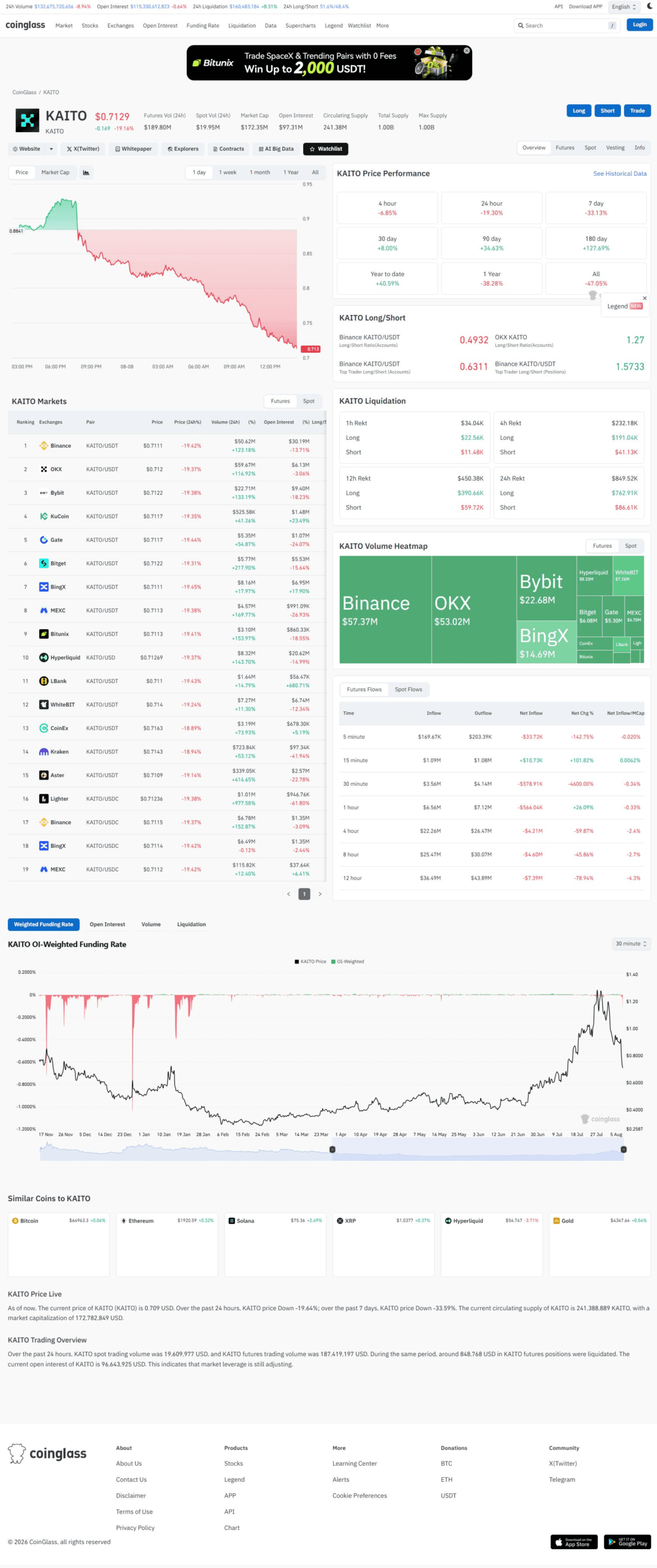
Ninety percent of Kaito’s price discovery right now runs through derivatives, not spot. CoinGlass lists 24-hour futures volume at $189.80 million against just $19.95 million in spot turnover. When leverage that lopsided gets forced to unwind, the candle does not politely digest it. It gaps.
The Chart Already Warned Buyers
Two separate technical reads point at the same conclusion. The first is structural. Kaito’s 30-minute chart shows a textbook double top: a spike toward $1.35 in late July, a lower secondary high just above $1.30 days later, then a breakdown through the $0.85 to $0.90 range that had held as a floor for more than a week. That is classical price structure, not an indicator’s opinion. The second high failing to clear the first is exactly the pattern that precedes exactly this kind of move.
The second read is momentum. On that same 30-minute frame, TradingView’s RSI Divergence Indicator printed three separate bearish flags clustered right at that lower high, the same zone where the Hyperliquid longs from the section above were being built.
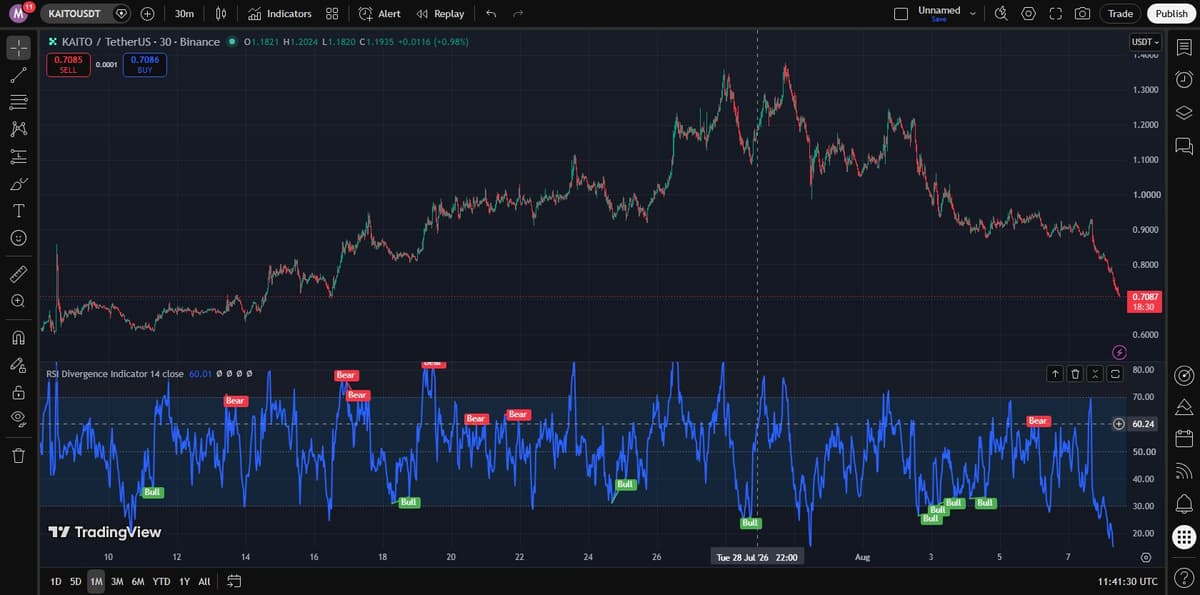
RSI on that same 30-minute frame has since collapsed to 9.94. Deeply oversold, technically speaking. The 5-minute RSI reads a less extreme 34.48, which tells its own story: the bleed accelerated hard in the final hours rather than grinding out evenly.
Structure warned first. Momentum confirmed it. Neither one causes a crash by itself. They just tend to notice the exit door before the crowd does.
A Giveback, Not a Collapse
Kaito is down 33.1 percent over seven days. It is still up 34.63 percent over 90 days and 127.69 percent over 180 days, per CoinGlass’s own performance panel. Whatever is happening this week is erasing part of a much larger run, not erasing the token.
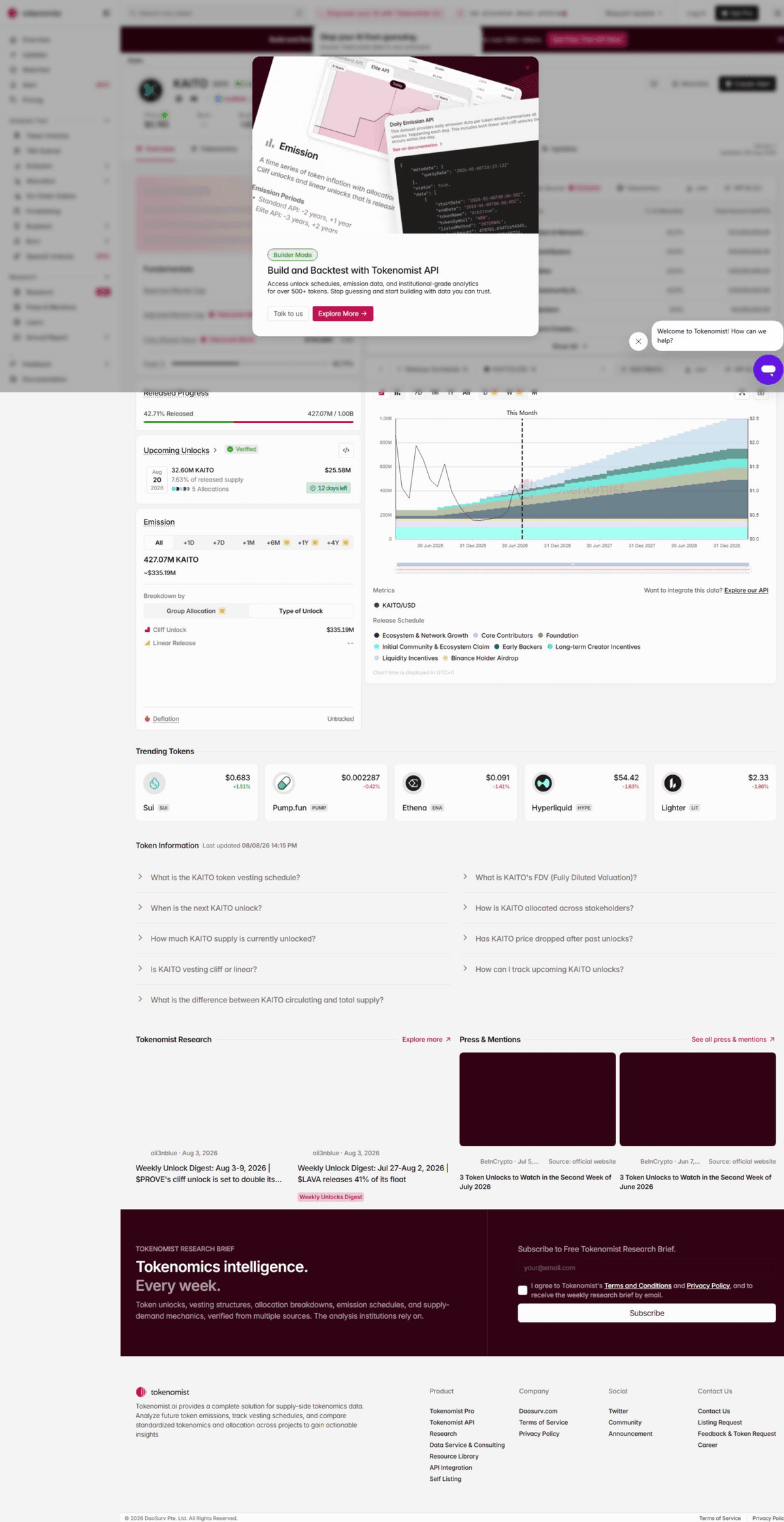
Circulating supply is where the numbers get messy. CoinGecko’s KAITO page lists circulating supply at 241.4 million, though the site’s own auto-generated summary text elsewhere on the same page cites 340 million, a discrepancy this piece is flagging rather than quietly picking a side on. Tokenomist counts something different again: 427.07 million KAITO, 42.71 percent of the 1 billion max supply, already released under the vesting schedule.
Whichever figure is closest to reality, another 32.60 million KAITO unlocks on August 20, worth roughly $25.58 million at current prices and equal to 7.63 percent of released supply, according to Tokenomist. That is 12 days out.
Bitcoin and Ethereum both traded flat to slightly higher over the same 24 hours, up 0.3 and 0.4 percent respectively, per CoinGecko. Whatever hit Kaito today did not hit the market. It hit Kaito, specifically the leveraged corner of it.
Kaito trades across nine of the ten largest centralized exchanges by volume, Binance, Coinbase, OKX, Upbit, Kraken, KuCoin, MEXC, Bitget and Gate among them, per CoinGecko’s own market listing, alongside Hyperliquid’s perpetual market where this week’s damage concentrated.
No official KaitoAI GitHub organization shows any public repositories or recent commit activity, a background note rather than a red flag given the product is largely a closed analytics platform, not an open protocol chain.
If Kaito reclaims the $0.80 to $0.85 shelf it broke from, today’s flush reads as exactly what the liquidation data suggests: leverage clearing itself out, not a change in the token’s underlying trajectory. A failure to reclaim it, with the August 20 unlock still ahead, would give sellers another two weeks to keep testing lower.