Babylon spent last week climbing. Binance was paying people to trade it.
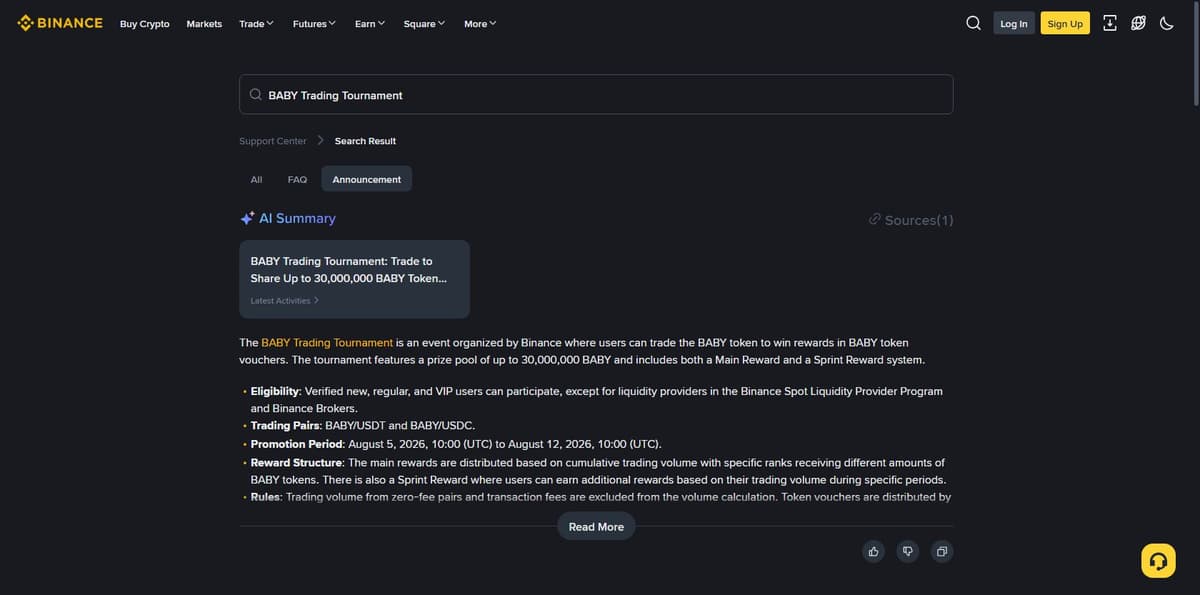
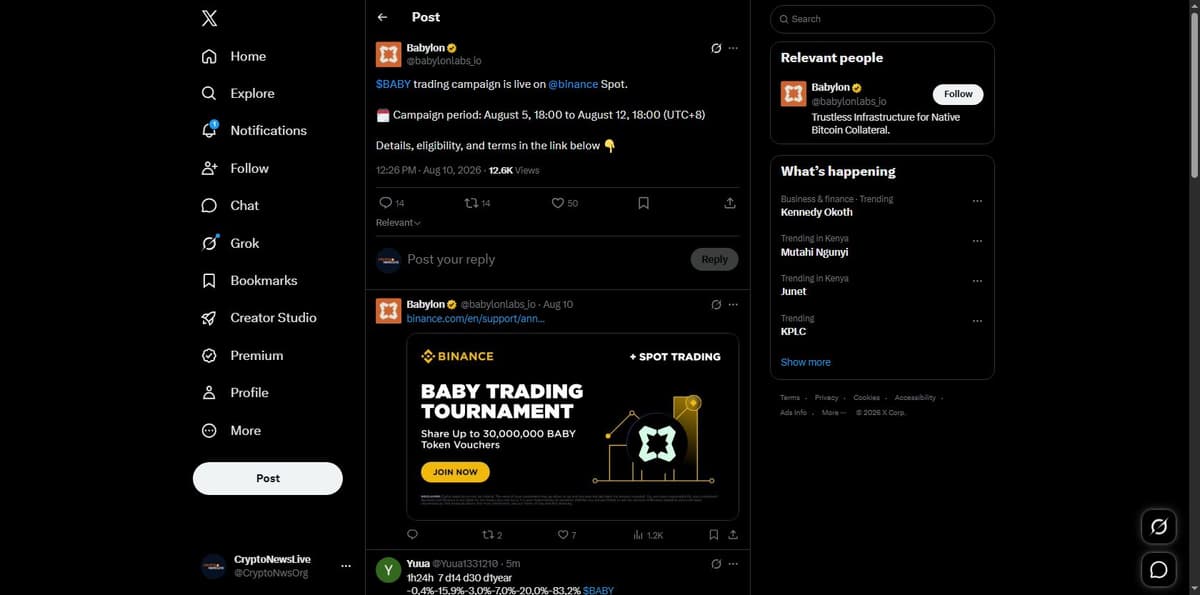
The BABY Trading Tournament went live at 10:00 UTC on August 5, a 30,000,000 BABY prize pool split across 5,000 ranked spots plus a bonus “Sprint Reward” layer for whoever traded hardest inside 48 hour windows. Price responded almost immediately: BABY climbed from roughly $0.0107 to a peak near $0.0133 by August 10, a 24 percent run that lined up, almost to the hour, with the promotion Binance itself had announced days earlier.
The Contest Ended. So Did the Bid.
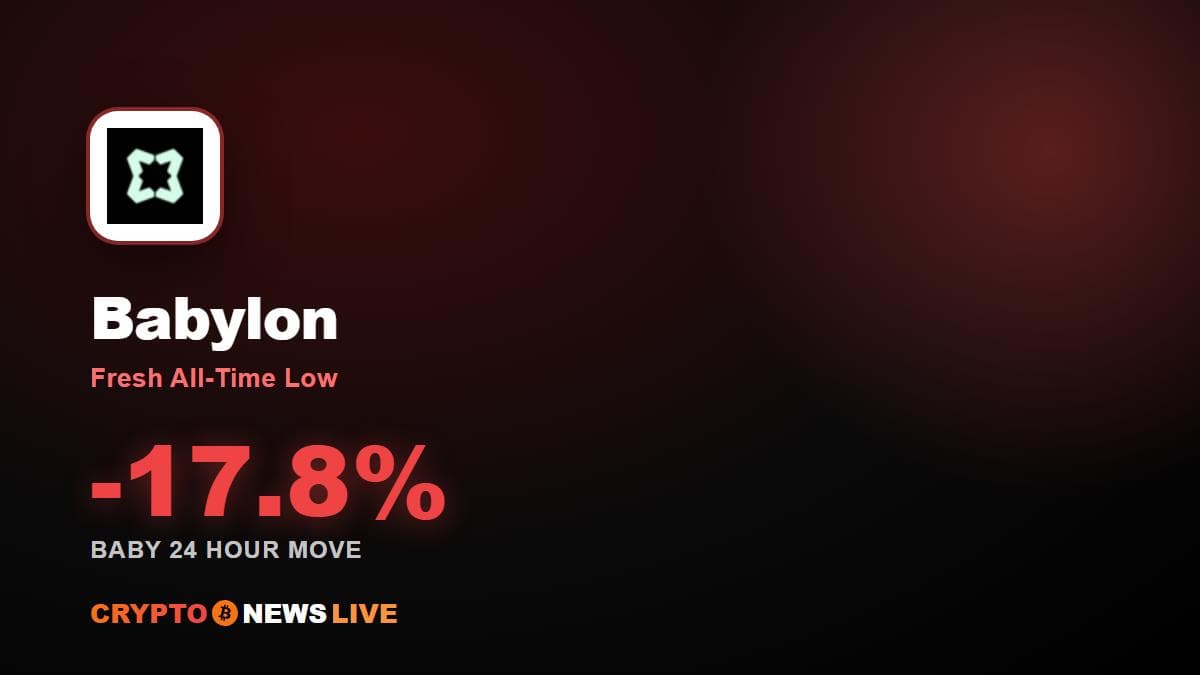
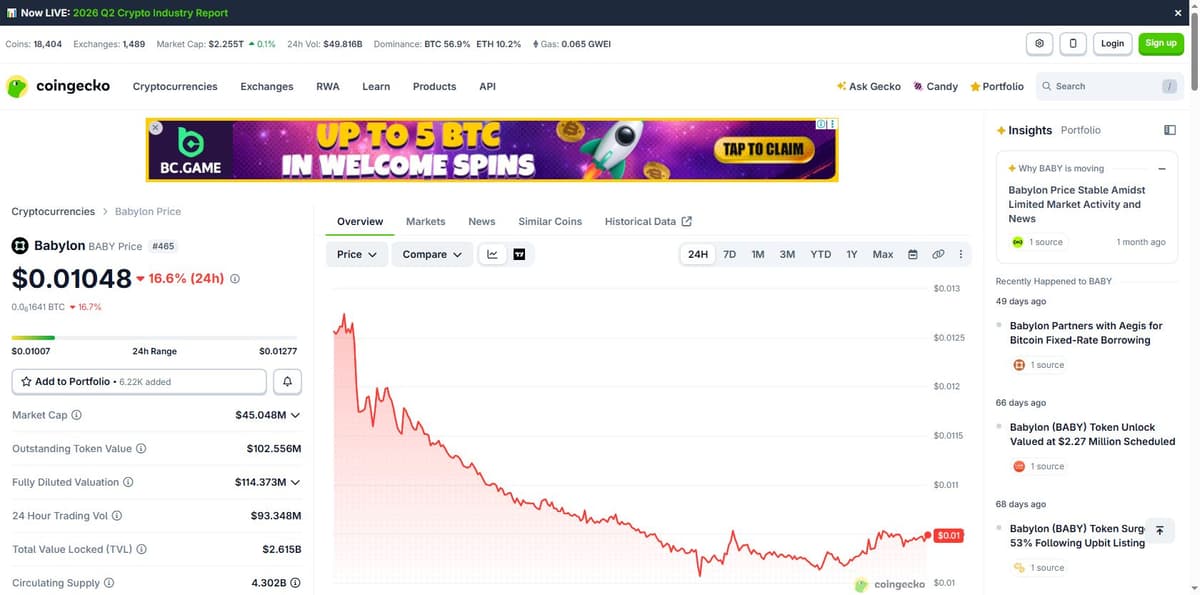
Binance’s own terms put the cutoff at 10:00 UTC on August 12. CoinGecko’s hourly price data shows BABY still changing hands near $0.01255 at 09:00 UTC that day, an hour before the tournament’s statistical window closed. Four hours later it was $0.01130. By the next morning it had cut clean through $0.0101, a level the token had never traded at before, and kept sliding to a fresh all time low of $0.01007. As of this writing BABY sits at $0.010342, down 17.8% on the day, according to CoinGecko.
Paid to Trade, Not to Hold
The reward structure explains the shape of the move better than any single seller could: rankings were paid on cumulative trading volume, not net buying, with fee-free pairs and wash-style round trips explicitly excluded from qualifying volume per Binance’s own rules. That rewards traders for pushing size through the book while the clock is running, and gives them zero reason to hold once it stops. This is at least the third Binance-hosted BABY incentive since June, after a “$BABY Trading Tournament” paying out in BNB on June 9 and a Binance Square CreatorPad round worth 2,390,000 BABY on July 23. Three contests, two months, one pattern. As Babylon’s own team put it on X: “$BABY trading campaign is live on @binance Spot.”
Longs Leaned the Wrong Way Into the Drop
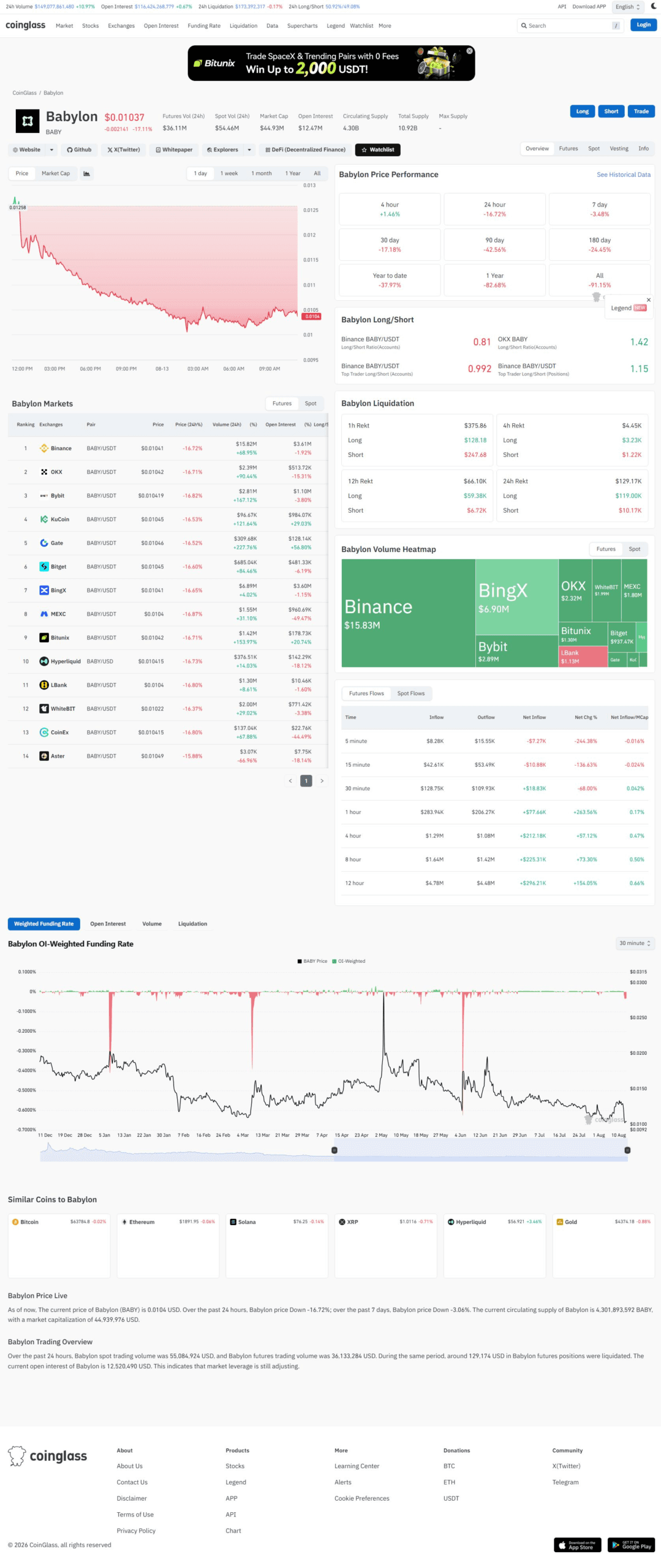
Babylon’s derivatives market is thin, just $12.5 million in aggregate open interest against a $44.9 million market cap, but the positioning data still tells a clean story. Coinglass shows Binance’s BABYUSDT perpetual alone absorbed $57,960 in long liquidations against only $10,170 on the short side over the past 24 hours; Bitget booked $21,720 long versus $27 short, Bybit $15,830 long with nothing on the other side, Gate $15,170 long and zero short. Funding sat mildly negative at -0.03% at last check, and open interest was falling on most venues, both signs of margin traders closing out rather than piling in fresh.
The Range That Didn’t Hold
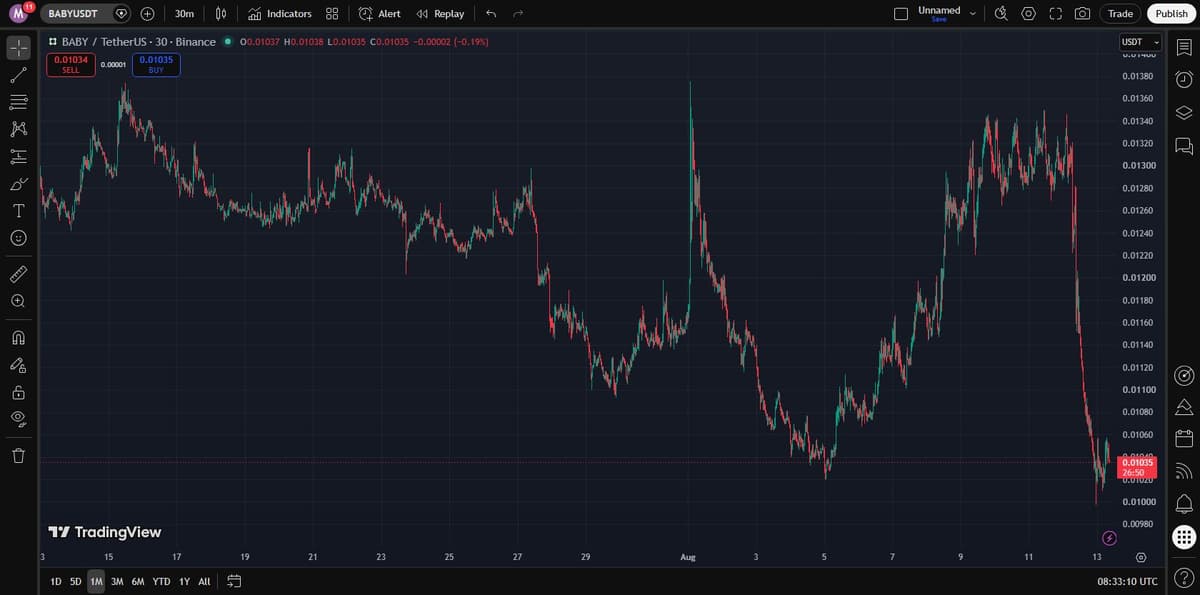
Zoom out and the chart tells the same story from a different angle. The one month view shows BABY grinding sideways through late July, then the tournament-week rally pushing into the low $0.013s before rolling over hard. That top-down read, the tournament-week price action failing to hold its own range, matches the intraday breakdown almost exactly: support that had held since late July gave way within hours of the contest ending, not gradually.
$2.6 Billion Secured, $44 Million Priced
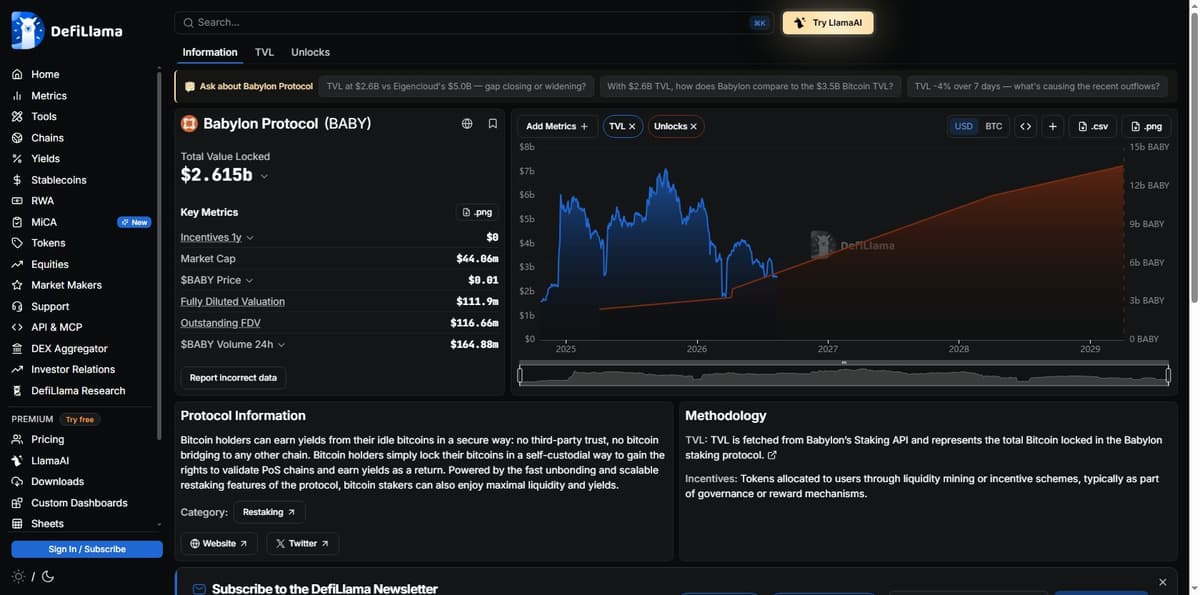
None of this happened because Babylon stopped working. DeFiLlama still counts $2.615 billion in Bitcoin locked through the protocol, good for second place among restaking platforms behind EigenCloud’s $5.0 billion, a figure worth roughly 58 times BABY’s own market cap. That comparison needs a caveat: the $2.6 billion is Bitcoin bonded by stakers to secure other chains, not capital denominated in BABY, so it does not rise or fall with the token’s price the way a lending protocol’s TVL might. What it does show is that Bitcoin holders keep using Babylon to earn yield even as the token that pays some of those rewards sits 93.7% below its April 2025 high.
The Supply Still Working Against It
The token side carries its own drag. Only 38.54% of BABY’s supply is unlocked, and Tokenomist’s vesting tracker shows several tranches, team, community incentives, research and development, still releasing on a combined daily basis worth tens of thousands of dollars. None of that lines up with today in particular, the next scheduled cliff isn’t until September 10 per Tokenomist, but it means every rally has new supply working against it before a single trader shows up. Babylon’s backers read like a venture capital who’s who, Paradigm, YZi Labs (formerly Binance Labs), Galaxy Digital, OKX Ventures and Polychain Capital all hold allocations, and the token launched through Binance’s own HODLer Airdrop program. Big names financed the project; they haven’t stopped the bleeding.
Not everyone reads the chart the same way. Trader Wizen Labs called BABY a “key accumulation zone” on X on August 9, one day before the tournament’s peak, arguing the correction from its all-time high had gone far enough. That call came before today’s breakdown, and it hasn’t aged well yet, but it’s the kind of contrarian read that’s easy to dismiss from a $0.01 handle and harder to dismiss from wherever BABY trades a year from now.
Almost none of BABY’s volume trades outside centralized exchanges, 99.9% of the roughly $85 million in tracked 24 hour turnover clears on CEX order books versus about $63,000 on Osmosis, so the tournament-and-liquidation read carries more weight here than any DEX-side theory would. DeFiLlama’s hacks database shows nothing for Babylon, and CoinGecko’s category tags confirm it is a genuine restaking project, not a memecoin riding the ticker. The next dated catalyst, that September 10 unlock, is still four weeks out. Whether BABY has found a floor before then depends less on Bitcoin’s own price and more on whether Binance runs a fourth tournament.