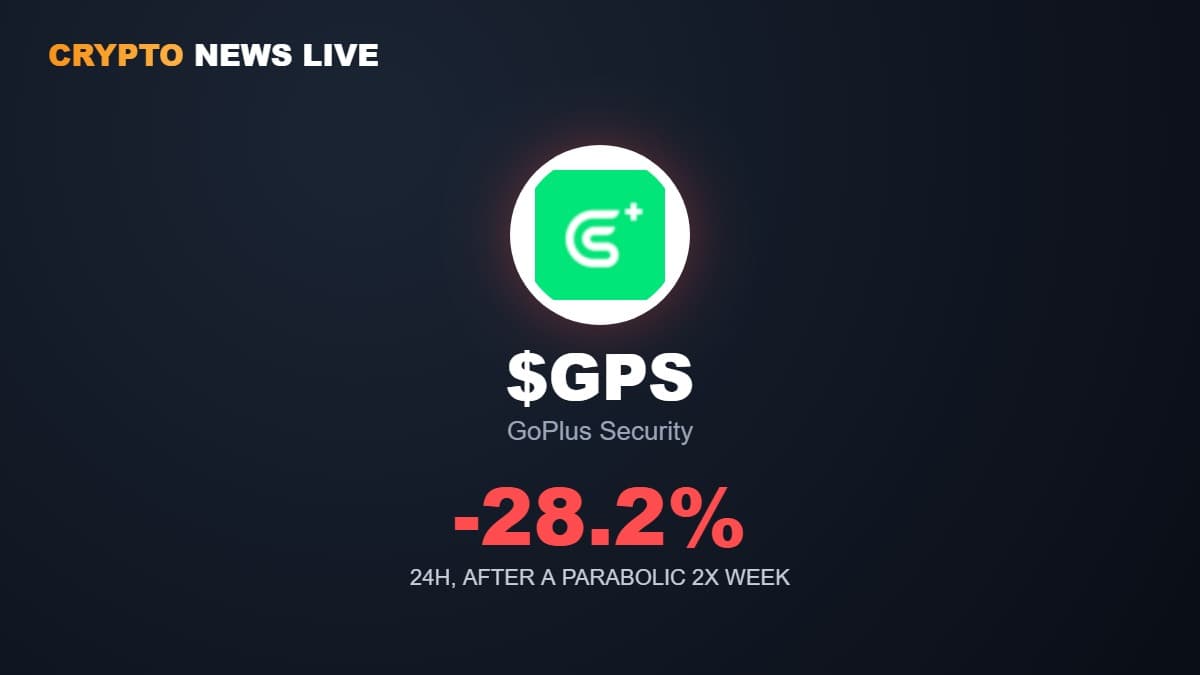
GoPlus Security spent a week building the kind of reputation a security firm actually wants: flagging real breaches, in real time, before anyone else did. GPS rallied roughly 30% over seven days on the back of it. Then, in the space of a single 24-hour stretch, the token gave almost all of it back. It fell 28.2%, dragging price from a parabolic high near $0.0189 down to $0.0122.
No hack of GoPlus itself. No exploit, no exchange delisting, nothing broken on-chain. The token just did what tokens riding a pure attention narrative tend to do once the narrative stops accelerating. It round-tripped.
The Alerts That Actually Built the Rally
GoPlus is a Web3 security layer, a permissionless scanner network that flags malicious contracts, phishing sites and wallet-drainer risk before users interact with them. Over the past week its own X account turned into a real-time incident desk. Each post landed while the story was still breaking, not after.
On August 14, GoPlus was first to detail a data leak at Trezor’s fulfillment partner, ShipMonk, warning that 11,742 customers had their full name, address, phone and email exposed, with another 1,947 hit by a deeper leak covering support tickets. Two days later, on August 16, the account walked through a live case study: a Bitcoin holder who moved funds to a CEX to dodge a suspected Coldcard hardware-wallet compromise, only to lose $750,000 in under 12 hours once his Google Authenticator cloud sync, not the hardware wallet itself, turned out to be the real point of failure.
On August 17, GoPlus flagged a leak at SafePal’s order-tracking plugin. Order data for roughly 39,800 users got exposed: names, addresses, phone numbers and emails, though not seed phrases or wallet keys. The team followed up the next day with a product push, an upgrade to its DeepScan smart-contract scanner pitched as a response to attackers now using AI to hunt deep-layer contract bugs faster than manual audits can catch them.
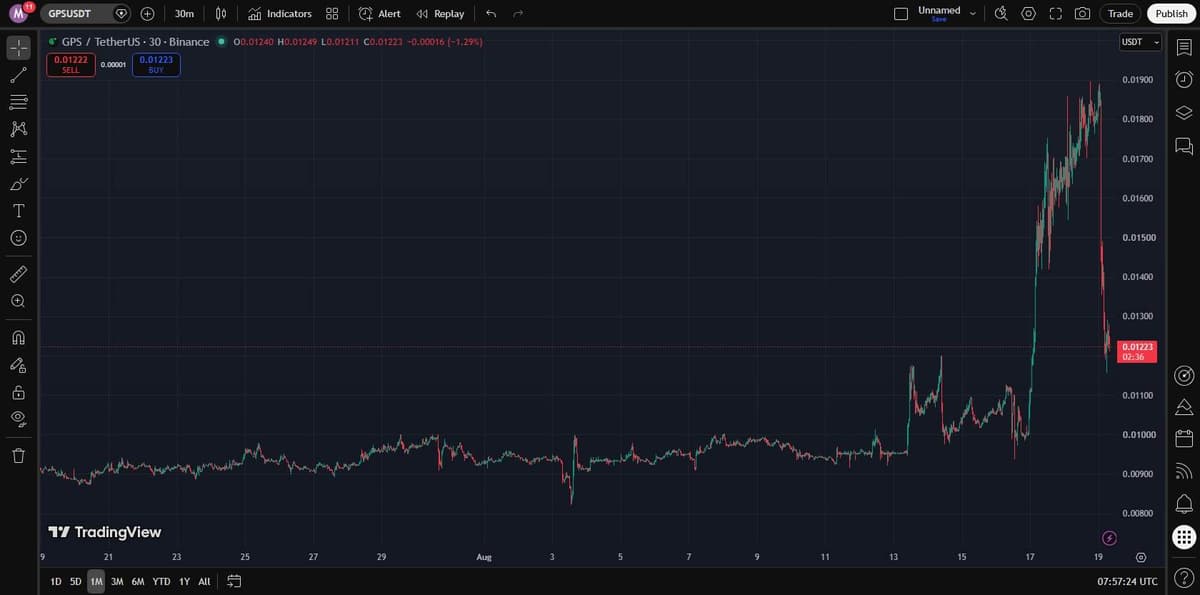
Three real incidents and a real product upgrade, all inside four days. That’s what took GPS from a flat $0.0095-ish range into a near-doubling toward $0.0189. Not a listing pump, not an airdrop headline. A security company’s own utility narrative compounding in real time, and traders bought the story while it was still being written.
Why the Chart Gave It Back
The 30-minute chart makes the shape hard to miss. A multi-week base around $0.0090 to $0.0105, a clean breakout on August 17, a vertical run to a $0.0189 high, then a reversal candle that erased more than a third of the whole move in under a day. Price now sits almost exactly back at the old range high, the same level that acted as resistance before the breakout. That’s a genuine decision point, not free-fall.
A former resistance zone that gets reclaimed on a pullback is the first real test of whether a breakout was structural or just a narrative spike. If $0.0120 to $0.0125 holds as support on the next bounce attempt, the breakout has a case for being real. Fail that, and price slides back into the old $0.0090 to $0.0105 base. Then the whole move gets filed as a liquidity-grabbing round trip with nothing left behind.
No Squeeze, Just an Unwind
Coinglass data on Binance’s GPSUSDT perpetual shows funding sitting close to flat, 0.0037%, with open interest at $12.04 million. Longs and shorts split almost evenly too, 50.9% versus 49.1%. That combination rules out the most dramatic explanation for the drop. This wasn’t a cascading long liquidation triggered by overleveraged positioning.
Funding never got aggressively positive during the pump. The unwind on the way down didn’t come with a lopsided long-short skew either. Reads more like spot-and-perp profit-taking after a fast, narrative-driven move than a forced deleveraging event.
The Next Unlock Is Two Weeks Out, Not Today
Token unlocks are the routine explanation for GPS weakness. The project has a documented history of unlock-adjacent drawdowns, including roughly a 9.4% decline around a June 2026 release. That isn’t today’s story though. Per Tokenomist’s vesting schedule, GPS’s next scheduled unlock isn’t until September 1, 2026: 166.44 million tokens, about 3.1% of released supply, roughly $2.06 million at current prices, going to advisors. Both too small and too far out to explain a drawdown this size in a single day.
Roughly 58.4% of the 10 billion total supply is already circulating. The remaining unlock schedule runs out into 2028, a real background overhang worth tracking, just not what triggered these particular 24 hours.
Where the Volume Actually Trades
GPS isn’t a thin, forgotten micro-cap that got lucky with a week of attention. CoinGecko lists it under both YZi Labs (formerly Binance Labs) Portfolio and OKX Ventures Portfolio, and the exchange depth backs that up. Binance, Coinbase, Bybit, KuCoin, Bitget and Gate all carry GPS/USDT or GPS/USD pairs, alongside smaller venues like MEXC, KCEX and Ourbit. The only DEX pool of any size, an Aerodrome pair on Base, carries roughly $147,000 in 24-hour volume against total reported volume north of $60 million. Well over 99% of real trading happens on centralized order books, not thin on-chain liquidity a single wallet could push around.
Correlation to Bitcoin over the past seven days computes to just 0.125, a weak relationship confirming this was a GPS-specific event on both the way up and the way down. Bitcoin dominance has been climbing toward 57% this week as capital rotates toward majors, which may have added a light headwind to the unwind. It doesn’t explain a move this token-specific in scale, though.
What’s Left After the Round Trip
Strip out the parabolic wick and GPS is still up roughly 31% over the past week, even after today’s drop. The rally wasn’t fully erased, just heavily discounted. Circulating market cap sits near $71 million against a fully diluted valuation of about $122 million, a gap worth watching as the remaining supply unlocks over the next two years.
The security incidents that drove the pump were real and independently verifiable. GoPlus’s own timeline on Trezor and ShipMonk, the Coldcard-adjacent Google Authenticator case, the SafePal leak, all of it checks out against the companies’ own disclosures. What’s still unresolved is whether that kind of attention turns into durable token demand, or whether GPS reverts to trading like every other utility token. A spike on the news cycle. Then a slow fade back to the range once the headlines move on.