Zcash (ZEC) fell about 22% in the seven days to Nov 26, 2026, and is down about 46% over 30 days, trading near $700 on Binance’s perpetual futures market.
No single event explains why Zcash dropped, and none of the primary sources checked for this report names one. Here is what can be confirmed, and what holders are being asked to decide next.

Is the Zcash drop a Zcash problem or a market problem?
On the data, why Zcash dropped looks mostly like a market story. Bitcoin is down about 25% over the same 30 days and trades near $60,400, under its 100-day average of about $77,500. ZEC fell almost twice as far, and the two moved closely together over the last seven days, with a correlation of 0.72 (1.0 is lockstep).
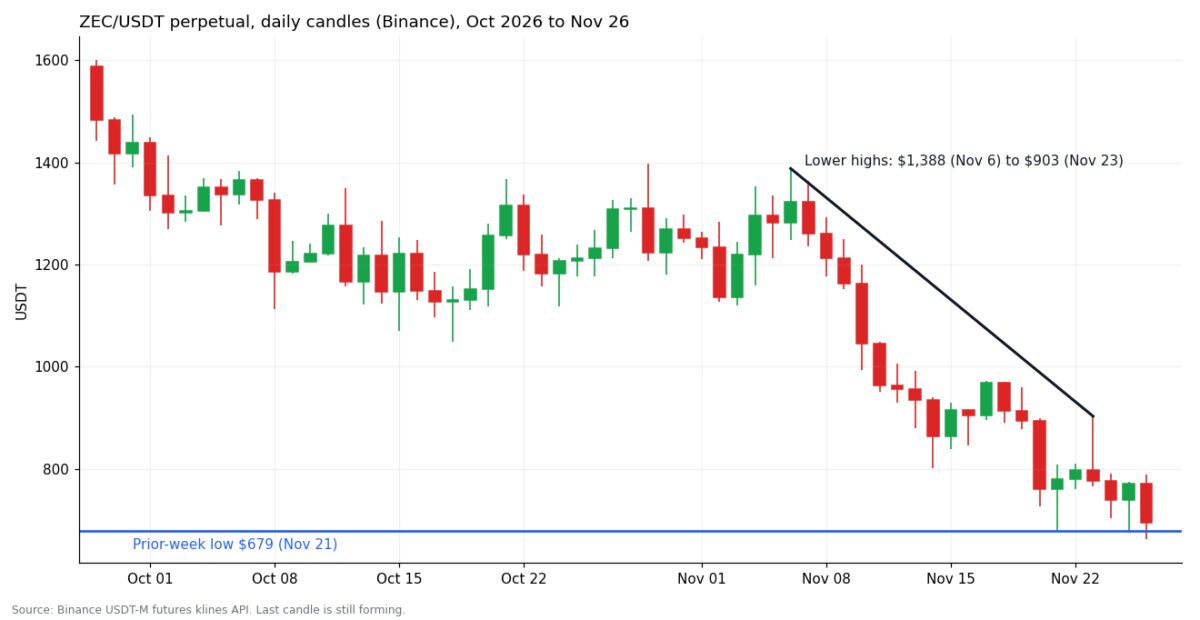
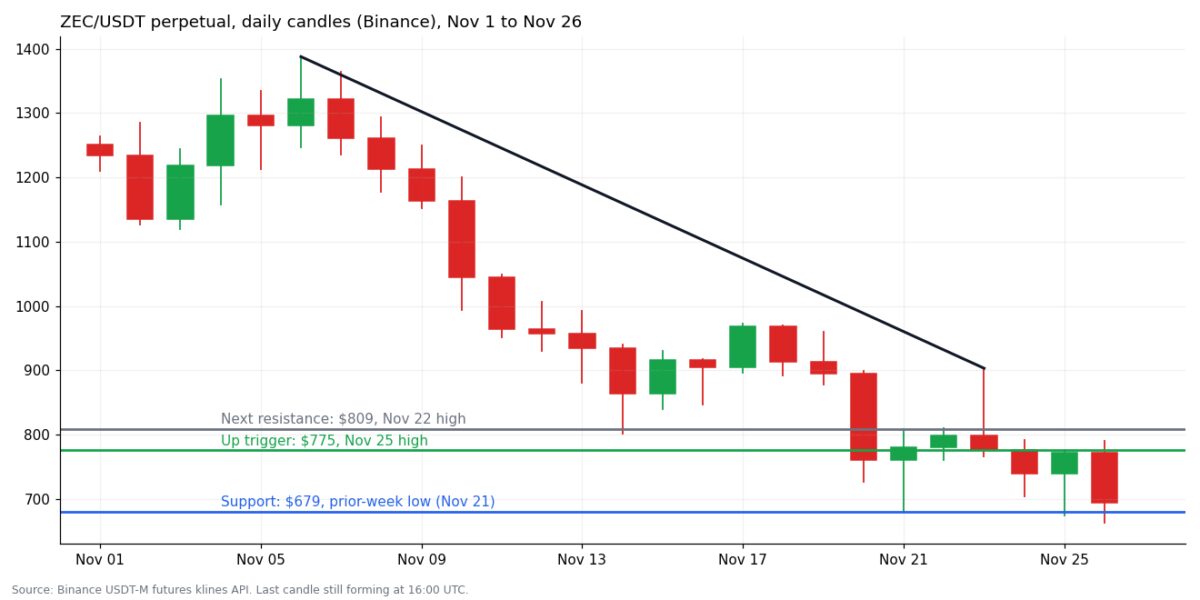
The slide has been steady, not sudden. ZEC’s highest price in November was $1,388 on Nov 6, and the latest bounce topped out at $903 on Nov 23. The black line below joins the two. ZEC rose about 4% on Nov 25 and gave all of it back on Nov 26. At about $11.9 billion in market value it is still the 11th-largest crypto on CoinGecko.
Other mid-size tokens have been sold in the same stretch. MEGA, for one, fell 28% in six days to Nov 25.
Zcash traders have been closing bets, not adding them
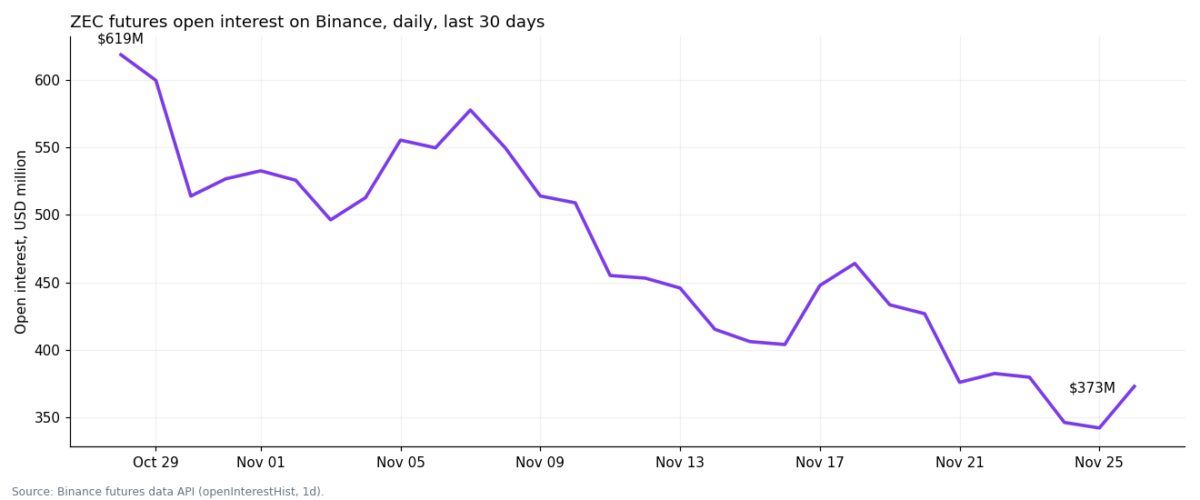
Open interest is the dollar value of futures contracts still open. On Binance’s ZEC contract it fell from about $619 million at the start of the 30-day window to about $373 million on Nov 26. Fewer open contracts means traders are closing positions rather than piling in.
Funding, the small fee that longs and shorts pay each other to keep a perpetual contract near the spot price, was 0.01% at the last reading. That is the usual baseline. When funding turns sharply negative instead, as it did on FET, shorts are paying to stay in the trade. ZEC is not there.
What Zcash holders vote on before Dec 1
Holders have until 02:59 UTC on Dec 1 to answer five questions in a community poll. Four of them cover the future funding of Zcash Community Grants. The fifth asks whether blocks should arrive every 20 seconds instead of 25, according to the Zcash Governance Portal, which Shielded Labs maintains.
The portal says Zcash sends 20% of block rewards to ecosystem funding: 8% to Zcash Community Grants and 12% to a program where coin holders pick which grants to pay. It also says the poll is not binding. Changes only happen if the network chooses to adopt them.
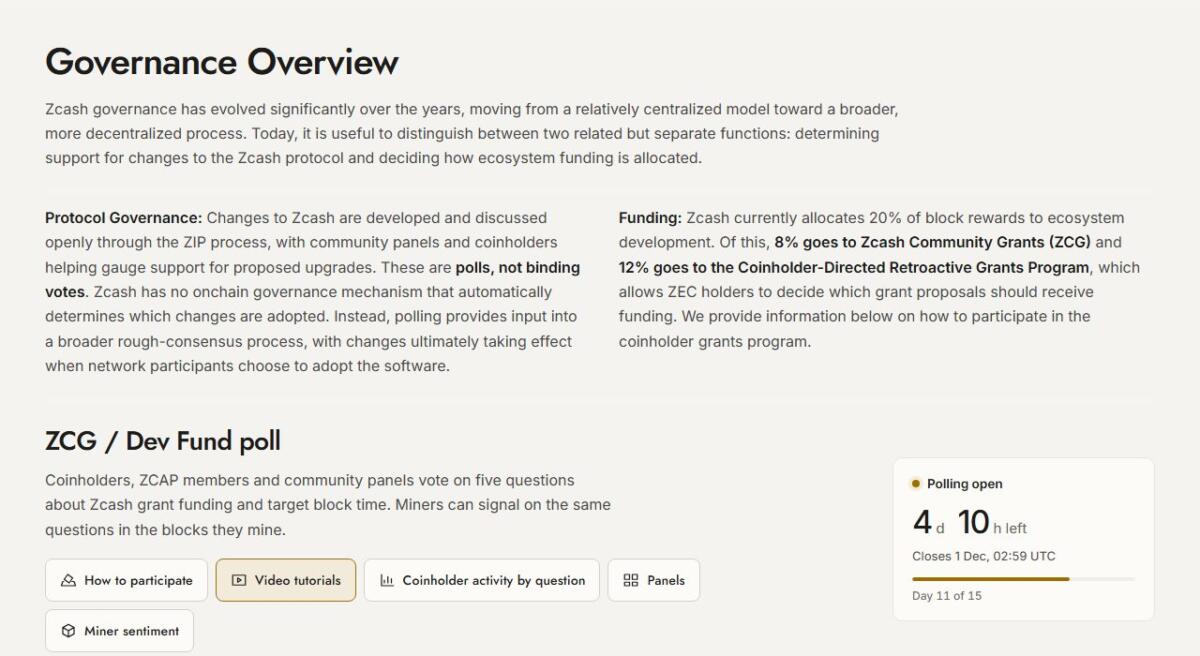
Turnout was still partial on Nov 24. A forum post about the portal that day reported that 94 of 204 members of the ZCAP voting panel had voted.
A proposal to retire the Zcash Sapling pool
On Nov 26 the Zakura team published a post on X, and a moderator of the Zcash Community Forum reposted it at 11:02 UTC. It urges Zcash to retire its older Sapling shielded pool sooner, with a network upgrade that stops payments into it, and asks anyone holding coins there to move them to the newer Ironwood pool.
The post puts about 400,000 ZEC in Sapling, under 2% of supply. It says transparent coins and Ironwood coins do not rely on the pairing-based cryptography at issue, and that a practical break of it has not been shown.
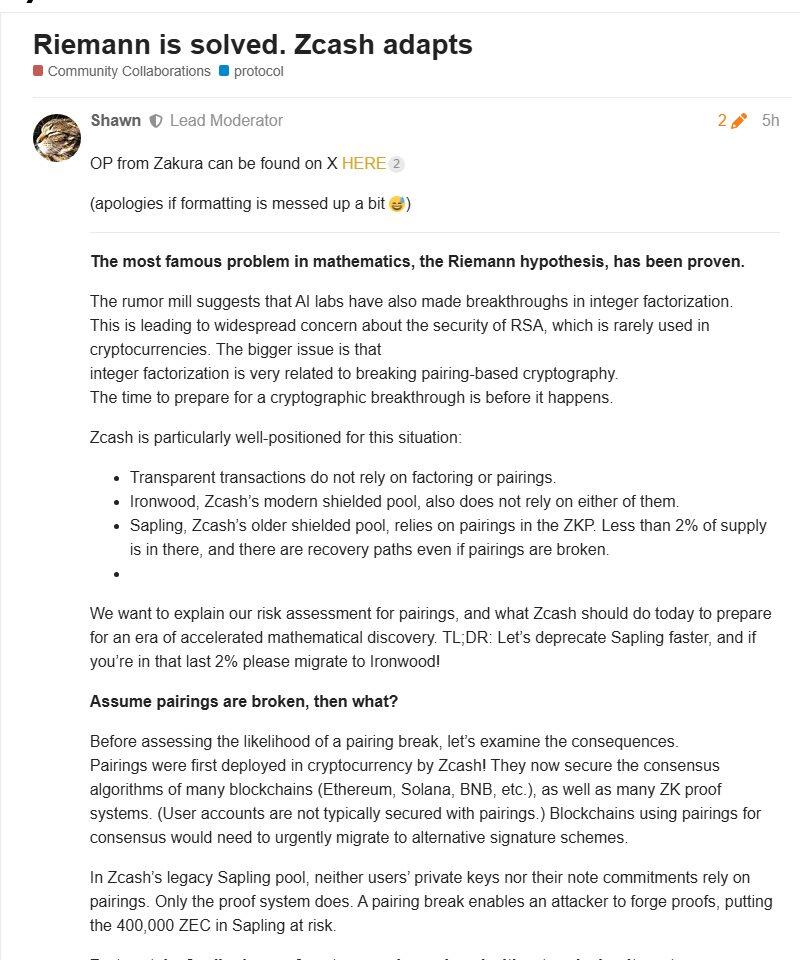
The post opens with the statement that the Riemann hypothesis “has been proven” and says AI labs “have also made breakthroughs in integer factorization,” citing only unnamed reports. CryptoNewsLive could not verify either statement. The price data does not line up with the post either: ZEC fell hardest between 14:00 and 15:00 UTC, about three hours after the forum repost.
What the Grayscale Zcash ETF numbers show
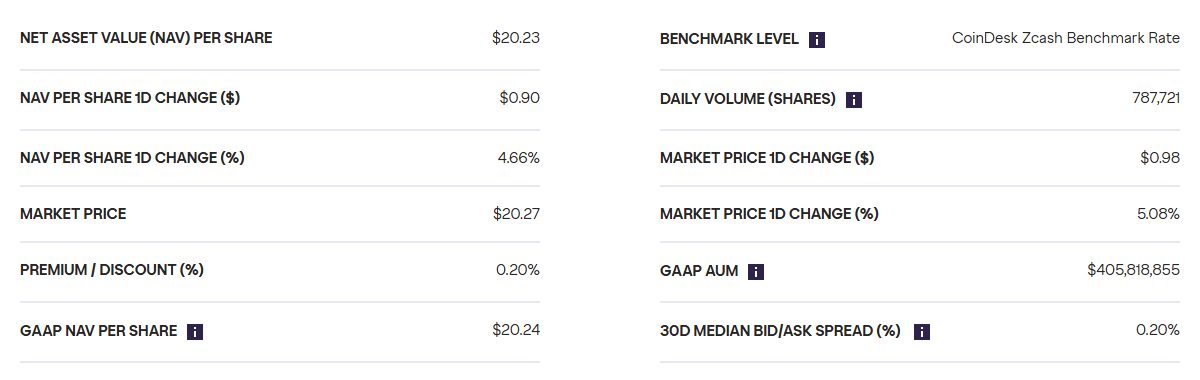
The Grayscale Zcash ETF (ZCSH) held $405.8 million in assets on Nov 25, roughly 3% of ZEC’s market value. Its shares rose 5.08% that day, in line with the coin, and the page has no data past Nov 25, so it cannot show why Zcash dropped on Nov 26. Grayscale also lists a 2x ZCSH ETF, ZECX, built to deliver twice ZCSH’s daily move, which rose 9.45% on Nov 25.
Where the ZEC chart gives the next signals
Two paths are open, and the chart has a line for each. If ZEC closes a one-hour candle above $775, the Nov 25 high, the next resistance is $809, set on Nov 22. That path is cancelled if a one-hour candle closes back under $775.
ZEC dipped under $679, the prior-week low set on Nov 21, within single hours on Nov 25 and Nov 26 but had not closed a one-hour candle below it as of 16:00 UTC. A close under it would put ZEC below every completed daily close in the 60 days shown. That path is cancelled by a one-hour close back above $679. For context, Bitcoin trades under its 100-day average.
The governance poll closes at 02:59 UTC on Dec 1, and the results will show how many holders back each funding option. They will not settle why Zcash dropped, but they will show which way holders want grant funding to go. Crypto prices are volatile and people can lose money, and this report is news, not investment advice.