ZANO climbed 7.5% on June 25, 2026, as Hard Fork 6, a network upgrade that introduces gateway addresses, two-directional bridging, and strengthened consensus, remains unlaunched with five days left in its Q2 target window.
The move happened with no new announcement from the team.
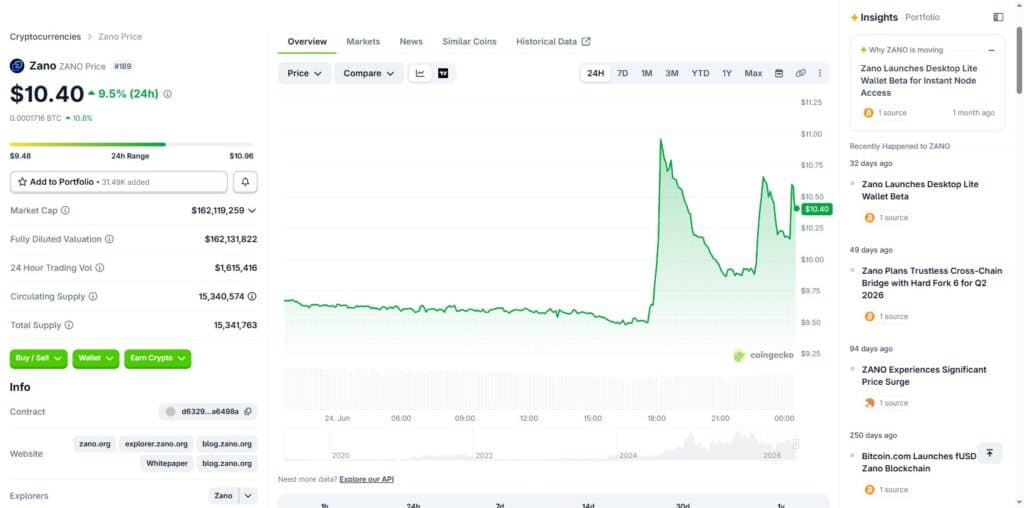
Zano (ZANO) trading at $10.40, up 7.5% over 24 hours, on June 25, 2026. CoinGecko — ZANO/USD
A Market Cap Number That Misleads
CoinGecko lists Zano’s market cap at $162 million against a circulating supply of 15.34 million tokens. The block explorer at explorer.zano.org tells something different. As of June 25, 10,524,487 ZANO, 68.6% of everything ever mined, sits locked in the network’s proof-of-stake mechanism earning stakers an annualised yield of 2.497%.
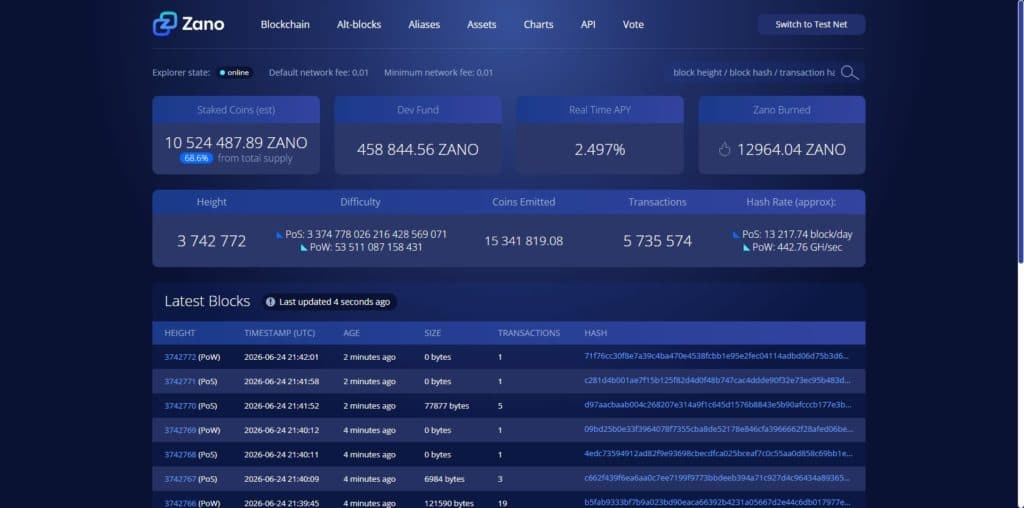
Zano explorer confirming 10,524,487 ZANO staked (68.6% of supply) and 100% fee burn on June 25, 2026. explorer.zano.org
Effective tradable float lands closer to 4.4 million tokens. At $10.40, that is roughly $45 million in real liquid supply. A token with $45M of tradable float moving 7.5% on 1.6 million dollars of daily volume is actually unremarkable. The $162 million number is not wrong; it just does not describe the liquidity environment buyers and sellers are navigating.
Every transaction fee on the Zano network burns. One hundred percent. Total destroyed since the chain launched: 12,964 ZANO. Deflationary pressure is structural, not opt-in.
What Hard Fork 6 Actually Adds
Privacy chains typically solve one problem: hiding what you do on their own network. Hard Fork 6 tries to solve a second, letting assets move in and out without surrendering the privacy they acquired inside.
Gateway addresses, the technical foundation for two-way bridging, are listed as completed on Zano’s public roadmap for Q2 2026. The hardfork launch itself is still marked “in progress” with the same Q2 estimate.
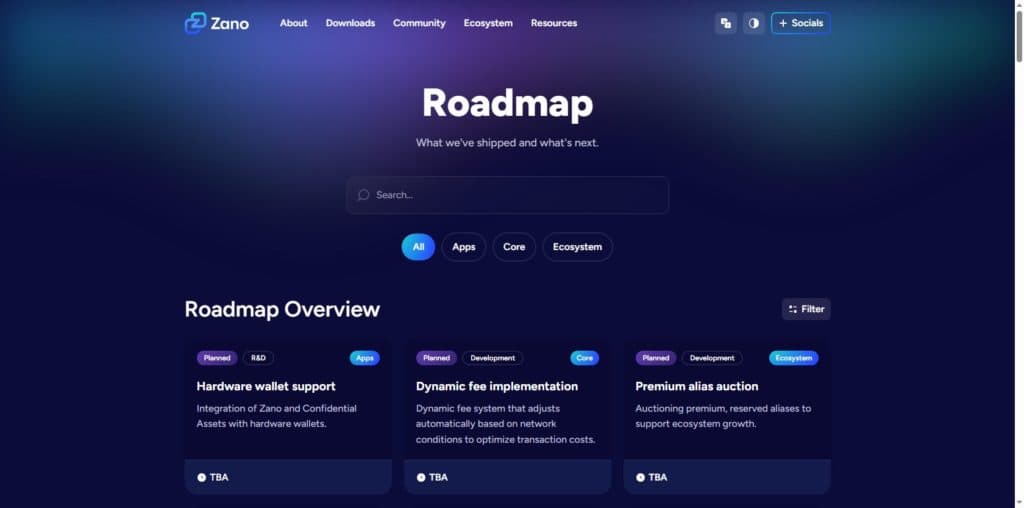
Zano roadmap as of June 25, 2026: Hard Fork 6 “In progress” (Q2 2026), gateway addresses “Completed” (Q2 2026). zano.org/roadmap
Andrey Sabelnikov, Zano co-founder and core developer, led code changes visible in the hyle-team/zano GitHub repository, where the release_hf6 branch was merged into the release branch on June 8 and again June 11. The code is built. The network event has not been triggered.
The project described the upgrade’s scope to Bitcoin.com in May 2026: after Hard Fork 6, native ZANO will be bridgeable through Bridgeless in both directions. Currently the bridge runs one-way. Assets can enter Zano’s private environment as confidential assets but cannot leave as native ZANO. On X, five hours before this article, the team promoted ETH-to-ZANO bridging through Bridgeless as if full capability were already live. The return path remains pending.
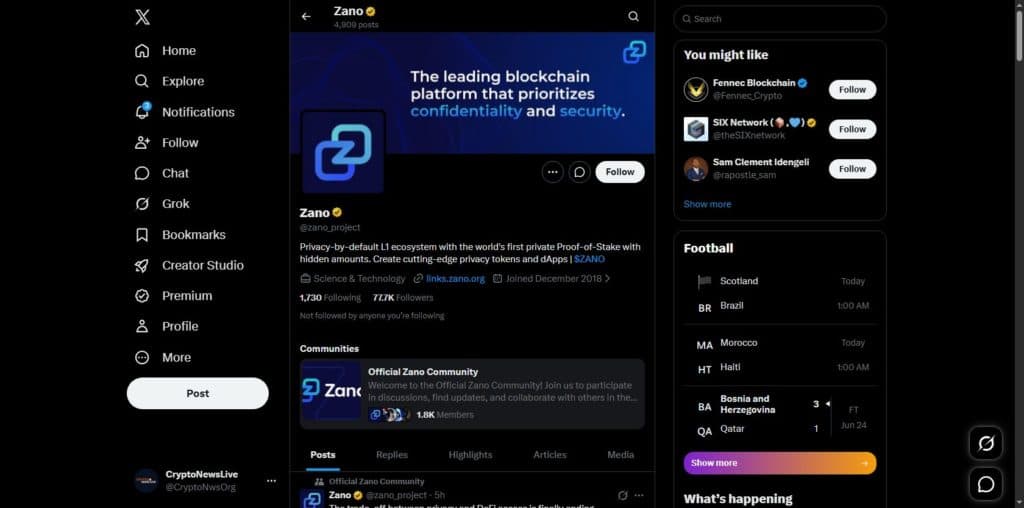
@zano_project on X, June 25, 2026, promoting ETH-to-ZANO bridging while the two-directional Hard Fork 6 upgrade awaits network launch. x.com/zano_project
Privacy Peers Went Nowhere
Monero gained 0.5% over the same 24 hours. Zcash added 0.3%. Bitcoin dropped 2.8% toward $60,700. Among privacy-focused chains tracked by CoinGecko on June 25, ZANO’s move was the largest by a factor of nearly two.
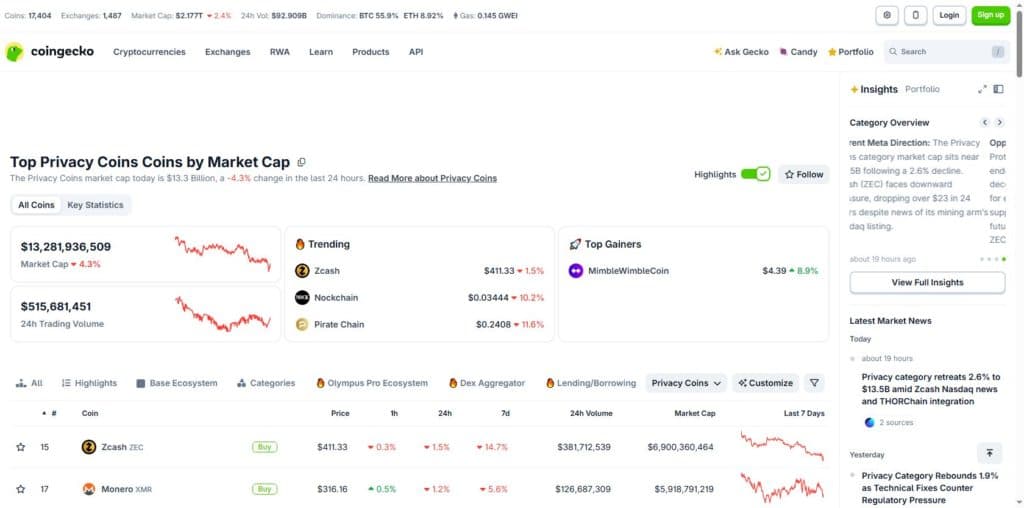
Privacy coin 24h performance on CoinGecko, June 25, 2026: XMR +0.5%, ZEC +0.3%, ARRR +0.8% versus ZANO’s +7.5%. CoinGecko — Privacy Coins
A token-specific story. Worth reading alongside the breakdown of how SYN surged 930% in eleven days with no fundamental backing, where sector context did identical work: price moved alone while the category sat flat.
No official announcement surfaced in the 72 hours before the price move. The team’s last blog post, “Zano Monthly Project Update #20” covering May, went live June 17, eight days ago. It described “steady momentum toward Hardfork 6” and the launch of the Desktop Lite Wallet beta, which removes the requirement for users to sync a full blockchain copy before transacting.
Who Holds It and Where It Trades
Zano runs its own layer-1 chain. Ring signatures and stealth addresses hide amounts, addresses, and asset types on every transaction. No public holder chart exists. Individual wallet balances cannot be observed on a block explorer the way they can for EVM tokens. The privacy is by protocol, not option.
What is visible from the explorer: a developer fund holding 458,844 ZANO, worth around $4.8 million at current prices. Also visible are network totals: 5,735,574 transactions across a seven-year chain history, block height 3,742,772 as of June 25.
Trading is narrow. MEXC handles 44.7% of daily volume, $718,395. DigiFinex accounts for another 26.82%. Binance, Coinbase, Kraken, OKX, Bybit do not list ZANO. That narrow exchange footprint compounds the thin-float dynamic: even modest demand finds no deep order book to absorb it. Thin float, thin books, and CoinGecko trending-list placement, where ZANO sat first on June 25, form a self-reinforcing loop for price amplification.
No third-party security audit submission was found on any public registry as of this writing.
The Code, the Companion, and June 24
The zano-extension repository received four commits on June 24 from developer PRavaga, all CI pipeline work: CodeQL static analysis integrated via [email protected], plus a CODEOWNERS file for the security workflow. Routine hardening. No functional feature landed that day.
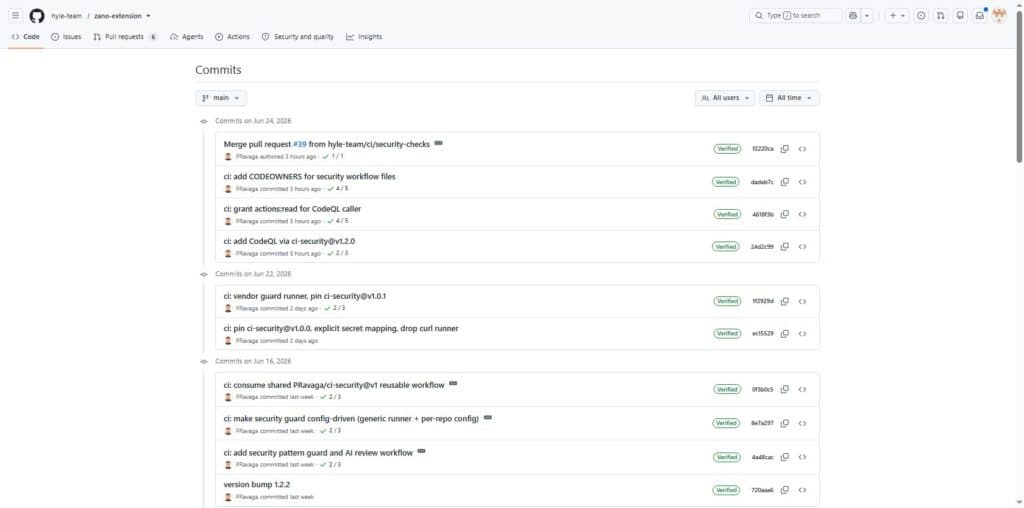
GitHub hyle-team/zano-extension showing June 24 CodeQL additions (CI security) and June 15 permission system fix (v1.2.0). github.com/hyle-team/zano-extension
Version 1.2.0 of the Companion browser extension shipped June 15. It fixed a real vulnerability: any website that detected the extension could previously read the user’s wallet address, balance, and transaction history without asking. After 1.2.0, sites must request access first. The blog post from developer Ravaga published May 15 described it: “Today, any site that detects the extension can read the active wallet’s address, balance, and transaction history the moment the page loads. After this update, sites have to ask first.”
Hard Fork 6 is the only item on the 2026 roadmap still marked “in progress” with a Q2 deadline. Everything else in that window shipped: the lite wallet, gateway address technology, the AI-assisted audit pipeline, the overhauled website. The remaining piece is the network activation itself, a coordination event requiring miners and stakers to upgrade their nodes before new consensus rules take effect.
Five days remain in Q2. The BAS analysis published here June 24 walked through how admin-level code capabilities shape token risk even when not used. For Zano the risk category is different, a deadline slipping, not a hidden function, but the principle holds: what the code can and cannot do matters more than price action on a given day.
ZANO’s 7d performance of 7.1% stands against an overall market that fell 5.4% in the same period. Among similar chains on CoinGecko, the category dropped 8.1%. Zano went the other direction. The question for anyone watching the chart is whether HF6 network activation, now days away from a missed quarterly target, confirms the move or reverses it.