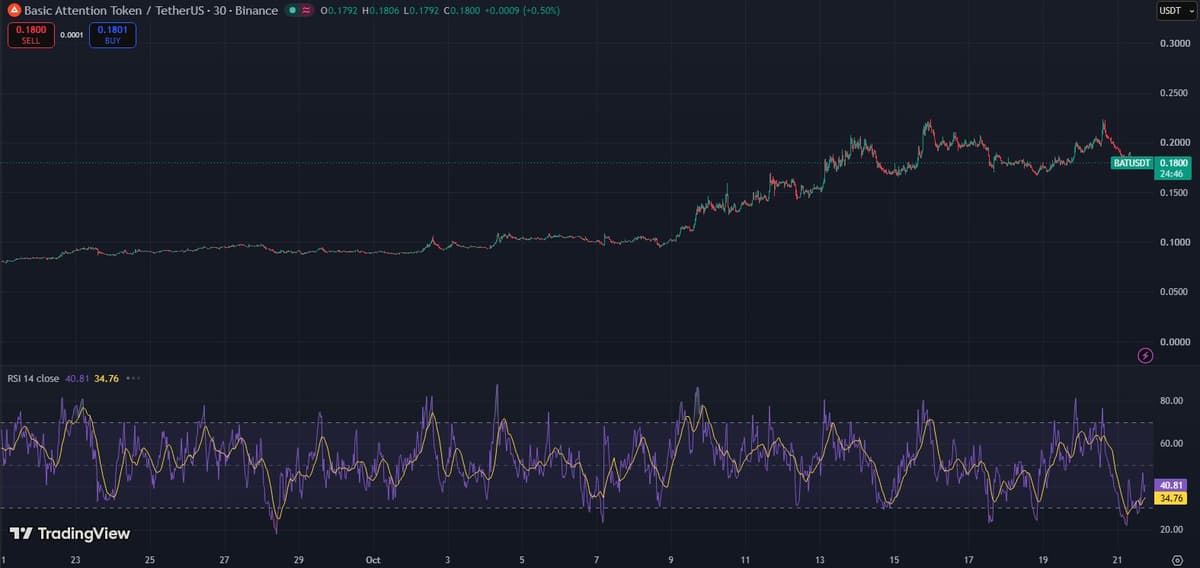
Basic Attention Token has now printed a BAT double top on Binance, and the two peaks sit almost exactly on each other. The October 15 high was $0.2236. The October 20 high was $0.2234. Between them the pair dipped as low as $0.1654 and came back. At 18:00 UTC on October 21 it traded at $0.1801, and CoinGecko’s top losers table listed it down about 13% over 24 hours.
The run from $0.0895 into the BAT double top
BAT closed October 1 at $0.0895. Daily turnover on Binance ran between $0.2 million and $4.3 million from October 1 to October 8. October 9 changed that. The day opened at $0.1026 and closed at $0.1353, a 31.9% candle, on $10.3 million of turnover against $1.2 million the day before.
The biggest volume day came on October 13, with $22.4 million traded and a close of $0.1976. Measured on closing prices, the move from October 7 ($0.1020) to October 13 is 93.7%, which matches the roughly 93% weekly gain that circulated that week. The first leg of the BAT double top came on October 15 at $0.2236, about 118% above the October 8 close.
Why the second peak of the BAT double top looks weaker
Daily RSI on the 14-day setting hit 87.6 on October 13 and 78.8 on October 15, the day of the first top. On October 20, when price reached the same high again, daily RSI was 66.4. Same price, less momentum behind it. The rejection came within hours. In the 14:00 UTC hour on October 20 BAT ran from $0.2019 to $0.2234 on $1.45 million, then lost the level and closed the day at $0.1944.
Daily RSI read 60.8 on October 21. A BAT double top with a lower RSI on the second peak is a description of what the chart shows. It does not say where price goes next, and the levels at the bottom of this piece are the only directional call here.
Futures interest rose eightfold before the double top, then gave back a third
Spot was not where most of the action sat. Coinglass lists futures volume of $86.08 million over 24 hours against $10.34 million in spot, roughly eight times as much, with open interest of $33.16 million across exchanges and a market cap of $269.84 million.

On Binance’s own BATUSDT perpetual, open interest was $1.9 million at the October 1 snapshot. It was $4.1 million on October 9, $16.4 million on October 14 and $10.3 million on October 21, which is 37% below that peak. Funding on October 14 at 00:00 UTC was -0.342% for the eight-hour period, so shorts were paying longs to hold positions. Binance’s global long/short account ratio moved from 1.26 on October 13 to 0.79 on October 14, then back to 1.02 on October 21.
What Brave’s roadmap says, and when it said it
Brave’s BAT Roadmap 4.0, published July 9, says the Brave Ads Notification unit “will begin a gradual sunset by the end of 2026” and that a percentage of Brave’s net revenue from Roadmap 4.0 sources will fund BAT buybacks. The text gives no percentage and no amount. It also says x402 and Machine Payments Protocol support will come to the Brave Search API over time. All of that is three months older than the October 9 move, so the dates do not line up with a roadmap-driven trigger. For a recent look at a token where futures dwarfed spot, see our reports on WLD and AVA.
Levels after the BAT double top
Bitcoin, at $84,660, is above its 100-day average of $74,804, so the broader backdrop is still an uptrend. For BAT, the bull case starts with a 1-hour close above $0.18907, the prior day’s low, with $0.19461 and then $0.2234 as targets. A 1-hour close back below $0.18812 voids it. The bear case starts with a 1-hour close below $0.17713, today’s low, with $0.16648 and $0.14209 as targets. A 1-hour close back above $0.17802 voids that path.
The roadmap says further tokenomics details for Brave Rewards will come in a separate blog post later in 2026. That post would be the next dated item to check against the chart.