
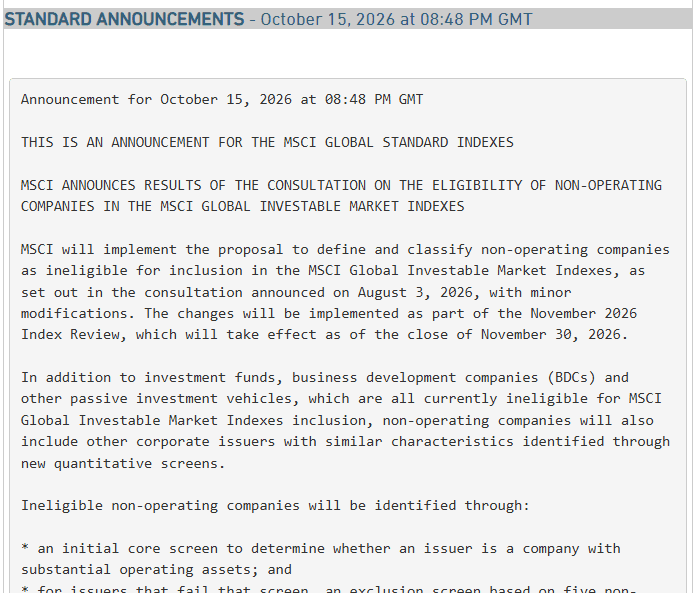
MSCI told the market late on Thursday that its rule on MSCI non-operating companies is going ahead. The announcement is dated October 15 at 8:48 p.m. GMT, and the change takes effect as of the close of November 30.
The MSCI non-operating companies text names no company. Strategy, which holds 848,250 BTC, says the proposal would exclude companies like it.
What the MSCI Announcement Actually Says
MSCI will implement the proposal from its August 3 consultation, with minor modifications. It lands in the November 2026 Index Review.
Investment funds, business development companies and other passive vehicles are already ineligible for the Global Investable Market Indexes. MSCI non-operating companies now join them, defined as other corporate issuers with similar characteristics, found through new quantitative screens.
The list of current constituents that could be affected is already posted on MSCI’s consultations page. The final list comes on November 11, with the index review announcement.
The Five-Ratio Screen for MSCI Non-Operating Companies
An issuer first faces a core screen that asks whether it has substantial operating assets. Those that fail it go to an exclusion screen built on five financial ratios, and four flags out of five make a security ineligible.
Buffers soften the blow. A non-constituent cannot be added if it fails the screen in either of its two latest annual filing periods, while an existing constituent is removed only if it fails in both.
MSCI is also switching off the interim measures it announced on October 10, 2025 for companies with digital asset holdings of 50% or more of total assets. That covers the freeze on share count increases and the deferral of additions. After the November review, those companies are judged under the new screens like everyone else.
Strategy Says MSCI Index Funds Hold 3.1% of Its Shares
Strategy has a page of its own on the consultation. It says the proposal would exclude “non-operating” companies, itself among them, and that it opposes the idea.
It also argues the damage would be small. Funds tracking MSCI’s Global Investable Market Indexes hold only 3.1% of its basic shares outstanding, which Strategy puts at roughly 13 million shares. That is less than one day’s trading volume in the stock, per the company’s footnote.
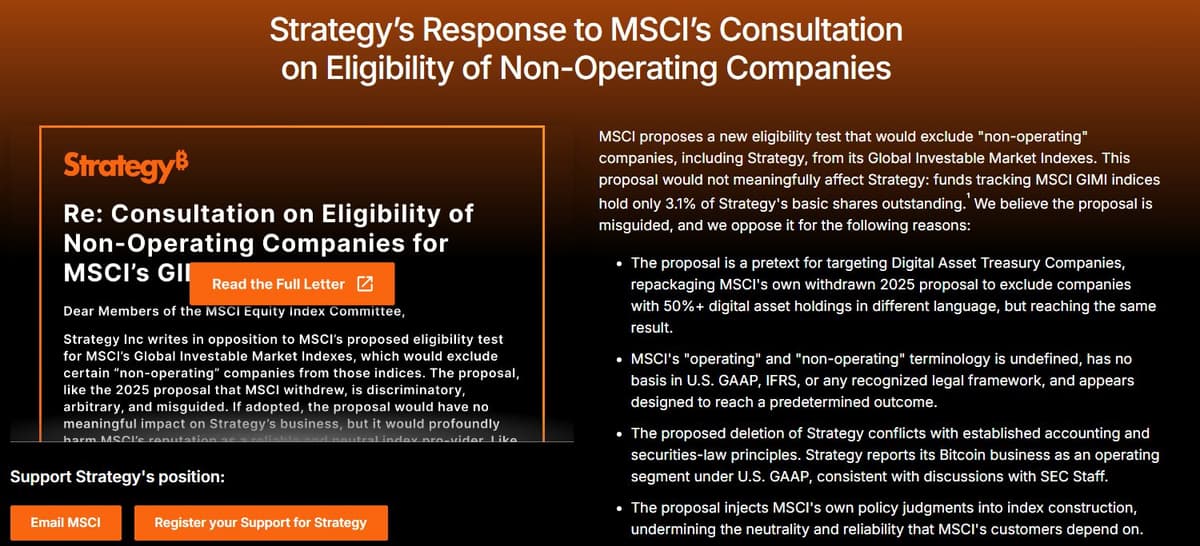
The company’s other argument is accounting. It says it reports its bitcoin business as an operating segment under U.S. GAAP, and that “operating” and “non-operating” have no basis in GAAP or IFRS.
Whether the screens flag it is for MSCI to say on November 11. Nothing in Thursday’s text settles that.
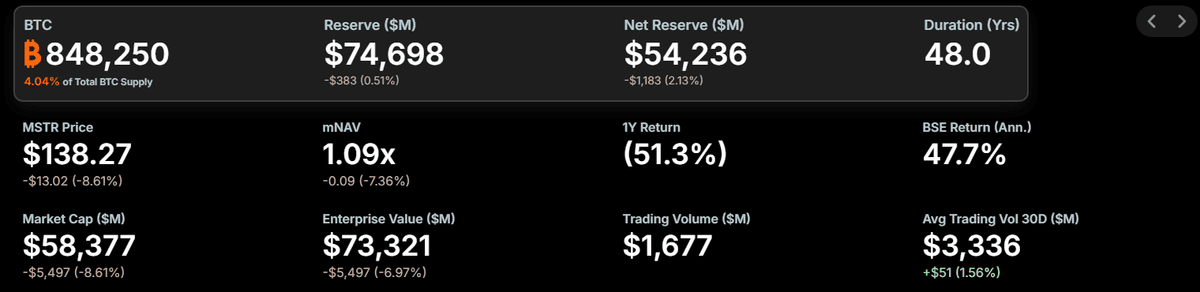
That dashboard shows 848,250 BTC on the balance sheet, 4.04% of total supply. The shares, ticker MSTR, were at $138.27 and off 8.61% for the day. Its mNAV read 1.09x.
Bitcoin Hugs Its 50-Day Line With the MSCI Rule Ahead
Price itself has not cracked. On Binance’s daily candles, BTC/USDT traded near $81,600 on Friday morning, which is a hair above its 50-day average of about $81,285.
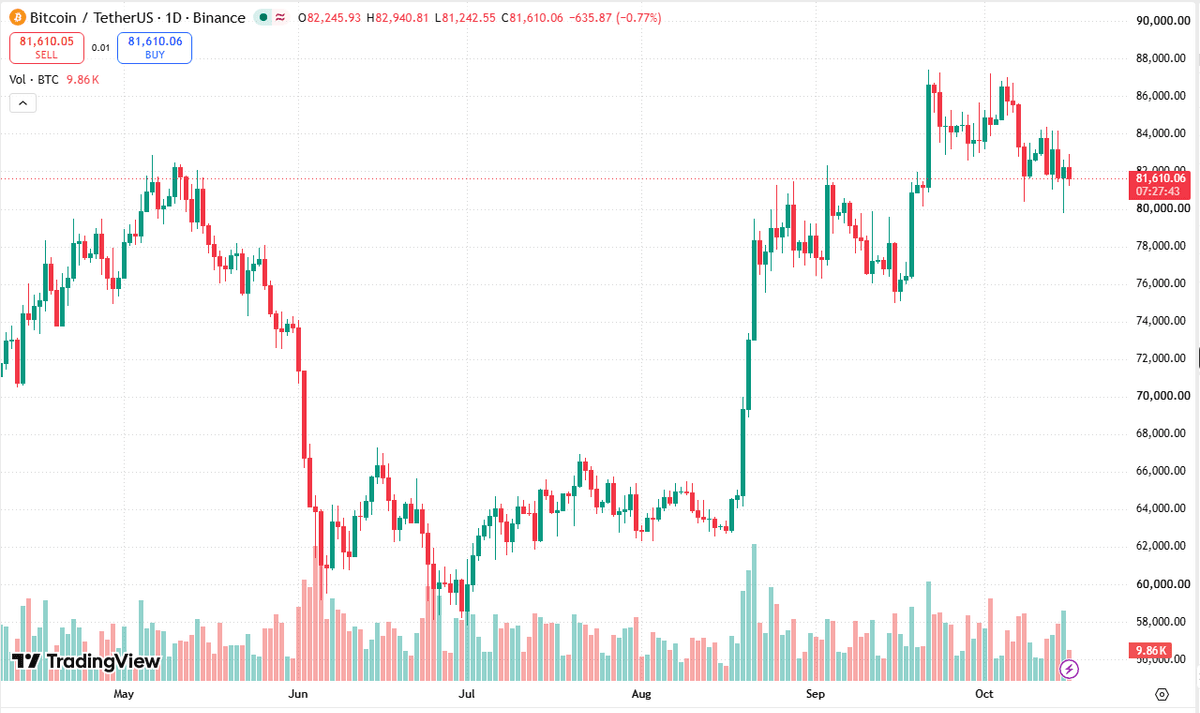
The chart tells a simple story. A July 1 low of $57,800, a run to $87,396 on September 21, and then a slow bleed to Thursday’s $79,800 low before buyers stepped in.
Two levels sit underneath. The 50-week average is near $76,575, about 6.2% below, and the 200-day is near $72,399, roughly 11.3% down. A full retest of the July low would mean a 29% slide from here.
A close below $79,800 would open the way toward the 50-week average. A push above $87,000 would put the September high in play.
Momentum is flat, not broken. A daily close under the 50-day would change the picture. For now it is a box, $79,800 at the floor and about $87,000 at the ceiling.
CPI and the Fed Frame the MSCI Index Change
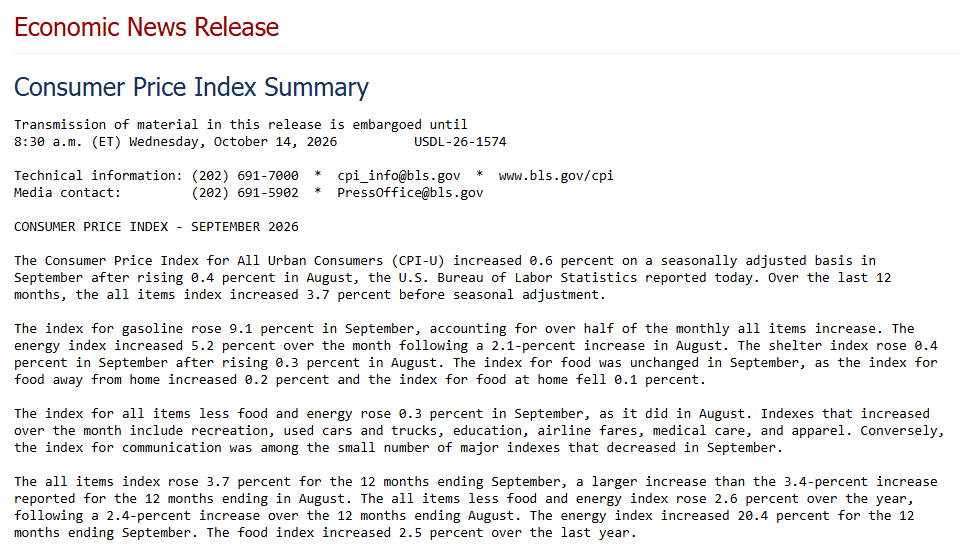
The Bureau of Labor Statistics put September CPI at 0.6% on the month and 3.7% over twelve months, against 3.4% in August. Gasoline alone rose 9.1%. We covered the market reaction in our CPI and PPI report.
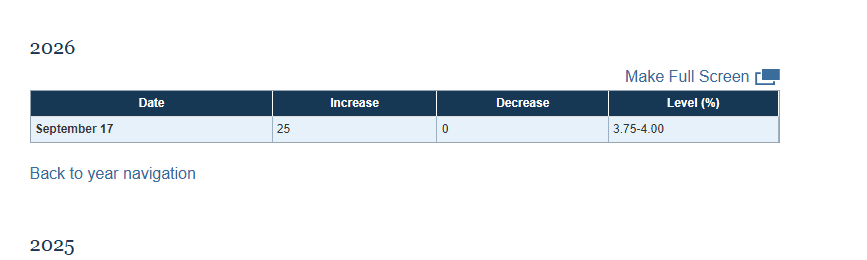
The Federal Reserve’s own table shows the last move: a 25 basis point increase on September 17, lifting the target range to 3.75% to 4.00%.
On the Fed’s October calendar sits a Bangkok fireside chat between IMF boss Kristalina Georgieva and Chairman Kevin Warsh. The committee’s next gathering is October 27 to 28.
MSCI Index Review Dates That Matter Next
November 11 brings the final list of MSCI non-operating companies. November 30 is the close on which the change takes effect.
Between now and then, Strategy’s page and MSCI’s list of potentially affected constituents are the two places to watch. For another rulebook change that crypto firms are tracking, see our piece on the SEC transfer agent rules.