UNI, Uniswap’s token, fell about 34% in the 30 days to Nov 26, 2026, and trades near $4.67 on Binance, although the Uniswap fee switch that burns UNI from trading fees is on.
Here is how much has been burned so far, what a bug on one chain has been doing to the burn, and what holders have already voted through.

What the Uniswap fee switch has burned so far
Burning UNI means taking it out of circulation for good. On Nov 26 the UNI token contract on Ethereum showed 114.6 million UNI as burned, meaning sent to the standard burn destination. That is about 11.5% of the 1 billion UNI originally minted, and CoinGecko’s total supply of 885 million UNI matches it.
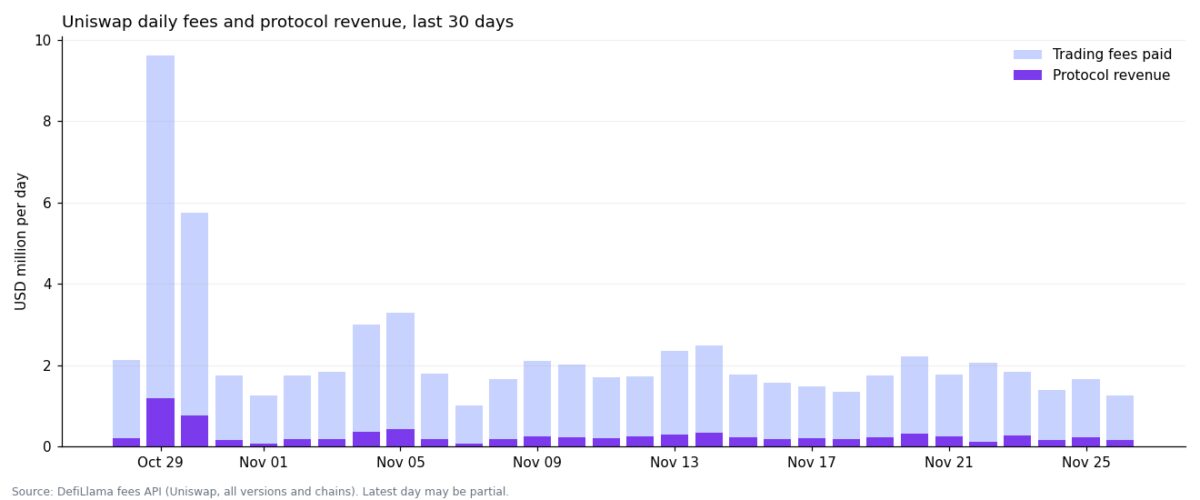
The ongoing part is small next to the market value. DefiLlama counts $67.3 million of trading fees paid on Uniswap over the last 30 days, of which $8.2 million was protocol revenue. If every dollar of that revenue bought and burned UNI at $4.67, it would remove about 1.8 million tokens, roughly 0.3% of the 607 million in circulation.
Why Uniswap fees on X Layer could not burn UNI, and the vote that fixes it
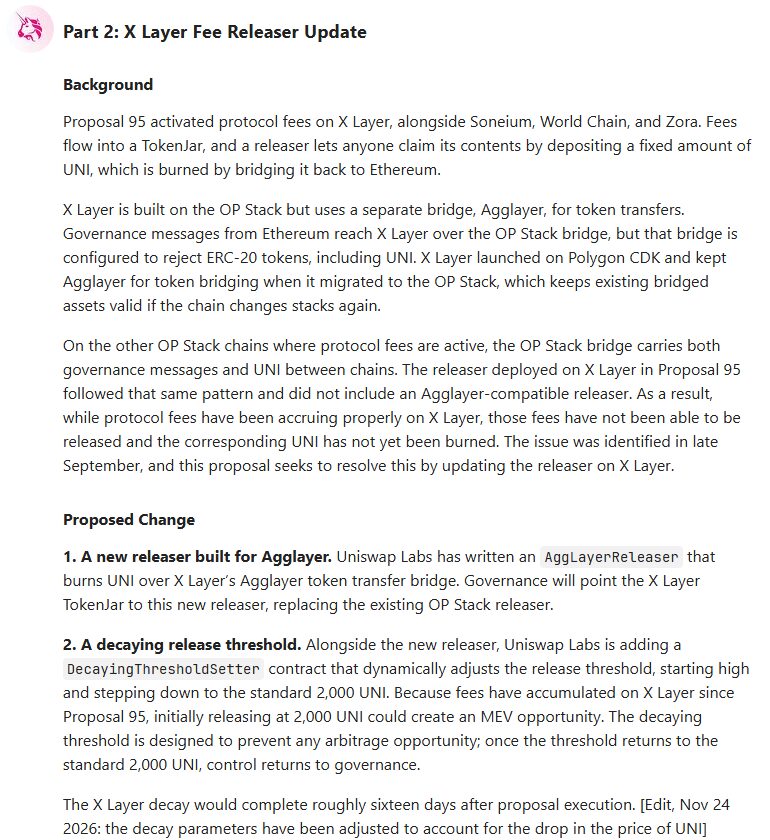
The Uniswap fee switch is meant to work on every chain where Uniswap runs, but Uniswap Labs said in a governance post on Nov 6 that fees on X Layer have been piling up without being burned. The reason is technical: the bridge that carries governance messages to X Layer rejects ERC-20 tokens such as UNI, so the contract meant to burn UNI there could not send any back to Ethereum. Uniswap Labs said it spotted the problem in late September and did not give a dollar figure for the stuck fees.
The fix is a new burn contract that uses X Layer’s own token bridge, plus a threshold that starts high and steps down to 2,000 UNI over roughly 16 days after the change goes live. On Nov 24 the post was edited to adjust those settings “to account for the drop in the price of UNI.”
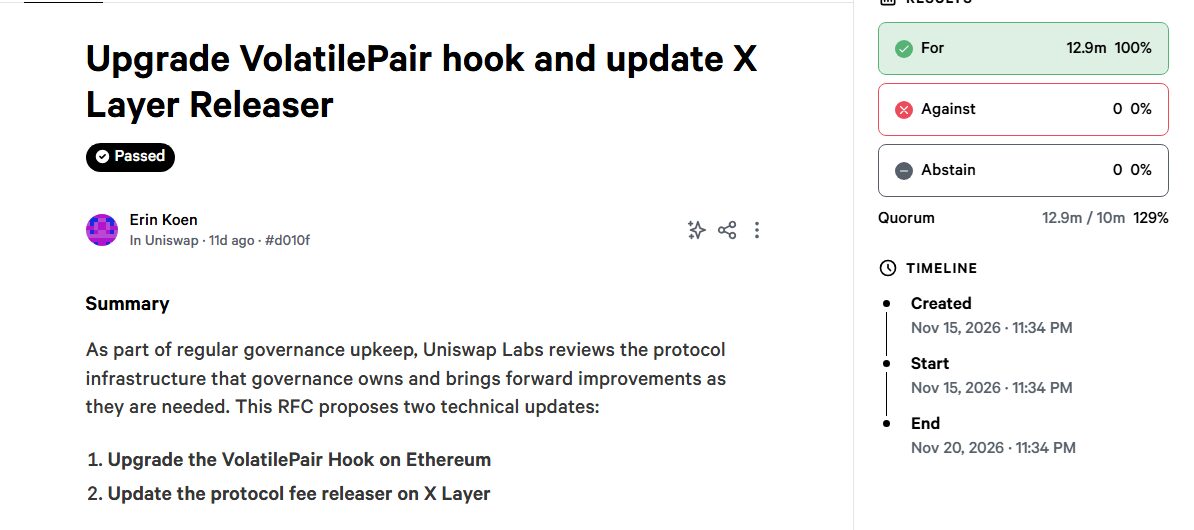
The X Layer vote on Snapshot closed on Nov 20 with 12.9 million UNI in favor and none against, above its 10 million quorum. Two more proposals closed on Nov 21 with 27.9 million UNI in favor of each and none against. One upgrades how v4 fees are calculated, the other turns on v4 protocol fees on Celo, Soneium, X Layer, World Chain and Zora, according to the proposal text.
Snapshot is a signal vote. Uniswap’s process, as described in that text, follows a five-day Snapshot with an onchain vote, and this report did not find the onchain results.
Bitcoin did most of the damage to Uniswap’s token
Bitcoin fell about 25% in that span. UNI fell further but tracked it hour by hour, with a seven-day correlation of 0.78 (1.0 would be a perfect match). Other tokens have slid too, among them Zcash and MEGA.
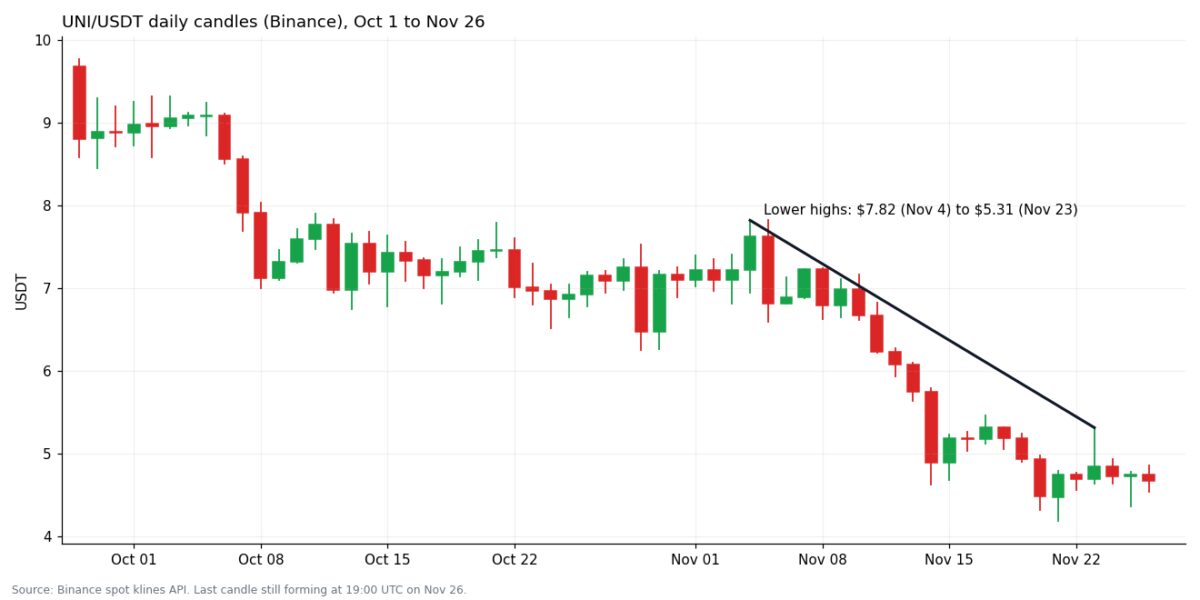
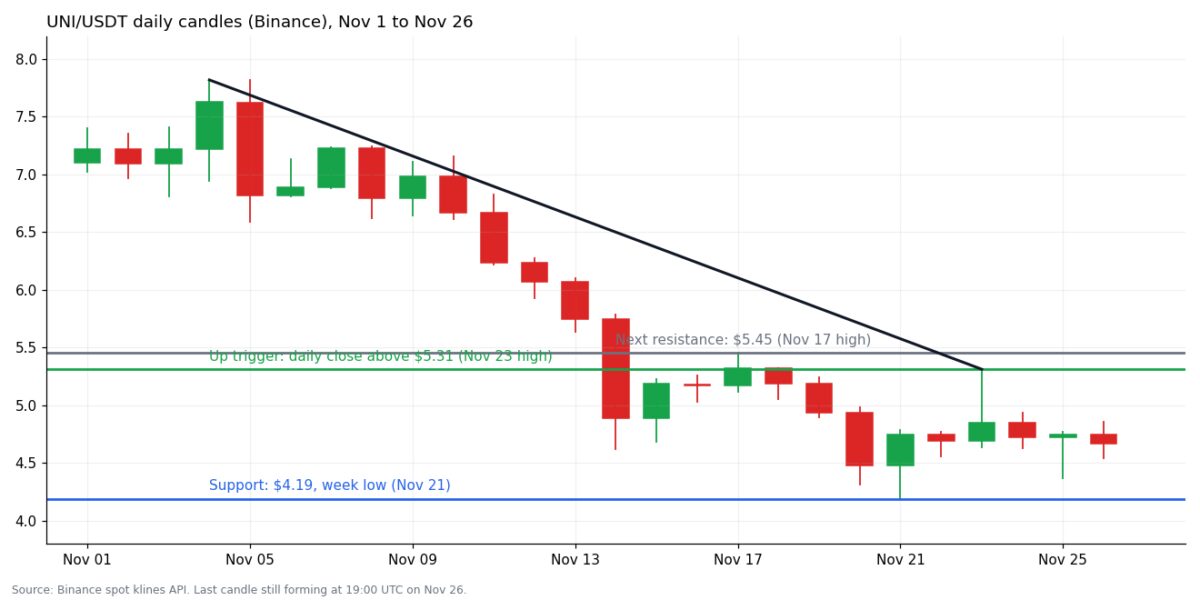
UNI peaked at $7.82 on Nov 4 and its latest rally stalled at $5.31 on Nov 23. The black line connects the two. CoinGecko ranks UNI 29th, with a market value of about $2.8 billion.
Where the Uniswap chart gives its next signals
A daily close above $5.31, the Nov 23 high, would put $5.45, the Nov 17 high, in view. A close back under $5.31 cancels that.
A daily close below $4.19, the Nov 21 low, would take UNI under every price of the past 60 days, and a close back above $4.19 cancels that. Bitcoin sits below its 100-day average as well, near $77,500.
The onchain votes on the Uniswap fee switch changes are the next dated step. This is news reporting, not investment advice, and crypto prices can swing sharply.