BitMart told its users their money is fine. Its own chain data says otherwise.
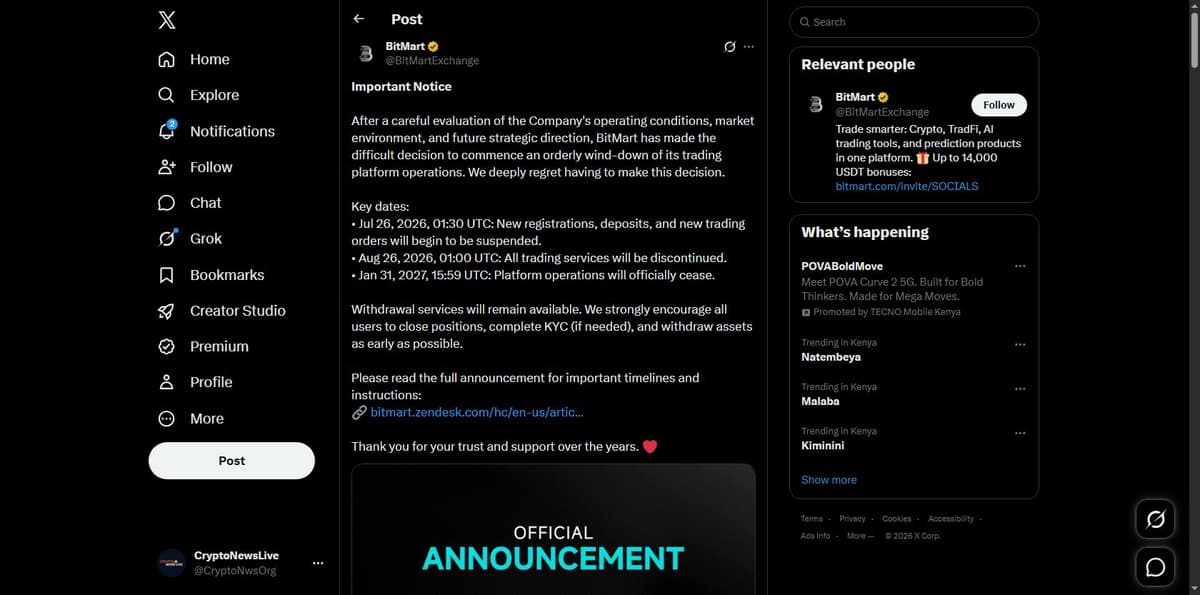
On July 26, the exchange posted an official notice on X announcing an orderly wind-down of its trading platform. New registrations, deposits and orders froze at 01:30 UTC that day. Full trading stops August 26. The platform itself is set to close for good on January 31, 2027. One line in the notice stood apart from the rest: “Withdrawal services will remain available.”
Important Notice
After a careful evaluation of the Company's operating conditions, market environment, and future strategic direction, BitMart has made the difficult decision to commence an orderly wind-down of its trading platform operations. We deeply regret having to make this decision.
— BitMart (@BitMartExchange) July 26, 2026
The Chain Disagrees
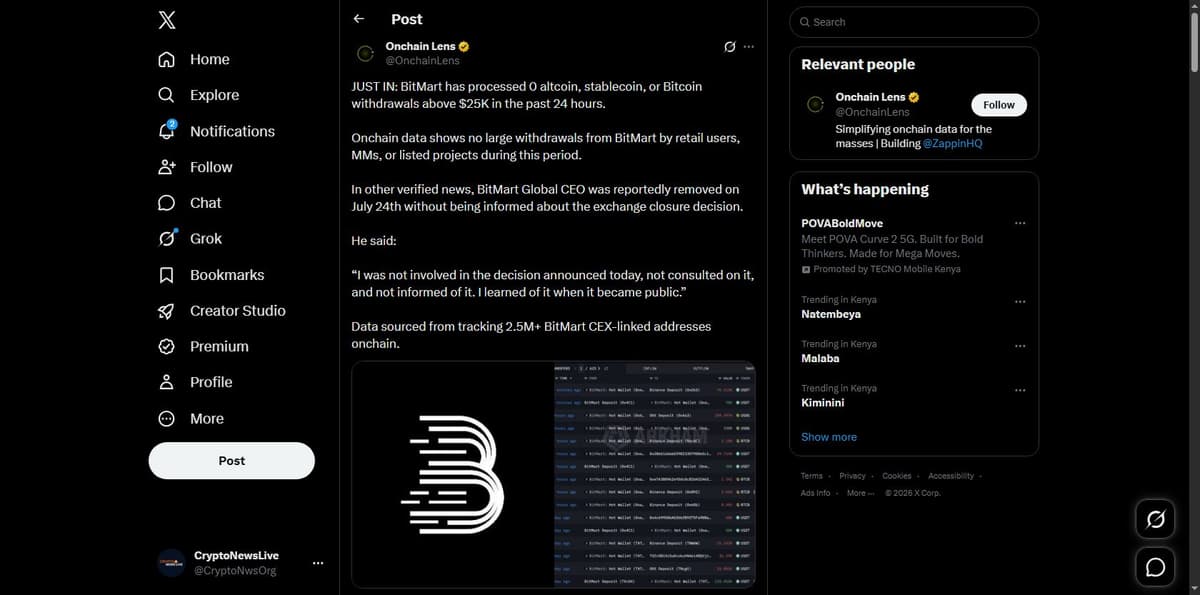
Fifteen hours later, onchain analytics account Onchain Lens posted a number that cuts against that reassurance: zero altcoin, stablecoin or Bitcoin withdrawals above $25,000 moved off BitMart in the trailing 24 hours, drawn from tracking 2.5 million-plus BitMart-linked addresses.
JUST IN: BitMart has processed 0 altcoin, stablecoin, or Bitcoin withdrawals above $25K in the past 24 hours.
Onchain data shows no large withdrawals from BitMart by retail users, MMs, or listed projects during this period.
— Onchain Lens (@OnchainLens) July 26, 2026
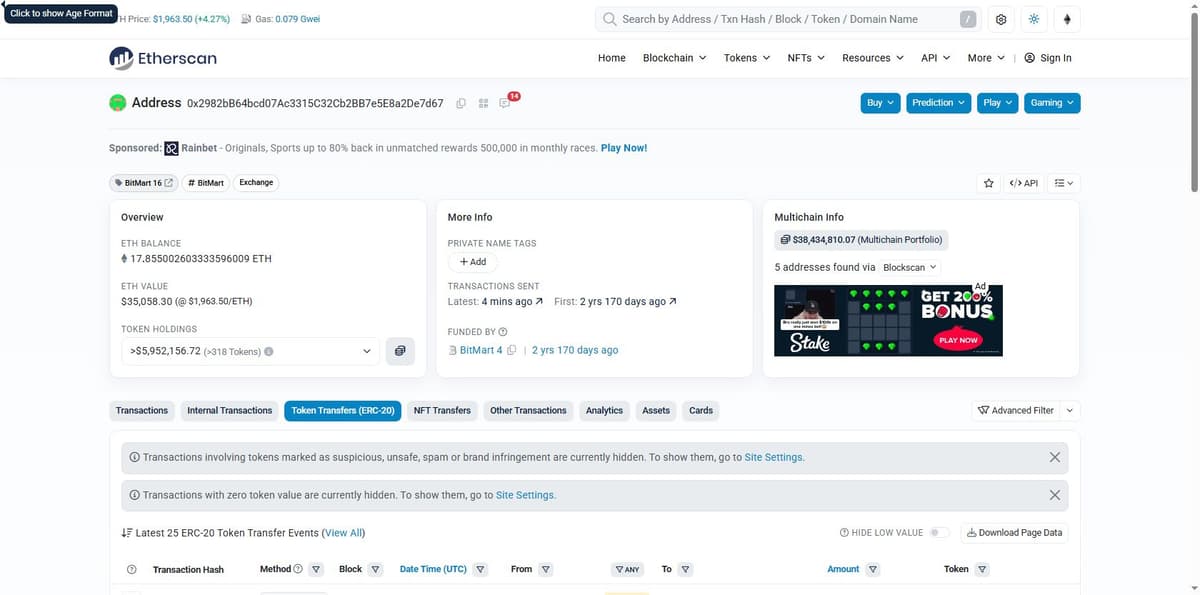
That number does not have to be taken on faith. BitMart’s own custody wallets are labeled directly on Etherscan, tagged by transaction pattern rather than guessed, and one of them, the wallet marked “BitMart 16,” tells its own story. Pulling its transfer history directly: the last movement carrying real dollar value cleared at 18:00 UTC on July 24. Nothing with actual value in or out again until 06:45 UTC on July 27, a roughly 61-hour blackout that swallows the entire wind-down announcement and the exact window Onchain Lens measured. Activity resumed in small pieces, two dollars here, a hundred there, nothing close to $25,000. One wallet is not BitMart’s whole withdrawal system, the exchange runs others, but it is a first-party number read straight off the chain rather than a claim taken on anyone’s word.
A Fired CEO, Two Days Early
The same Onchain Lens post carried a second claim: BitMart’s Global CEO had been removed on July 24, two days before the shutdown went public, without being told the shutdown was coming. That detail traces to a real person with a verified account, not a rumor. Nenter Chow posted his own statement hours after the company notice went out.
On 24 July 2026 I was informed that my employment as Global CEO was being terminated and that my offboarding would begin immediately… I was not involved in the decision announced today, not consulted on it, and not informed of it. I learned of it when it became public.
— Nenter (@50Nent) July 26, 2026

Chow’s wording matters as much as its content. He tells users to trust only BitMart’s official channels and stops short of saying anything, good or bad, about whether withdrawals are actually clearing. “I will not be commenting further on the matter,” he wrote, closing the door on the one question everyone actually wants answered.
BMX Itself Is Down 81% in a Week
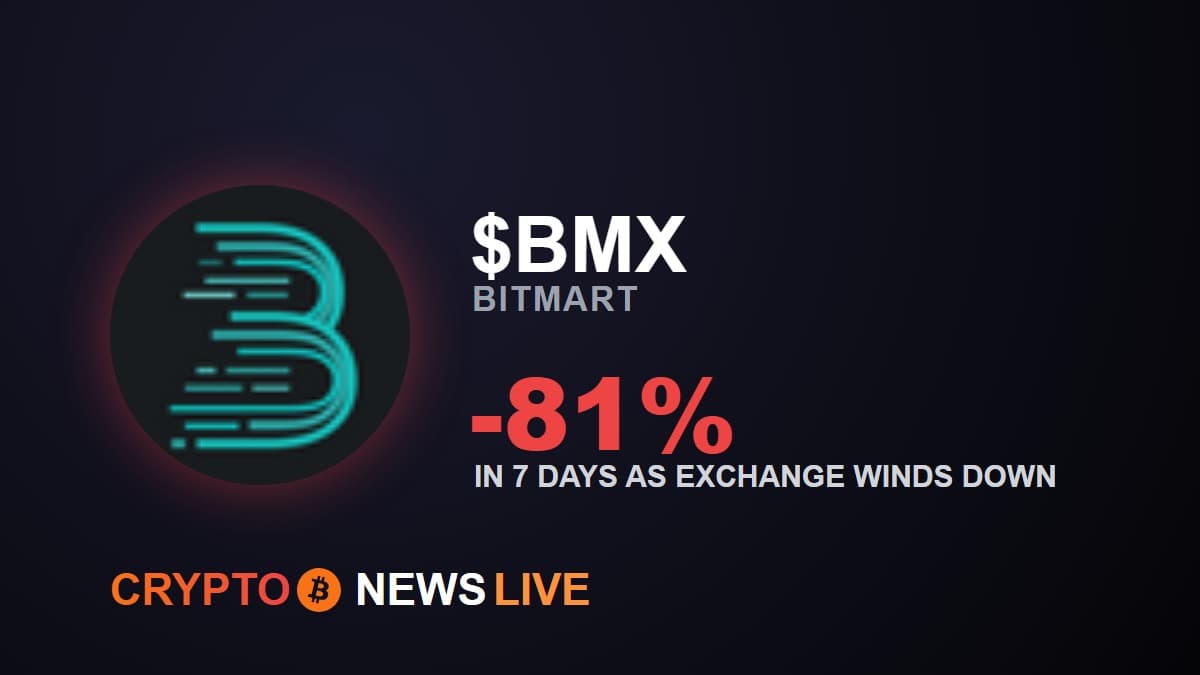
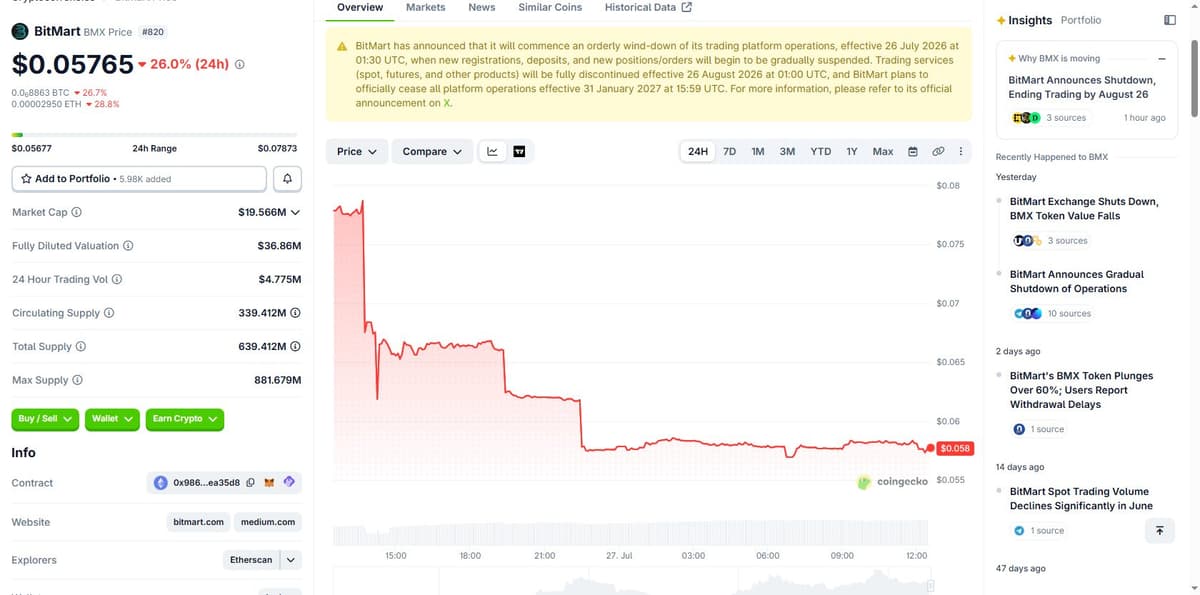
BitMart runs its own token, ticker BMX, an ERC-20 first issued back in 2017 under the name BMC. It is not spared. BMX trades near $0.0576 as of writing, down 26% in 24 hours and 81.05% across seven days, per CoinGecko. That leaves it 90.7% below its June 2024 high of $0.619, on a market cap near 19.5 million dollars.
Here’s the part that reads almost backwards. BMX’s biggest wallet, unlabeled, holds 300 million tokens, 34.5% of everything in circulation, worth roughly $17.3 million at current prices. Etherscan’s own transaction log for that address shows exactly one transfer ever: the deposit that funded it, over eight years ago. Nothing sent out, not this week, not ever. The top three unlabeled wallets together control close to 78% of supply. Concentration across the top 100 holders sits at 98.92%, a Gini score of 0.9985 that leaves almost no daylight for an “even distribution” argument.
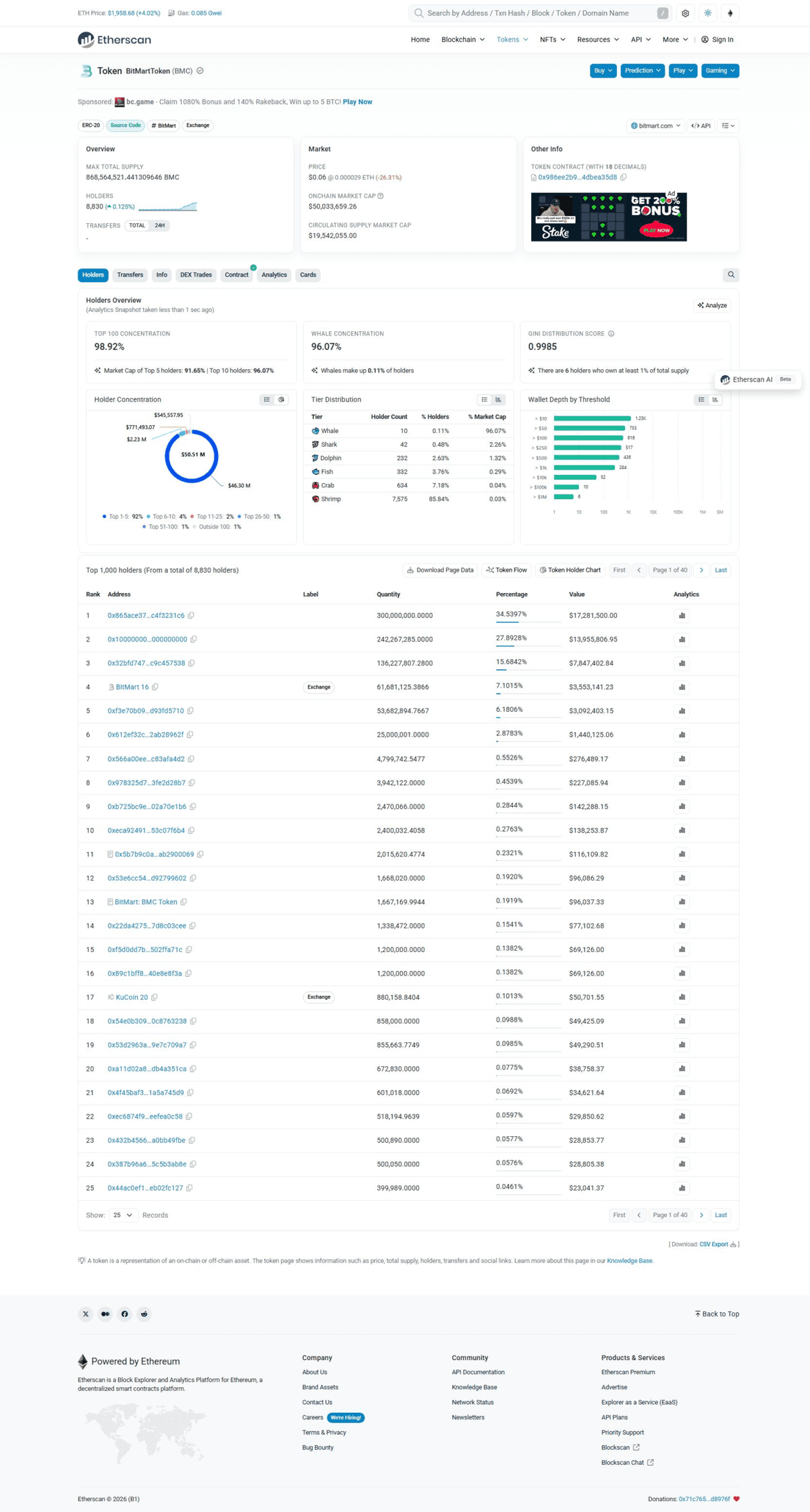
So the 81% collapse did not come from a whale exit. It came from whatever’s left, a thin float trading almost nowhere except one place.
One Order Book, One Point of Failure
That one place is BitMart itself. Pull the market data and the BMX/ETH pair on BitMart’s own books carries about $2.13 million of daily volume, BMX/BTC another $1.5 million, BMX/USDT roughly $860,000. KuCoin adds around $102,000. Every Uniswap pool combined, V2 through V4, totals under $13,000. Call it over 99% of real volume sitting on centralized order books, the overwhelming share of it BitMart’s own. A token whose main market is the exchange currently winding itself down carries a structural risk most coins never have to price in.
Under both the company notice and Chow’s post on X, individual users have been piling on with complaints of their own, stuck withdrawals, pending transfers sitting for hours, one account naming a six-figure balance it says it cannot move. None of that is verified the way the notice, the termination and the onchain zero are. It is unconfirmed, posted by accounts with no way to prove the underlying claim, and BitMart has not replied to a single one of them on the platform where the whole story is unfolding.
What’s verified: the notice, the termination, the zero, and now a matching 61-hour silence on one of BitMart’s own labeled wallets across the exact same window. What isn’t: whether that silence reached every wallet, every chain, every user actually trying to get funds out. BitMart has a seven-month runway before trading stops entirely and a window into 2027 before it says goodbye for good. Whether withdrawals genuinely flow through that whole stretch is still the one claim in this story the exchange itself has not addressed.