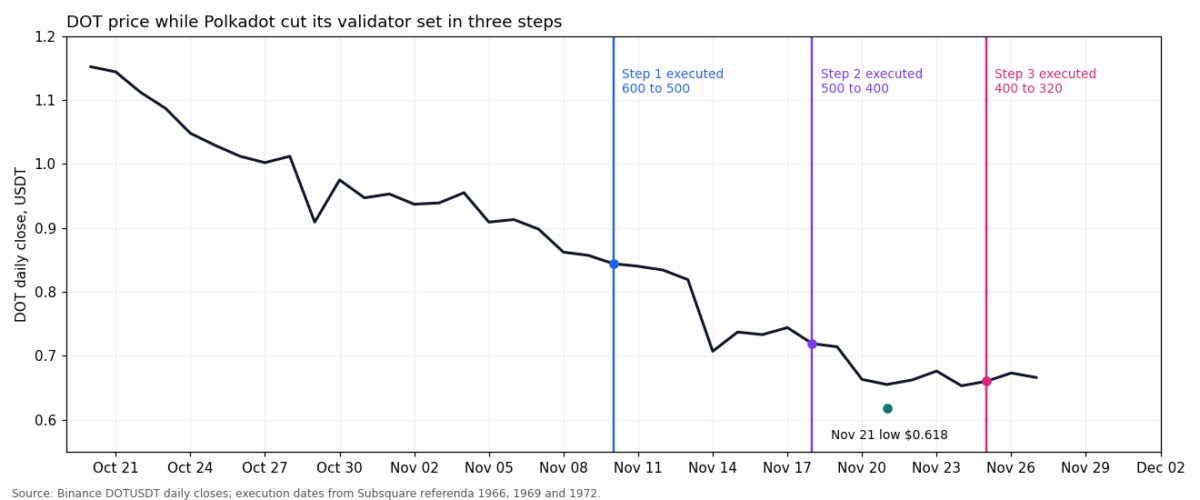
The Polkadot team completed the process of reducing the validator set from 600 to 320 on Nov 25. Meanwhile, DOT had reached a record low of $0.618 on Binance four days earlier. The Polkadot developers wrote in October that 600 “exceeds the needs of Polkadot.” The Polkadot validator cut is a network decision, and Polkadot’s own documents do not tie it to the price.
The market seems like the more dominant force. DOT lost 34.2% of its value during the 30-day period ending on Nov 27 and Bitcoin lost 26.3%.

What the three Polkadot votes changed
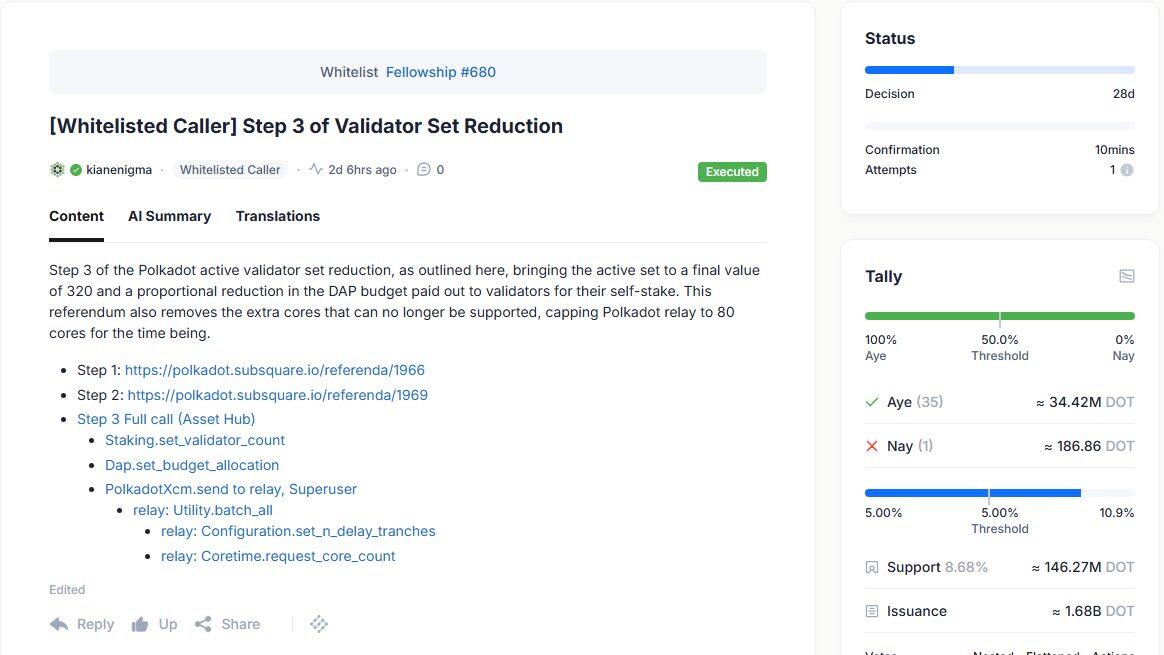
The validators are the machines used to verify block transactions for the Polkadot network, and their number was 600 until November. There were three successful votes done on-chain to reduce the validator count gradually – the referendum 1966 reduced it to 500 on Nov 10, 1969 was 400 on Nov 18 and 1972 was on Nov 25.
The third referendum brings the active set to 320 while reducing the budget paid to validators for their self-stake. In addition, it also limits the Polkadot relay chain to 80 cores. It passed with 35 yes votes and one no.
Why Polkadot says it shrank the set
The plan for the Polkadot validator cut was published on the Polkadot forum on Oct 16. It says 600 validators is more than the network needs, and a smaller set lets Polkadot raise the rewards of operators who also run Asset Hub and People Chain servers.
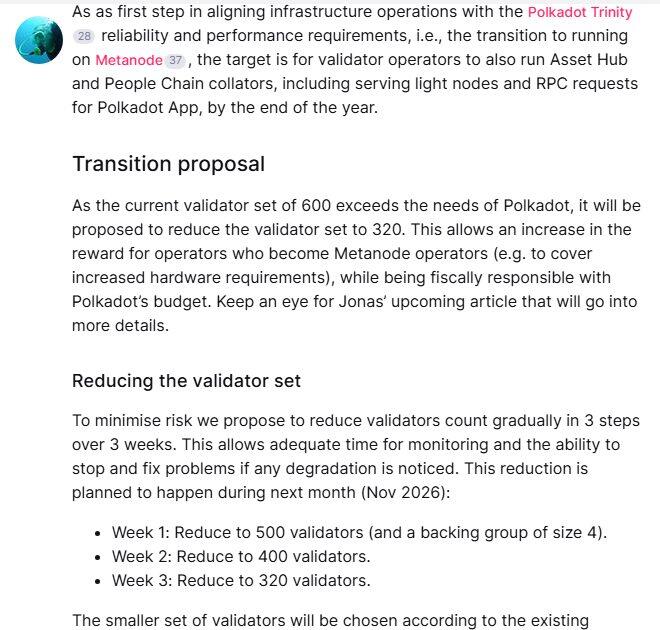
None of that ties the Polkadot validator cut to the DOT price. The same post says the three steps were spread over three weeks so problems could be spotted and stopped.
Did the cut or the market push DOT down?
Mostly the market, going by Binance prices. The 30-day correlation between the price movement of DOT and Bitcoin is 0.72, and the past seven-day correlation is 0.52. During the worst day, the fall of DOT was higher compared to that of Bitcoin; on Nov 14, DOT fell 13.7% while Bitcoin fell 6.1%.
Other tokens of similar magnitude have also been on the decline, including NEAR down by 36.4% within the same period, and UNI down by 34%.
Traders have not abandoned the token. The open interest of Binance’s DOT perpetual futures, which is the total number of outstanding contracts, stood at 36.1 million DOT on Nov 26 compared to 34.9 million DOT on Oct 29. In dollar terms, the value of the contracts declined from approximately $35 million to $24 million. This decrease is attributed to the price decline.
What the DOT chart shows at the record low
Each bounce since Oct 10 has stopped at a lower high. The trend line drawn from the $1.30 high seen on Oct 10 to the $1.00 high on Nov 4 is close to $0.72 on Nov 27, while DOT trades below at $0.67.
The 20-day moving average stood at $0.75 as of the Nov 26 closing price. The RSI indicator, a measure of momentum where any reading below 30 indicates heavy selling, has remained below 30 since Nov 14 and stood at 29.2 as of the Nov 26 closing price.
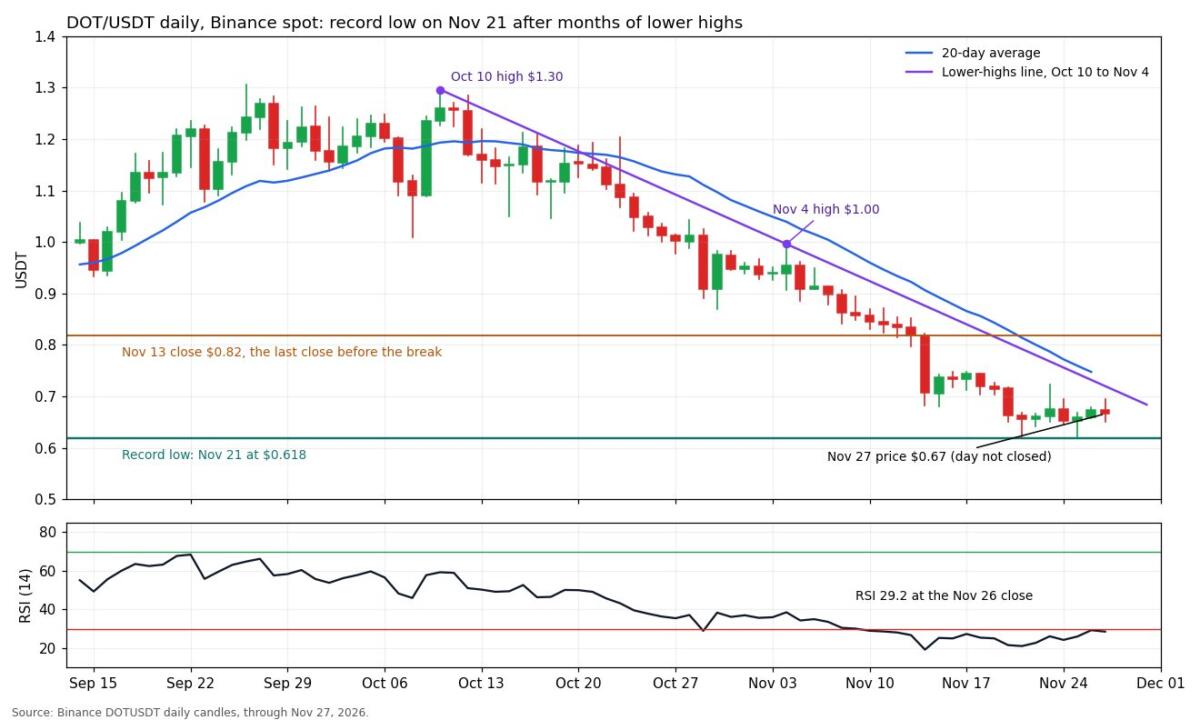
The most recent close prior to the Nov 14 drop occurred at $0.82 on Nov 13, while the low on Nov 21 of $0.618 is the lowest price ever on Binance.
The two price cases for DOT
A daily close above the $0.75 average would break the run of lower highs, putting the Nov 13 close of $0.82 in range. As long as price remains below the average and line, the chart leans lower.
A daily close under $0.618 would be a new record low, with no earlier price to lean on. Data is taken from Binance daily candles up until Nov 27, and voting information from Subsquare and Polkadot forum. None of the above is investment advice, and cryptocurrencies are volatile enough for you to lose your money.