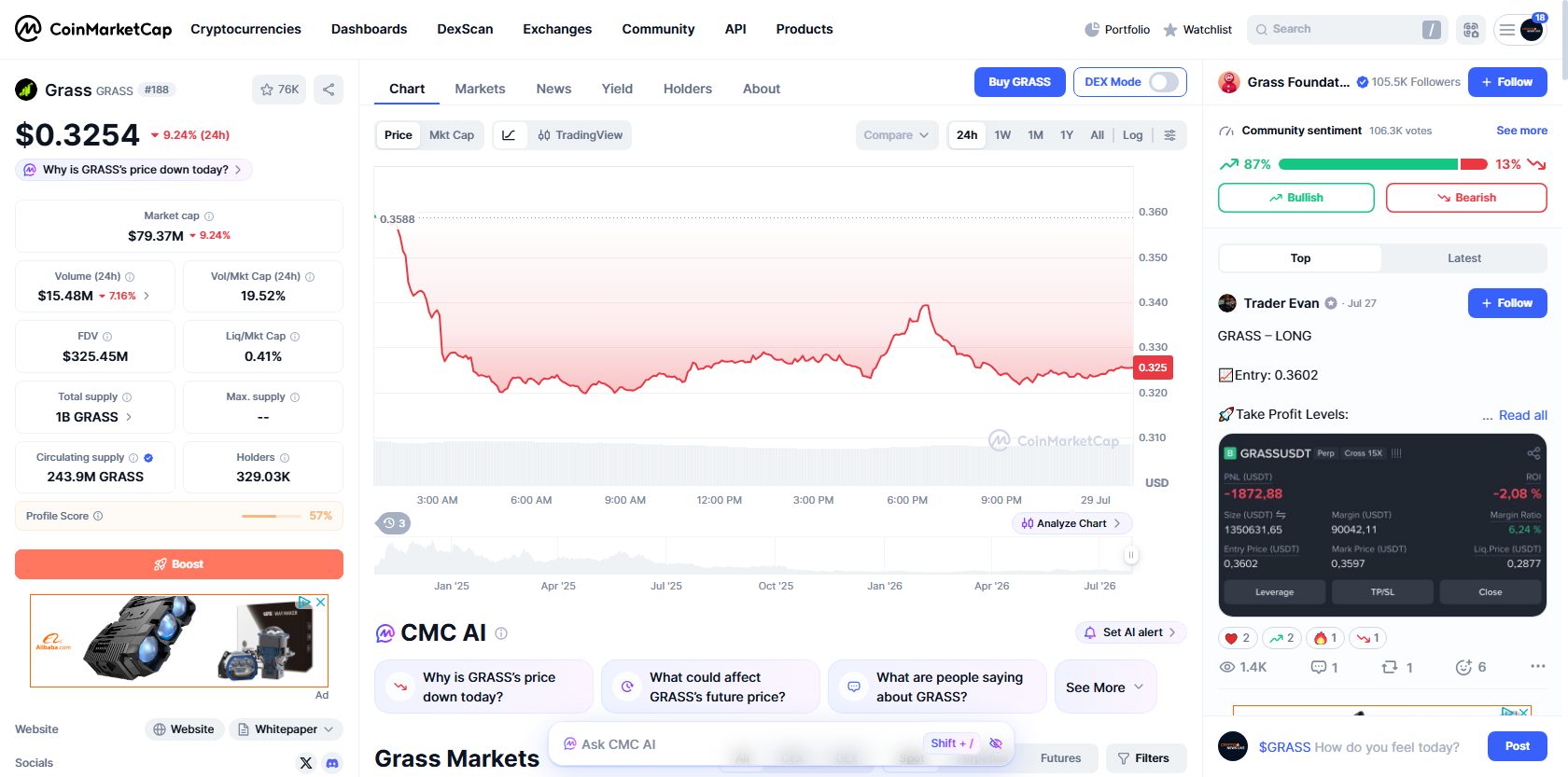
Someone using the handle Trader Evan posted a long on GRASS three days ago. Entry at 0.3602, take profit levels listed underneath, stop loss attached, the kind of clean setup that gets copied by whoever scrolls past it on CoinMarketCap’s community feed. By Wednesday the position sat underwater by close to two thousand dollars. Price had drifted more than three and a half cents below that entry with no bounce showing up on the chart.
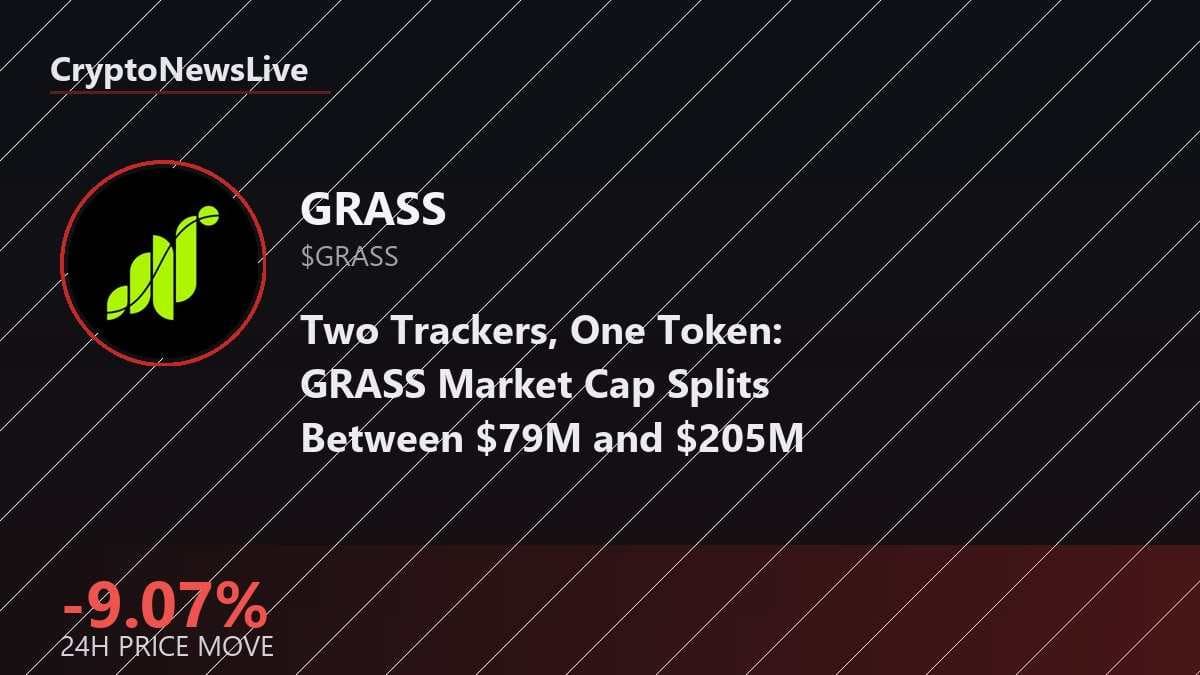
GRASS was down 9.07% on the day, changing hands around $0.325 across MEXC, Binance and a handful of other venues. Bitcoin, over the same 24 hours, moved a little over one percent. Whatever pushed GRASS lower did it alone.
No Catalyst Found, and Two AI Tools Agree
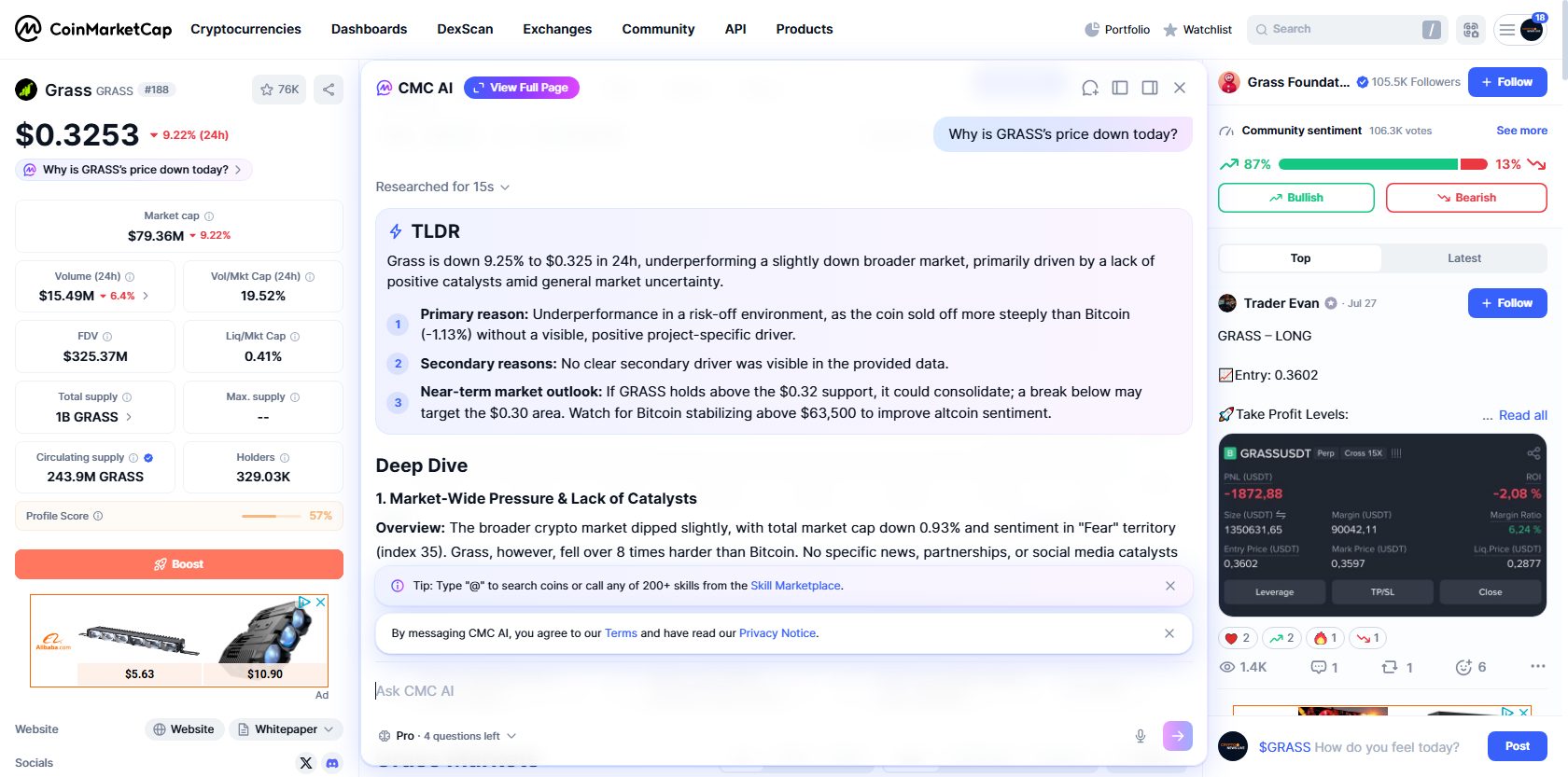
CoinMarketCap runs its own AI research tool on every listed token, and someone asked it directly why GRASS was down today. The answer came back blunt: underperformance in a risk-off environment, the coin selling off more steeply than Bitcoin’s 1.13% decline “without a visible, positive project-specific driver.” The tool’s own secondary-reasons line read even flatter. No clear secondary driver was visible in the data it had access to.
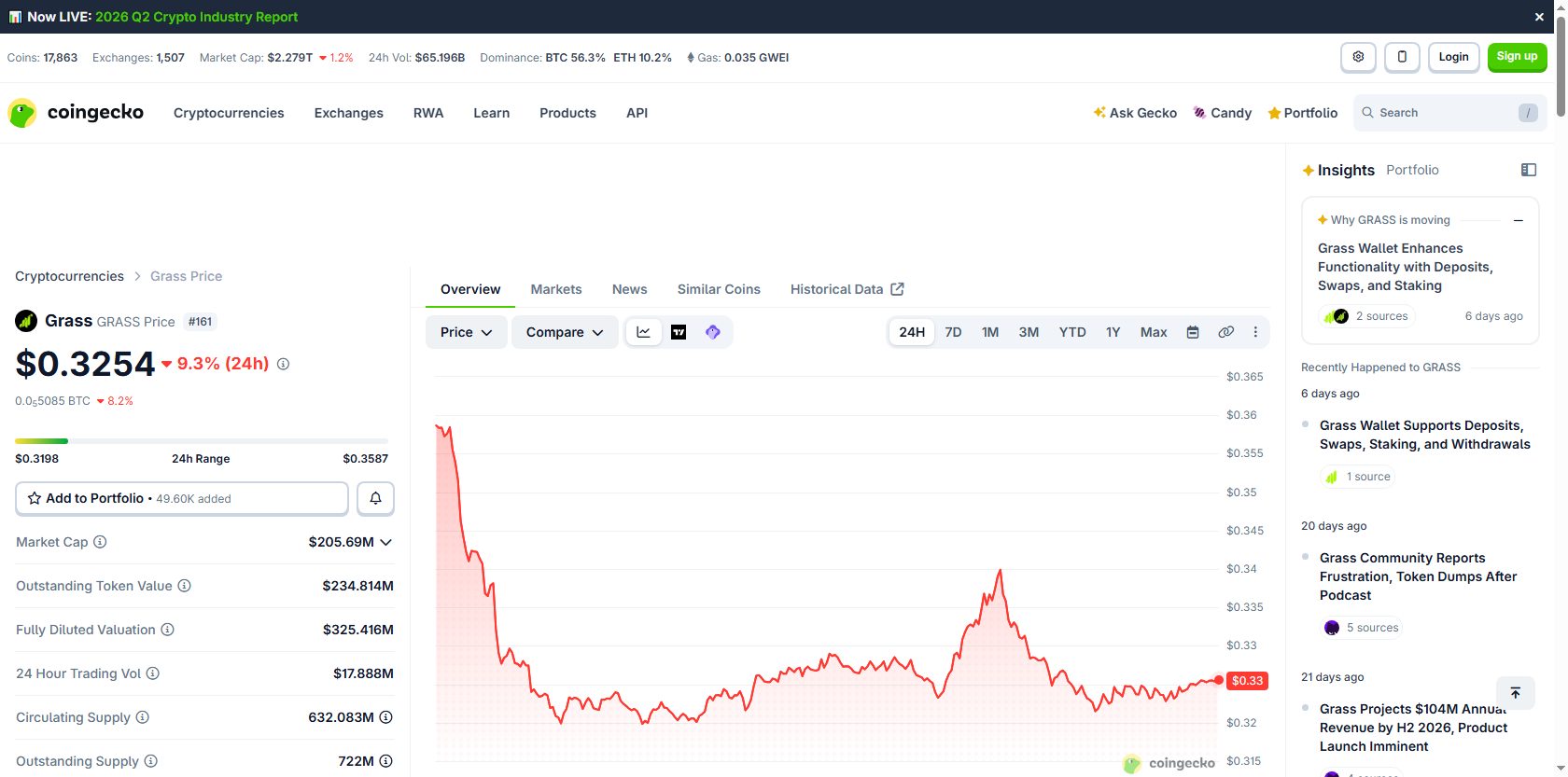
CoinGecko runs a similar feature under a “Why GRASS is moving” panel on its own token page, sourced independently of CoinMarketCap. It didn’t point to anything from today either. The most recent item it surfaced was a wallet feature update, deposits and swaps and staking support, dated six days earlier. Before that, a “Grass Community Reports Frustration, Token Dumps After Podcast” story sits twenty days back, cited across five separate sources at the time. Neither lines up with Wednesday’s move. Two independent research tools, built by competing companies, landed on the same conclusion without anything resembling a coordinated answer.
Longs Took the Brunt of the Liquidations
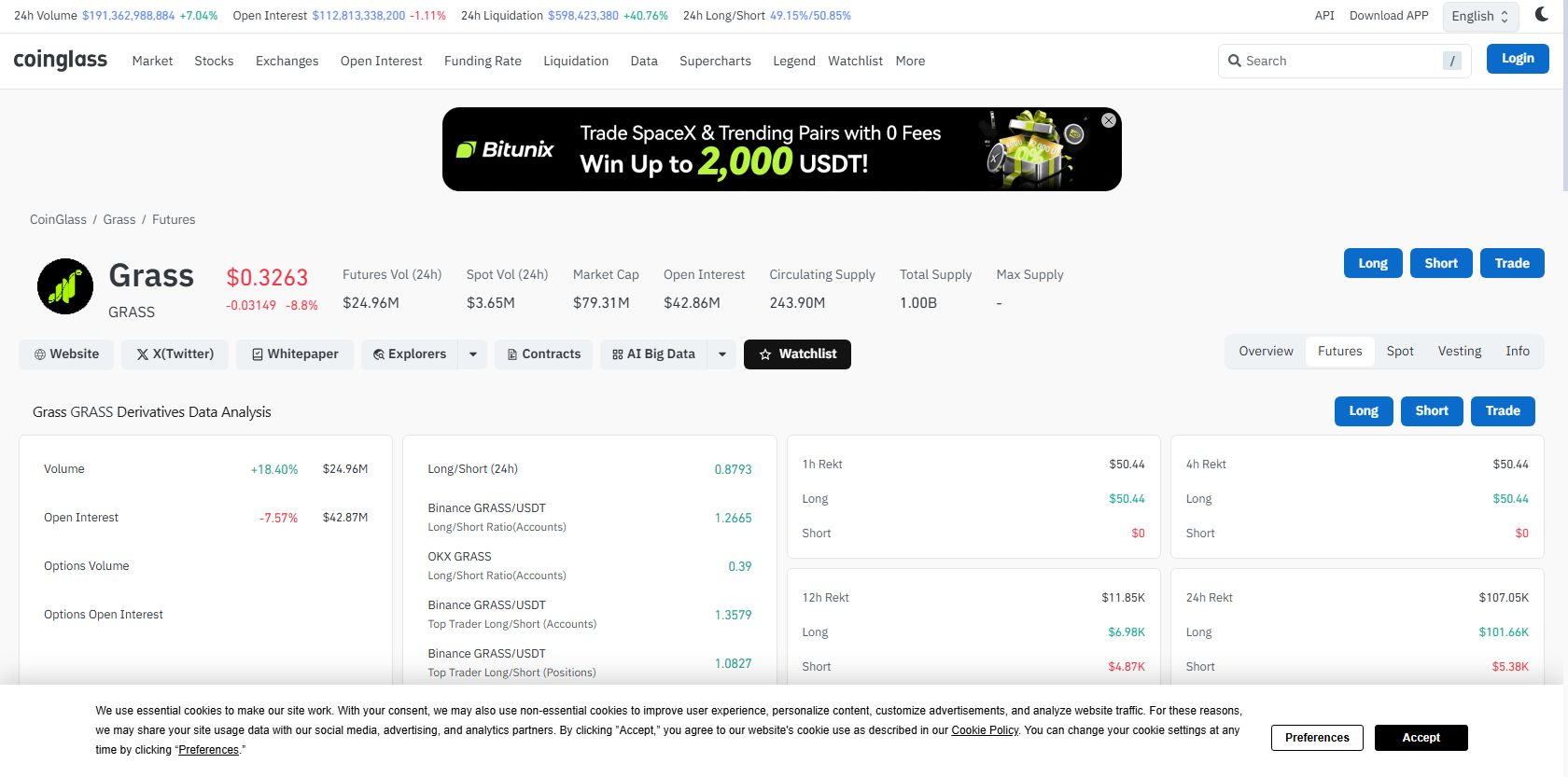
Open interest on GRASS futures, per Coinglass data, sat at $42.87 million heading into the drop, a figure that alone runs to 54% of the token’s CoinMarketCap-listed market cap. Futures volume over 24 hours reached $24.96 million against spot volume of just $3.65 million, meaning roughly seven dollars changed hands on margin bets for every dollar traded on the actual coin.
That structure showed up in the liquidation data. Over the trailing 24 hours, $101.66K in long positions got force-closed against just $5.38K on the short side, close to a nineteen-to-one split. Open interest itself fell 7.57% across the same window, moving in the same direction as price rather than against it. That combination, positions closing as price falls rather than shorts piling in fresh, reads like a deleveraging flush more than a bet against the token gathering strength. For a similar margin-driven flush on a smaller altcoin, CryptoNewsLive’s coverage of COTI’s own liquidation event follows the same pattern.
Trader Evan’s post wasn’t an isolated one either. Several near-identical “GRASS – LONG” setups, same entry logic, same take-profit structure, surfaced from different accounts on the same community feed within a day of each other. Whether that’s coordinated promotion or just several traders reaching for the same technical level independently isn’t something a screenshot alone can settle. It’s worth flagging regardless, since a reader copying any one of those posts this week would be sitting on a loss right now.
Two Trackers, One Token, Two Market Caps
Here’s where it gets stranger. CoinMarketCap lists GRASS circulating supply at 243.9 million tokens, carrying a verified badge, putting market cap at $79.37 million. CoinGecko, pulling from the same on-chain token, lists circulating supply at 632.083 million, an “estimated” figure by its own label, putting market cap at $205.69 million. Same asset, same moment, a gap of roughly $126 million between what two of the industry’s most-cited trackers say GRASS is worth.
The total token supply isn’t in dispute. Solscan’s on-chain record for the GRASS mint shows just under one billion tokens issued, matching the 1 billion figure both CoinMarketCap and Coinglass carry as total supply, with fully diluted valuation landing near $325 million on every platform that reports it. What differs is how much of that billion each site treats as freely circulating versus still locked, unvested, or held by the foundation. CoinGecko’s number assumes a much larger share is loose. CoinMarketCap’s verified figure assumes most of it isn’t. Neither site’s page explains the gap to a reader landing on either one for the first time, and Grass Foundation hasn’t put out a circulating-supply breakdown that would settle which number is closer to reality. Readers who followed CryptoNewsLive’s report on Worldcoin’s own locked-supply mechanics will recognize the shape of the problem, tokenomics pages that disagree on the one number that decides what a coin is actually worth.
Thin Order Books and a Quiet GitHub
GRASS trades mainly on centralized exchanges. Its Solana-based spot pool, a Phoenix GRASS-USDC pair, shows transfers frequently sized under a dollar, thin enough that a single mid-sized order could move the on-chain price meaningfully. That’s a familiar pattern for tokens where the real price discovery happens on futures books rather than the spot market, similar to what CryptoNewsLive found looking at Pearl’s own order book depth, and it lines up with the derivatives-heavy volume split described above.
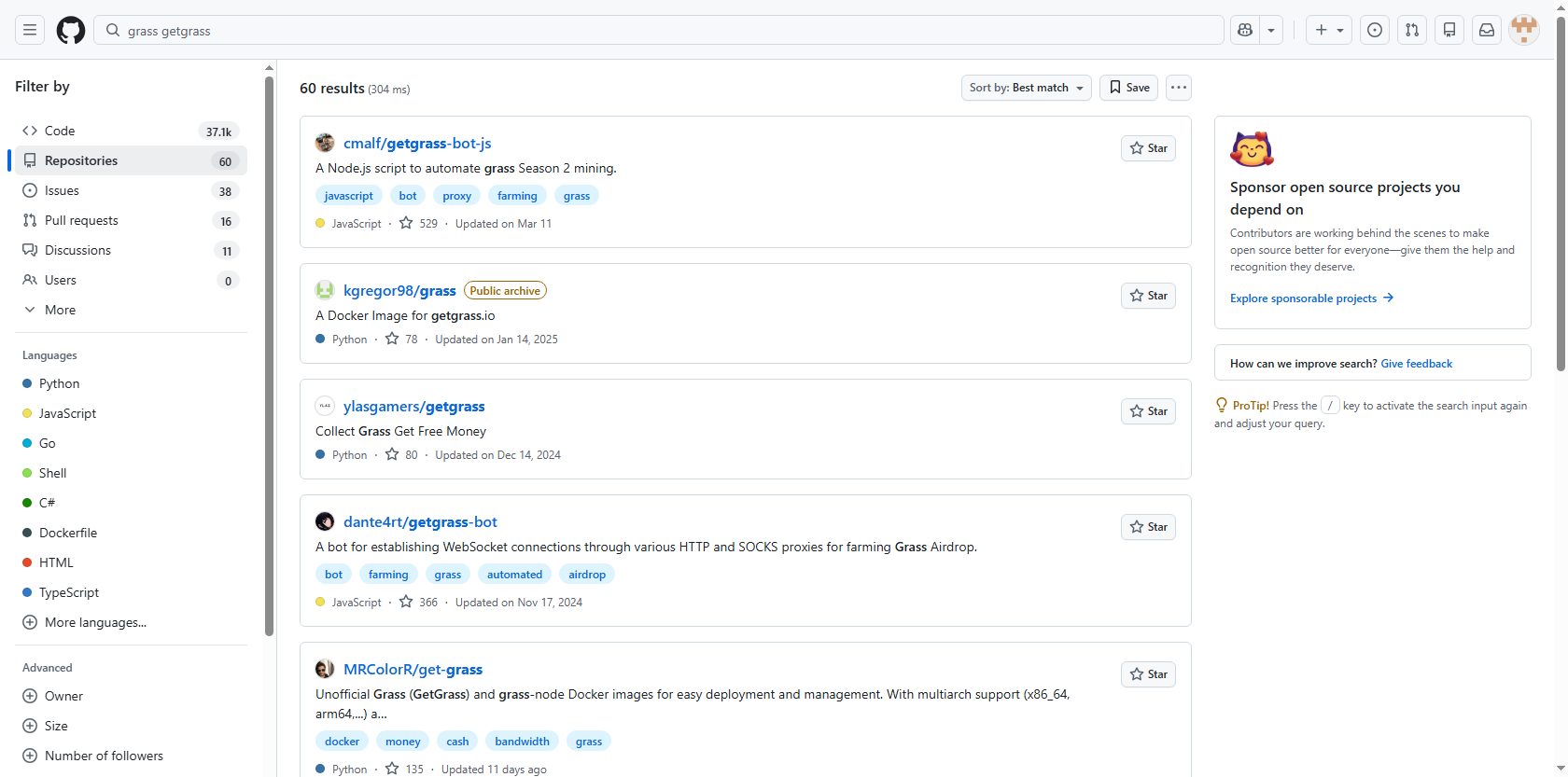
A search of public GitHub repositories turns up no official Grass Foundation organization actively shipping code. What does turn up, in volume, are third-party projects: bot scripts for automating node uptime, proxy tools for farming the network’s bandwidth-sharing rewards, unofficial Docker images for running a Grass node without the official client. Several of those repos carry hundreds of stars and recent commits, more than most official token repos see. The activity is real. It’s just aimed at extracting rewards from the network rather than building it.
Key Takeaways
GRASS fell 9% today and neither CoinMarketCap’s AI tool nor CoinGecko’s own research panel could point to a specific cause from the last 24 hours.
Long positions absorbed $101.66K of a roughly $107K liquidation total in the same window, while open interest fell alongside price rather than rising against it.
CoinGecko’s circulating supply reading for GRASS sits at 632 million tokens against CoinMarketCap’s verified 243.9 million, a split worth roughly $126 million in market cap depending which site a reader trusts.
What to Watch Next
CoinMarketCap’s own AI flagged $0.32 as the level GRASS needs to hold to avoid a slide toward $0.30, and tied any relief to Bitcoin stabilizing back above $63,500. Both are worth checking against price action over the coming days rather than taking as settled.
Whether Grass Foundation ever publishes a circulating-supply breakdown that reconciles the CoinGecko and CoinMarketCap numbers remains an open question, one that matters more the longer neither tracker corrects toward the other.
Open interest sat at $42.87 million after Wednesday’s flush. Whether that keeps unwinding or rebuilds into fresh margin exposure over the next few sessions will say a good deal about whether Wednesday’s move was a one-time deleveraging event or the start of something longer.
This article is for informational purposes only and does not constitute financial or investment advice.