A Familiar Slide, Then a Snap
COTI spent the better part of a year bleeding out. Then it stopped.
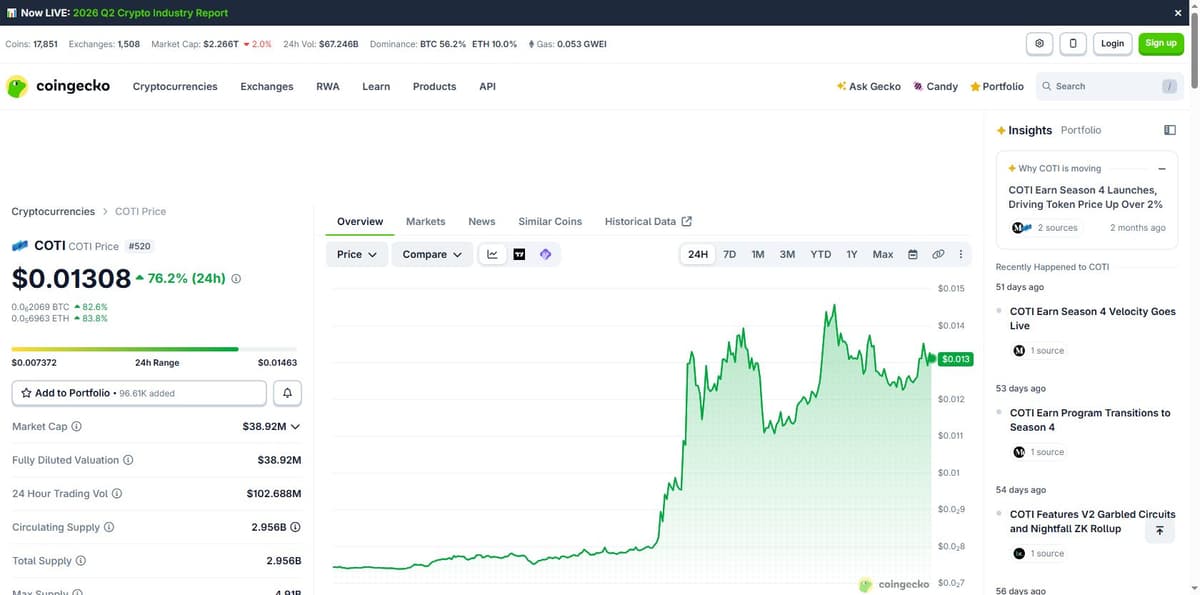
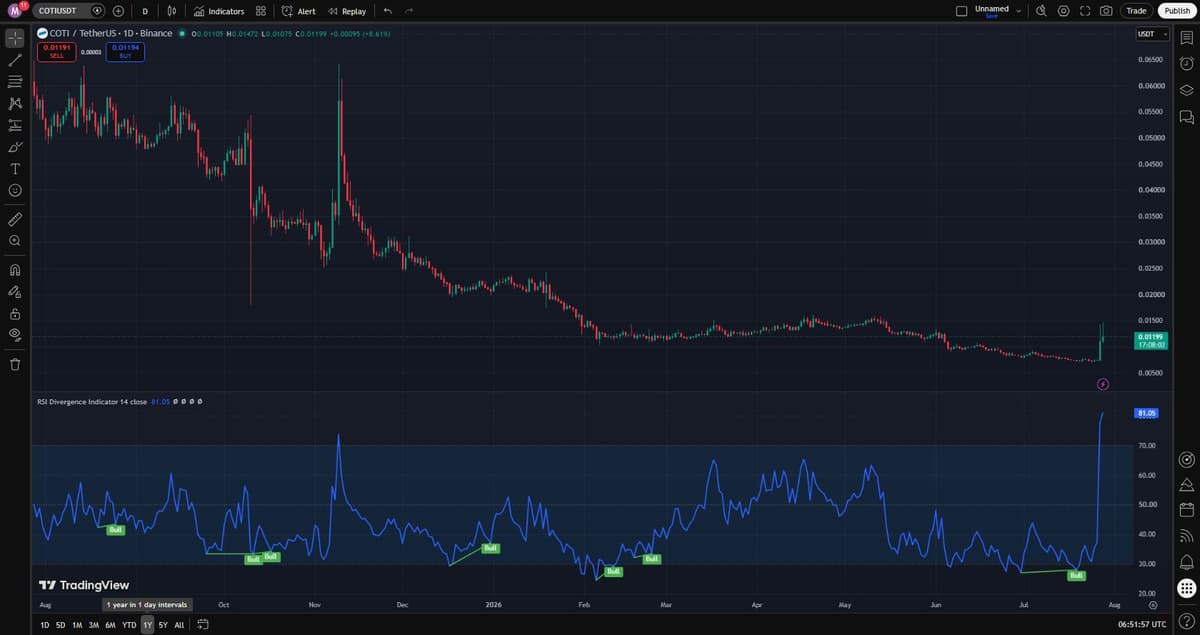
The token touched $0.007204 this week, its lowest print across the entire trailing twelve months, based on daily chart data pulled from TradingView. Within hours it was trading above $0.014, a move CoinGecko’s own historical table logs at 69.6% over 24 hours, with intraday prints running as high as 76% before cooling. Volume did something stranger. Trading activity jumped 4,683% versus the prior day, per CoinGecko’s own live figures, pushing 24-hour turnover to roughly $102.7 million against a market cap of just $38.9 million. That ratio, over 260%, is the kind of number that usually means one thing got announced and everyone showed up at once.
COTI Fixed The Public Ledger Problem
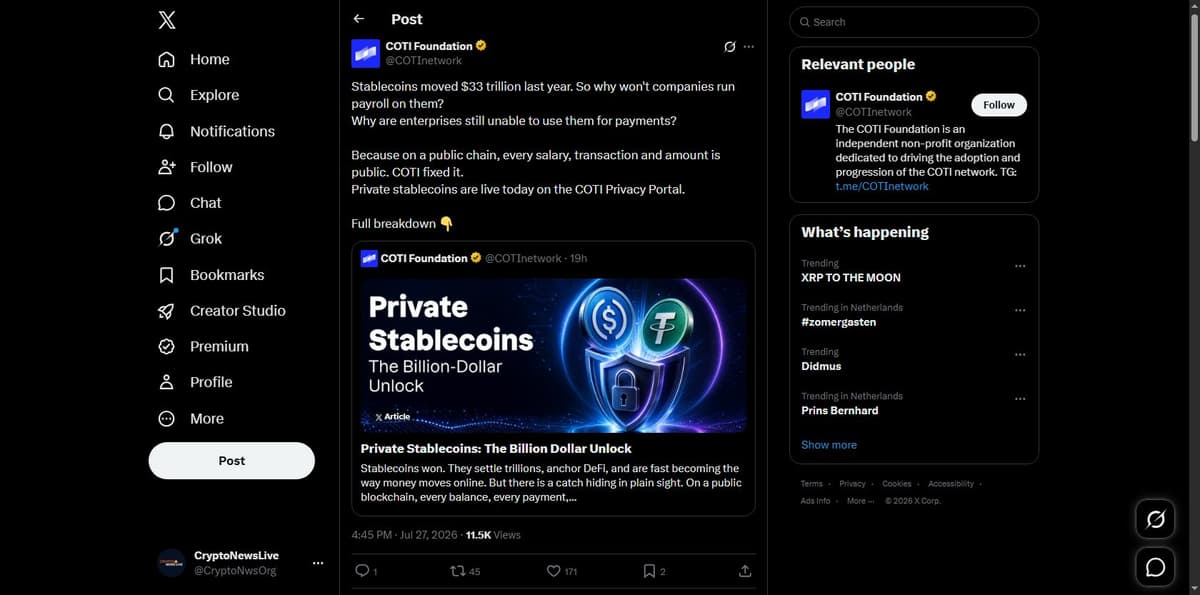
Something did get announced. The COTI Foundation posted directly to its own account, @COTInetwork, at 4:45pm on July 27: stablecoins moved $33 trillion last year, the post read, yet enterprises still can’t run payroll on them because every salary and every balance sits exposed on a public chain. COTI’s fix, the post said plainly, is already live. Private stablecoins are now running through what the Foundation calls its Privacy Portal.
A follow-up post eight hours later doubled down: “Every chain needs privacy. Nobody has to build it from scratch anymore.” The company is branding the feature Privacy-on-Demand. It isn’t only talk. An independent user, posting days earlier under the handle @Shenanigrahams, described getting early access to “COTI’s new privacy portal on @avax” and testing shielded transaction features directly. Avalanche’s own account has not yet echoed the announcement, so the integration reads as confirmed on COTI’s side and corroborated by an outside tester, not yet a two-sided press event.
Where The Money Actually Moved
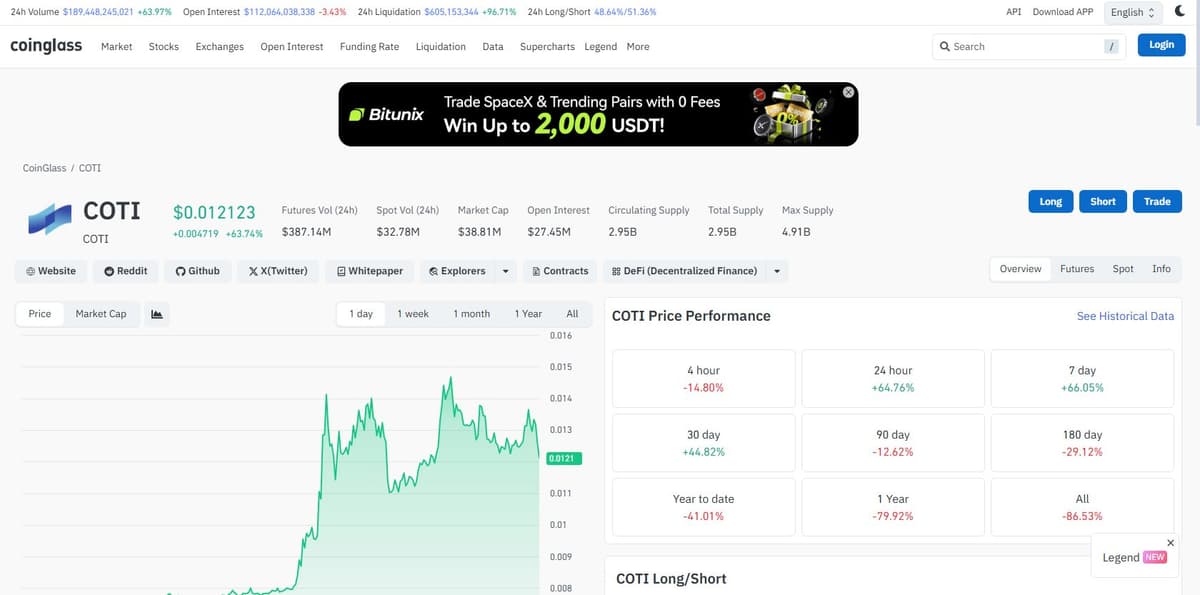
Here is the part that ties the announcement to the candle. Coinglass data shows COTI futures volume hit $386.6 million in 24 hours against just $32.7 million in spot, better than an 11-to-1 tilt toward futures over real spot demand. Total liquidations over the same window came to $3.23 million. Short positions ate $2.29 million of that, nearly 71%. Longs lost less than a third as much.
Read that against the timeline. Shorts had piled up against a token in a year-long downtrend, a reasonable bet until the ground moved. The Privacy Portal news landed, price snapped off its low, and the crowded side got run over within hours, not days. Binance’s own account data now shows a long/short ratio of 1.29, meaning the crowd has flipped to the other side already. A token that squeezes shorts on the way up can just as easily squeeze longs on the way back down.
The Code Behind The Marketing
Marketing claims are cheap. Repositories are not. COTI’s GitHub organization lists 63 repos, and several tied directly to Privacy-on-Demand, including coti-sdk-pod, coti-pod-inbox-contracts and pod-ecosystem-integration, all showing recent activity at the time of writing. That is a real technical footprint sitting under the announcement, not a rebrand with nothing behind it.
It also isn’t a Bitcoin story wearing a COTI ticker. Pulling 30 and 7 day price arrays from CoinGecko’s own API and computing an actual correlation coefficient against Bitcoin returns 0.14 over 30 days and close to zero, negative 0.04, over 7 days. Bitcoin itself rose a modest 3.1% the same day, Ethereum 4.4%. Whatever moved COTI, it wasn’t the market.
Worth a paragraph of its own: a verified account calling itself Jackson Albert spent the same window blasting out fake “signal group” posts, cheering COTI alongside seven unrelated tickers in a two-minute span, each post pulling six to nine views. That is engagement-farming noise chasing the move after the fact, not evidence anyone organized this rally.
What The Chart Isn’t Saying Yet
On the daily chart, RSI spiked to 81. On the hourly, it briefly touched near 90 before easing back to the high 50s as price gave back roughly 3% in the hour before this was written. Momentum extremes that fade this fast tend to mean the easy money already moved.
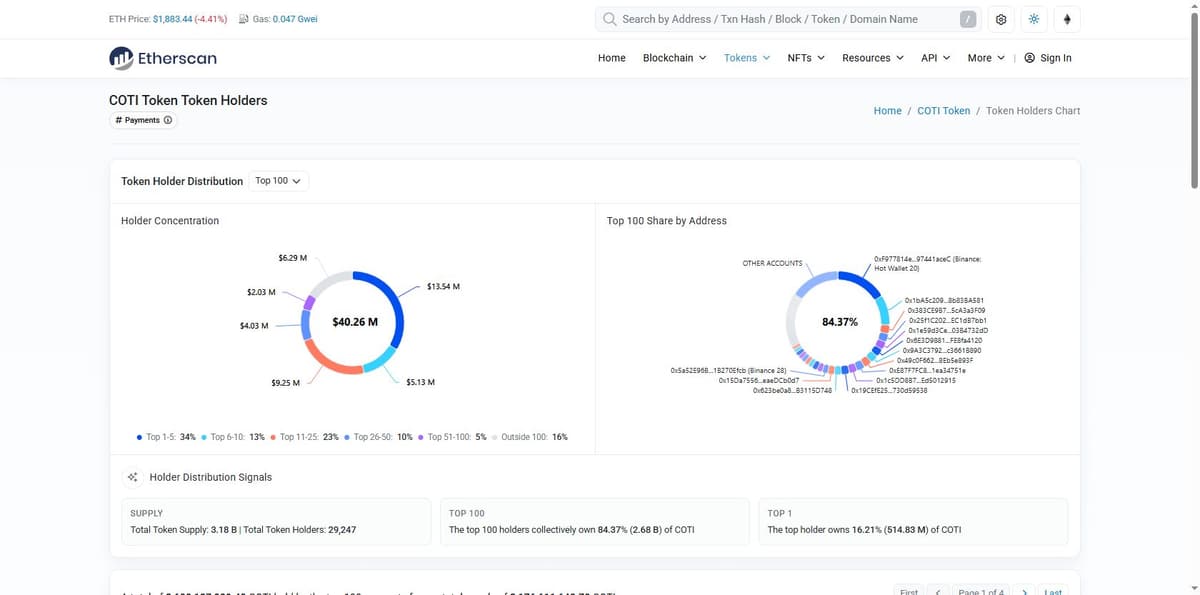
Supply tells its own quieter story. COTI’s circulating and total supply both sit at 2.956 billion, but max supply runs to 4.91 billion, nearly 66% higher. Fully diluted valuation as CoinGecko calculates it matches market cap today only because total and circulating happen to be equal right now. Once more of that ceiling enters circulation, the math gets less flattering. On the holder side, Etherscan shows Binance’s own hot wallet controlling 16.2% and a single unlabeled address holding 9.44%, followed by eleven wallets each carrying almost exactly 2.5%, a pattern that reads like a structured original allocation rather than fresh accumulation. Roughly 57% of supply sits across the top fifteen addresses.
None of that is new information forcing today’s move. It’s the risk sitting underneath it.
The Next Move Depends On Two Things
If Privacy-on-Demand keeps shipping real integrations beyond Avalanche, and the GitHub activity holds, the utility case survives the squeeze that got it here. If it doesn’t, a token still 98% below its 2021 high, now carrying a crowded long book instead of a crowded short one, has given traders a textbook setup to fade.