Upbit posted a notice at 09:48 UTC on October 20 saying IOST deposits and withdrawals would stop at 03:00 UTC the next day for an IOST hard fork, and the next hourly candle on Binance was the first of a run from $0.000745. The token topped out at $0.001908 on October 21. Then it lost 29.0% inside a single hour.
That hour was 23:00 UTC. The spot candle opened at $0.001569 and closed at $0.001114. By 13:00 UTC on October 22 the pair was hovering near $0.0009, which is still about 20% above where it ended October 19 ($0.000749).
Upbit’s IOST hard fork notice landed first
Notice 6681 on Upbit’s service center names the IOST hard fork as the reason. Trading stays open while transfers are paused. The halt lasts until stability is confirmed, and Upbit says a resumption notice will go up on the same page. At 13:20 UTC on October 22 the page didn’t have one.

Nothing from Upbit, Binance or the project links the notice to the buying. Twelve minutes between a notice and a candle is a dated sequence, and that’s the extent of it. As a trigger the notice rates possible, not confirmed.
Before that candle IOST had barely traded. From the evening of October 19 until 10:00 UTC on October 20, hourly spot turnover rounded to zero and the price sat between $0.00074 and $0.00075. October 20 then closed at $0.001054 on $8.6M of spot volume. A day later spot did $52.7 million.
What the IOST hard fork changed, and skipped
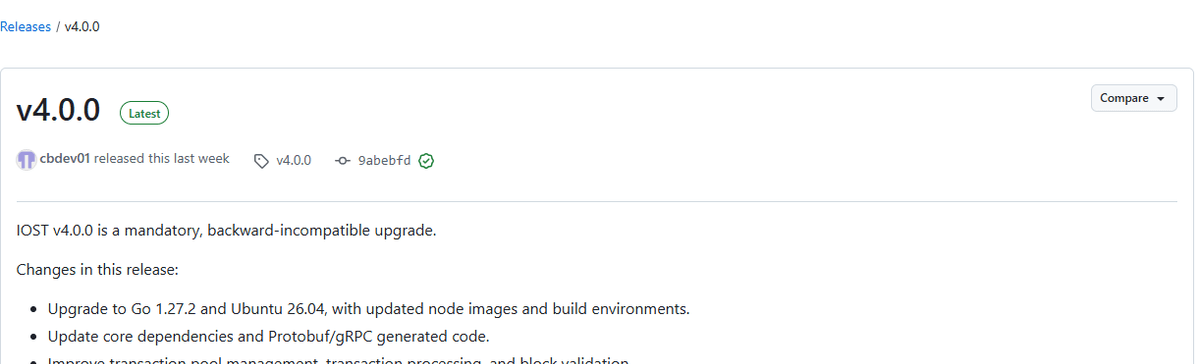
The IOST hard fork is the v4.0.0 release. Look at the go-iost repository and there’s nothing between June 28, 2024 and October 9, 2026. Seven commits then landed in under five days, finishing with a merge on October 14 and a tagged release at 11:55 UTC.
The notes cover a Go 1.27.2 toolchain, refreshed dependencies, transaction pool and block validation fixes, wallet signing fixes and the switch-off of the old v3.10.0 fork. Supply, staking rewards, fees? None get a mention.
IOST’s own post on Medium, published 09:30 UTC on October 19, says every mainnet consensus node had already switched. Exchanges and custodians that hadn’t were told to upgrade immediately. That fits Upbit’s pause fine. It doesn’t explain a 156% price move.
A second Upbit notice, posted 04:40 UTC on October 21, said round 19 of an IOST airdrop to Upbit holders had started paying out. Upbit’s wording gives 852.8 million IOST spread over 48 monthly rounds. One round works out to about 17.8 million tokens, roughly $34,000 near the peak.
Perpetual fell first, spot followed
Futures did most of the trading, the same lopsided split seen in recent reports on AVA and BAT. Binance’s USDT-M IOST perpetual turned over $1.118 billion on October 21, against 52.7 million dollars on spot, roughly 21 times as much. October 20 ran close to 12 times. On October 19 the perpetual managed just $1.9M.
Open interest on that contract climbed from $1.90 million at 08:00 UTC on October 20 to $16.26 million by 20:00 UTC on October 21. Funding was +0.005% at the 04:00 UTC settlement on October 21. After that it printed -0.34%, -0.99%, -0.91% and -2.00%. Negative funding means shorts pay longs.
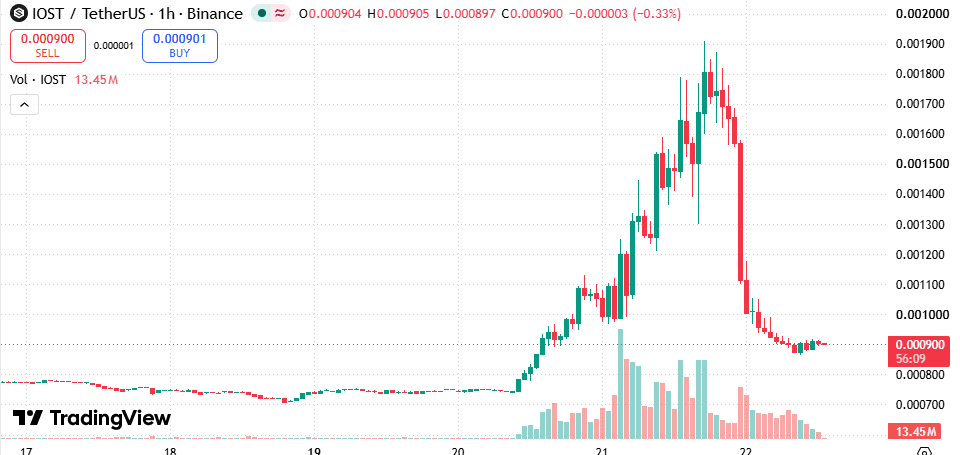
The perpetual spent most of the run under spot. On 15-minute closes the gap was 3% at 16:00 UTC on October 21 and hit 24.5% by 17:45. It sat around 9% through the evening.
Then 22:15 UTC. The perpetual slid away again, closing 16.4% under spot, then 24.1% at 22:30 and 26.9% at 22:45. That 22:30 quarter-hour alone carried $24.1M of perpetual volume. Spot hung around $0.0016 until the 23:00 hour, dropped to $0.001114 by 23:45, and in the first quarter-hour after midnight the gap was down to 6.6%.
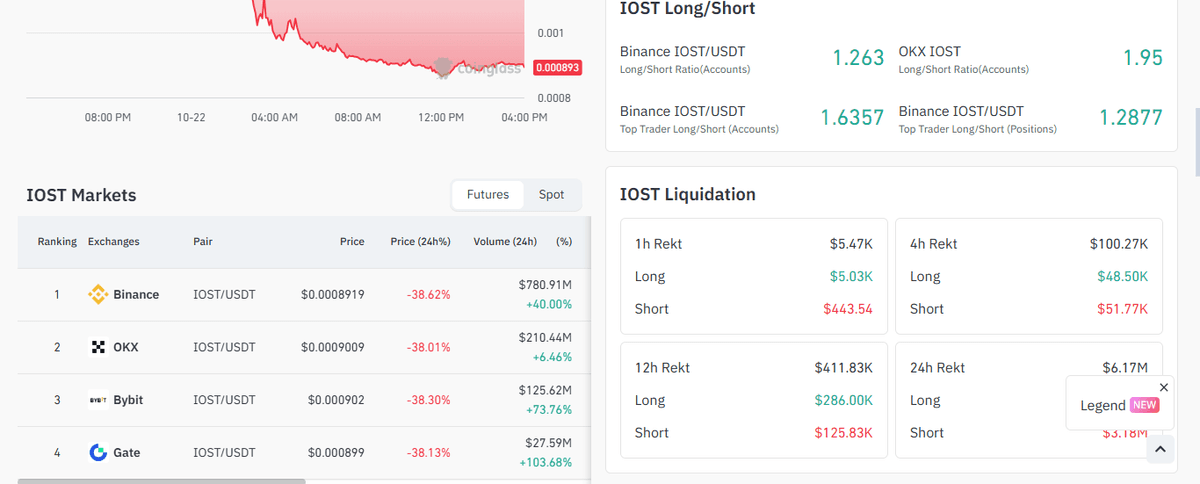
Open interest fell from $16.26M at 20:00 UTC to $10.70M at 23:00, a 34% drop. Coinglass logged $6.17 million of IOST futures liquidations in 24 hours, $3.18 million of it shorts. Binance by itself showed $2.30M in longs and $2.09M in shorts. No exchange or project notice sits near 22:15 UTC. The trigger for the drop is unexplained.
The September spike ended the same way
IOST pulled this move once before. On September 9 the Binance spot pair spiked to $0.002448 and closed at $0.001886, with $48.9M changing hands. The next day it closed at $0.001017. By September 13 it was $0.000770, below the $0.000854 it opened at on September 9.
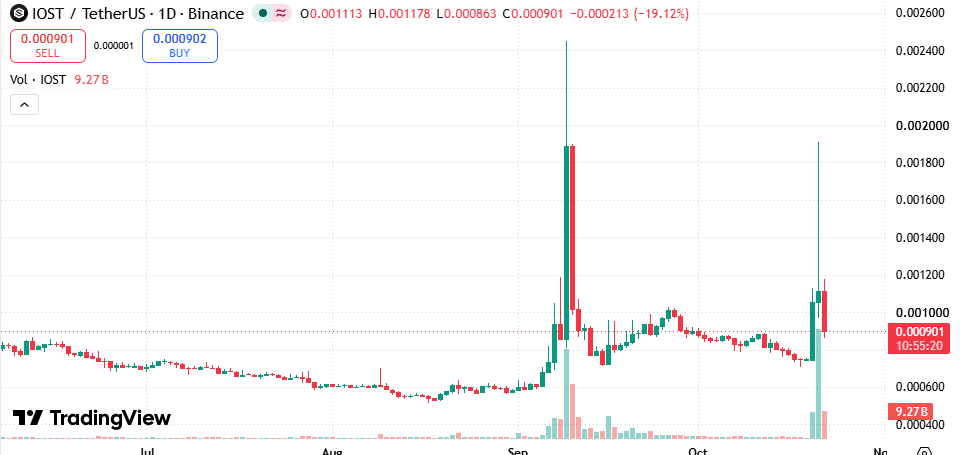
One earlier case is one data point. The September 9 spike gave back its whole gain inside four days, and that carries no weight as a forecast.
Levels after the hard fork drop
Bitcoin sits at $81,608, above its 100-day average of $74,964. Since the IOST hard fork, the token has stayed inside its range. Daily RSI read 52.4 at 13:00 UTC on October 22 and the hourly read 36, with price above both the 20-day average ($0.000851) and the 50-day ($0.000873).
These levels come from Binance perpetual candles. The bull case starts with a 4-hour close above $0.000966, the October 21 low, aiming at $0.001025 and then $0.001792. A 4-hour close back under $0.000899, the October open, voids it. The bear case starts with a 4-hour close below $0.000856, the October 22 low so far, aiming at $0.000838 and $0.000785. A 4-hour close back over $0.000899 voids that path.
Evidence favors neither side. September went lower. Price is also still 20% above its October 19 start. Funding read -0.049% and the account ratio read 1.26 at 13:00 UTC, snapshots that can change within hours. This is market reporting and not investment advice. The next dated item is Upbit’s resumption notice, which its page hadn’t posted as of 13:20 UTC on October 22.