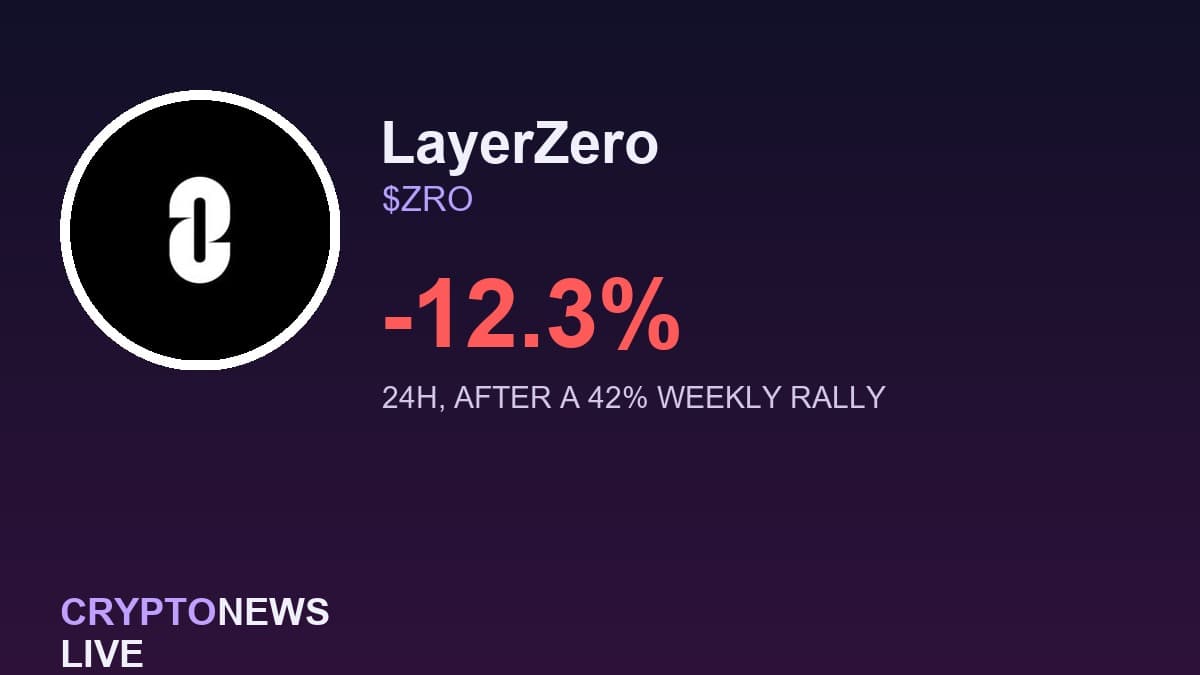
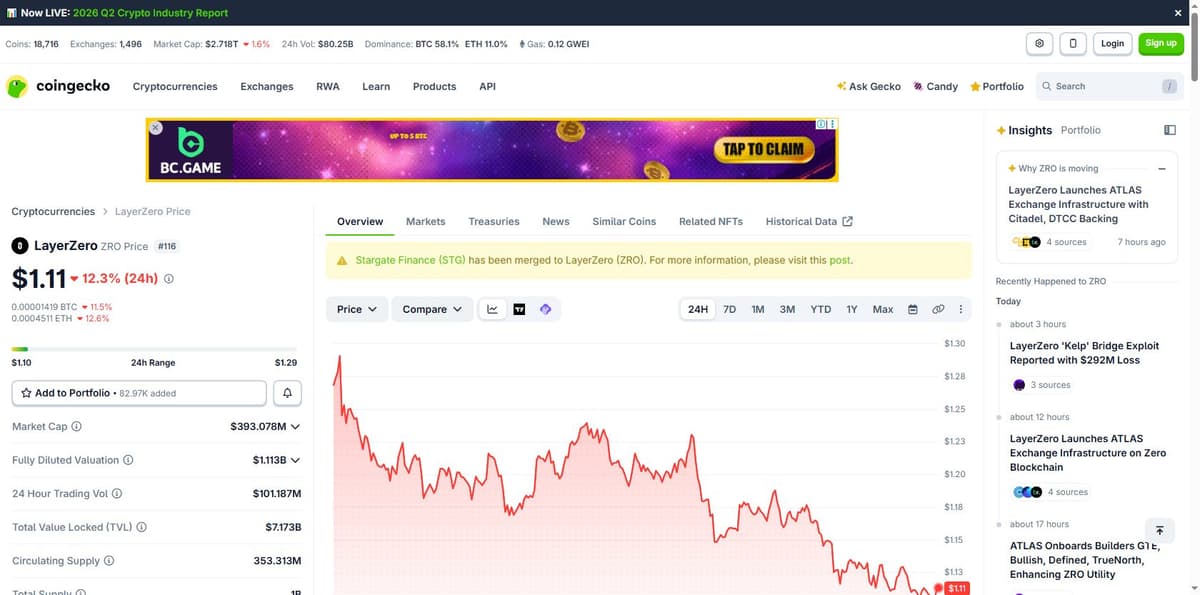
$ZRO woke up down 12.3% on Wednesday. Anyone who scrolled to CoinGecko’s own insight panel for an explanation got a strange answer: “LayerZero ‘Kelp’ Bridge Exploit Reported with $292M Loss,” timestamped about three hours old.
That headline is real. The timestamp is not.
The Hack That Wasn’t Today’s Hack
DeFiLlama’s own hack registry lists the Kelp bridge exploit under a single date: April 18, 2026. Amount lost, $293 million, near enough to the figure CoinGecko’s feed just recycled that the two are obviously the same event. CryptoNewsLive covered it as it unfolded that spring, including the piece confirming Arbitrum’s fund-return effort in early May and the one closing the loop on Aave’s own $293M rsETH exposure by May 31.
None of that happened today. Whatever aggregator feeds CoinGecko’s “recently happened” module appears to have re-surfaced a four-month-old story with a fresh clock on it, a known failure mode for scraped insight feeds and a reminder that a scary headline on a token’s own page is not the same thing as a verified, dated event.
So if an old hack didn’t do this, what did?
What Actually Pumped It First
Zoom out to a week and the chart tells a completely different story than “down 12%.” ZRO is still up 42.25% over seven days and 29.49% over thirty, according to Coinglass. The trigger was LayerZero’s ATLAS exchange infrastructure, launched on its Zero blockchain with backing reported from Citadel Securities and DTCC, a genuinely rare pairing of a small-cap altcoin with two of Wall Street’s own market-structure names. The daily chart shows exactly what that kind of headline does to a token that had spent six months grinding from $2.50 down toward $0.70: a violent, near-vertical spike to $1.24 in a matter of days.
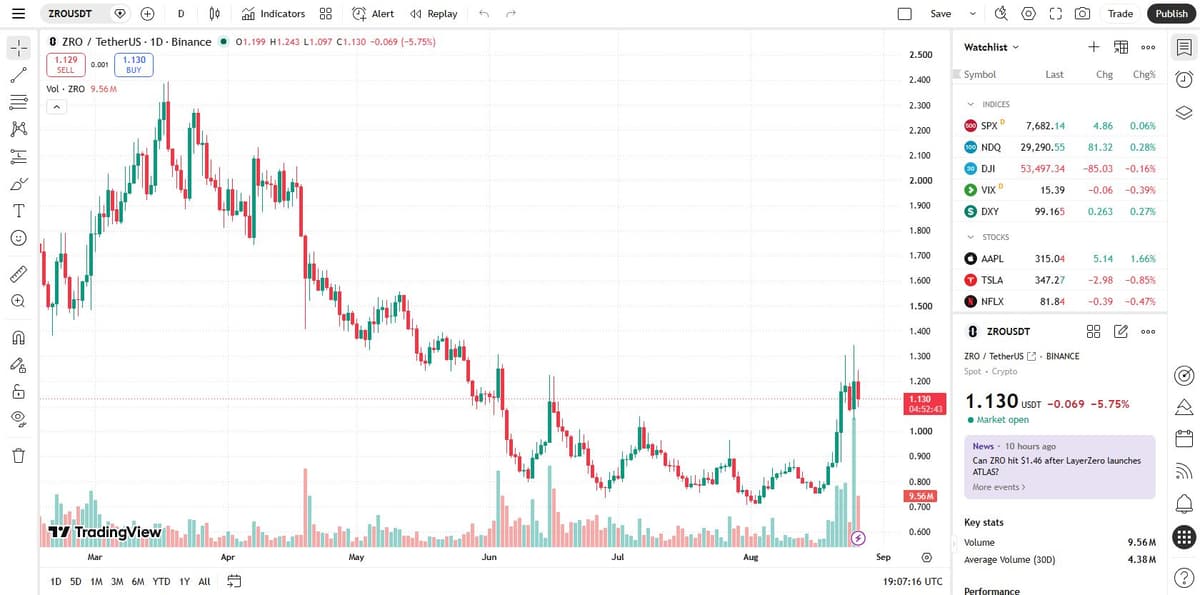
Wednesday’s drop is that spike partially unwinding, not a new negative catalyst arriving.
Then the Longs Got Squeezed
The mechanism behind the size of the drop shows up in the derivatives data. Coinglass puts Binance’s top-trader long/short position ratio on ZRO at 2.73 to 1, meaning the accounts with the biggest positions were overwhelmingly betting the rally would continue. OKX’s book showed a similar 1.82 to 1 long skew. When the price turned, those positions became the fuel: 24-hour ZRO futures liquidations hit $495,290, and $379,360 of that, 76.6%, came from long positions getting forced out, against just $115,940 on the short side.
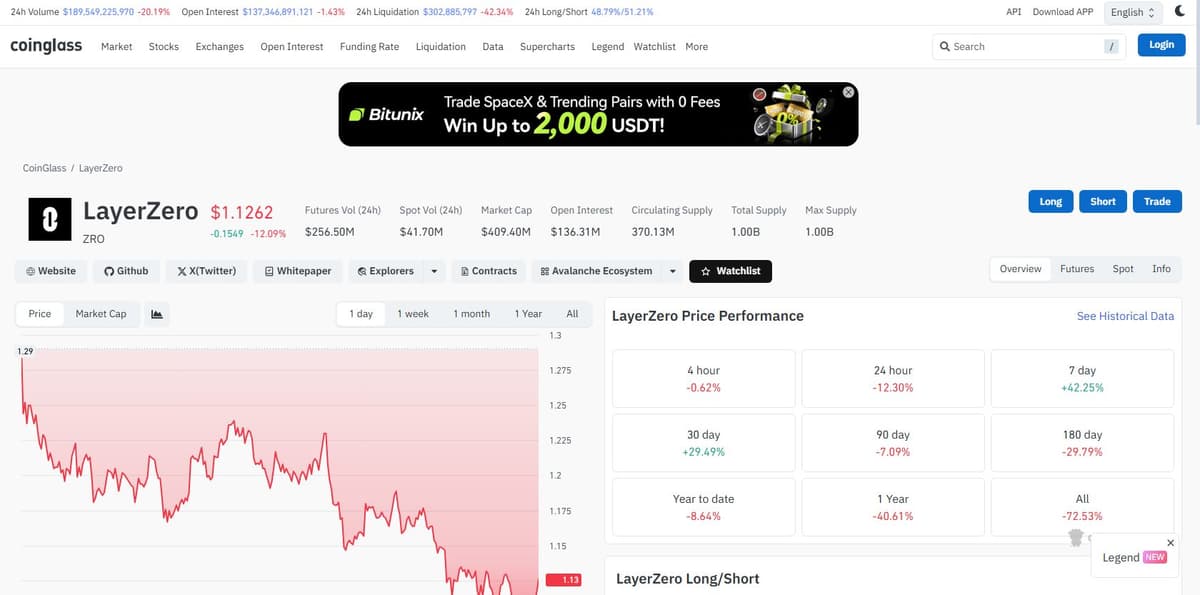
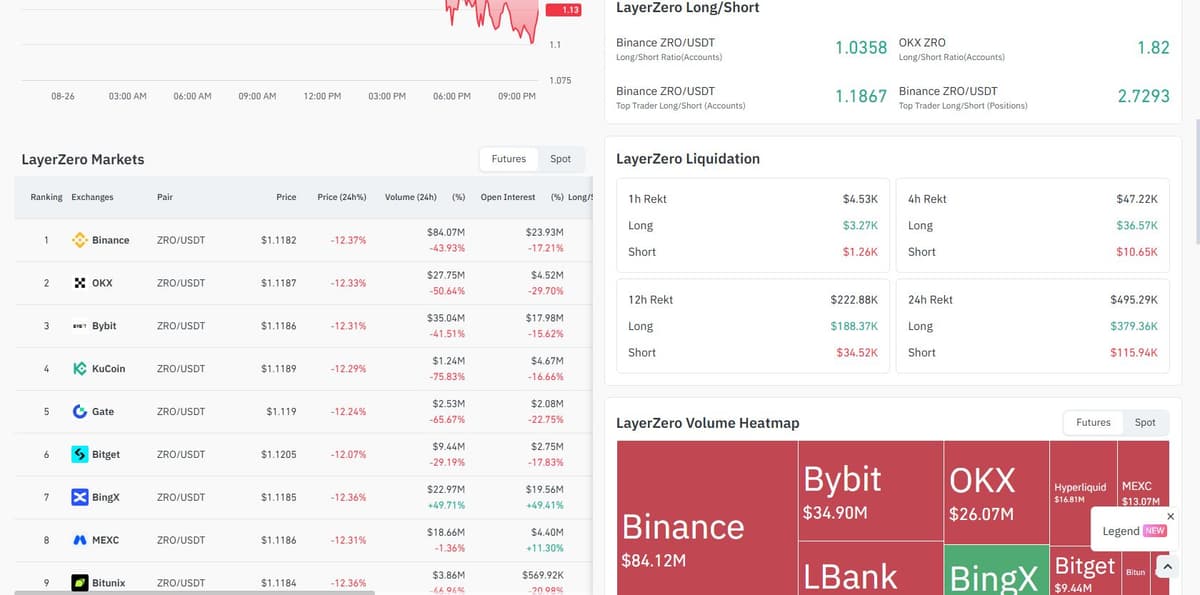
That is a textbook margin-debt unwind sitting on top of a fundamentally real pump. The ATLAS news was genuine. The crowd that piled into borrowed longs on top of it was not braced for a pullback, and the market obliged.
No Unlock, No Macro Excuse
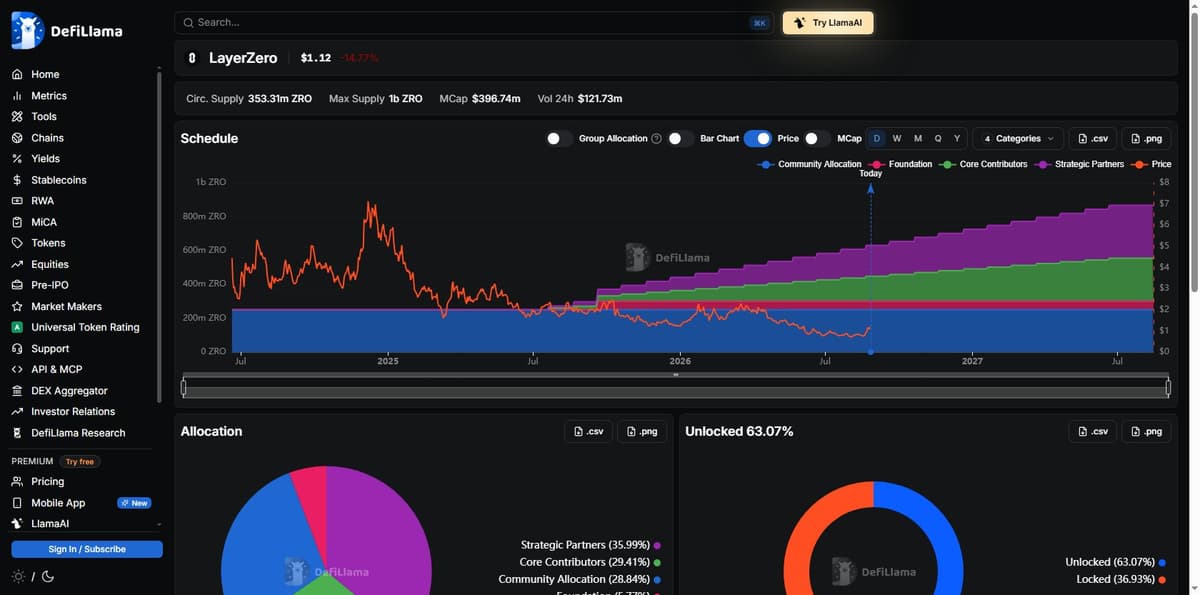
Two other explanations are worth ruling out explicitly. DeFiLlama’s own vesting schedule for ZRO shows a smooth, linear release curve with no cliff landing anywhere near today; the last real unlock event, 25.71 million ZRO, happened six days ago on August 20 and was already priced in well before Wednesday. And this was not a market-wide risk-off day either. Bitcoin traded roughly flat and Ethereum was mildly green at the same hour ZRO was down double digits, uncorrelated with the broader tape.
A Quieter Bridge Business Underneath the New One
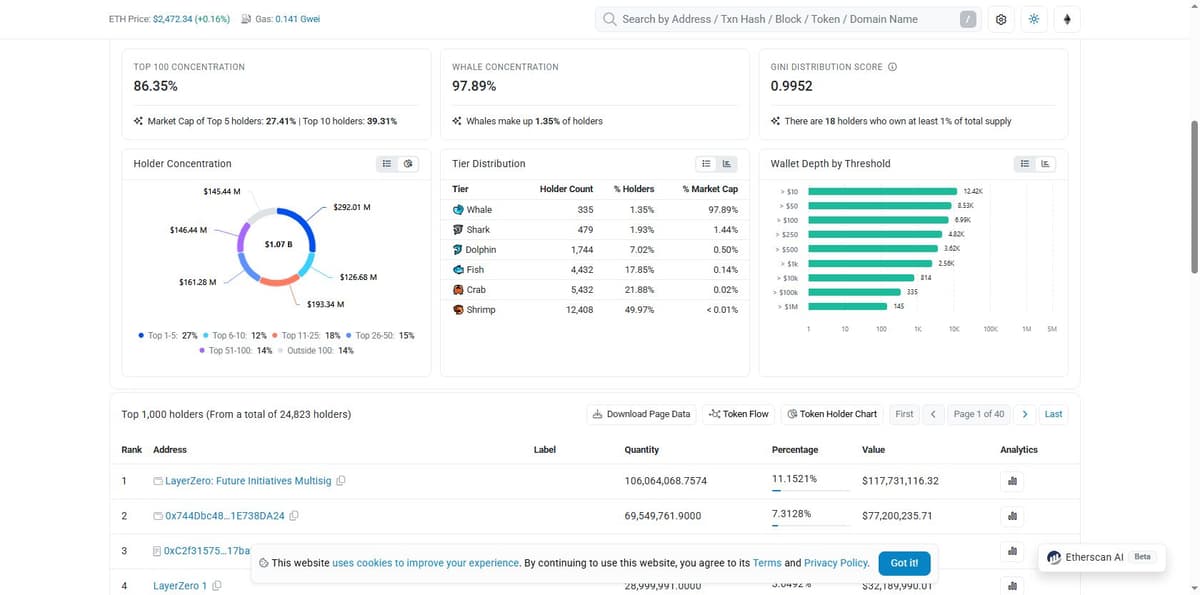
There is a background tension worth noting. Even as ATLAS launches with institutional fanfare, LayerZero has spent the past month winding down parts of its older business, ending off-chain support for chains in three separate announcements since late July, most recently a plan to drop support for 15 networks within 30 days. Holder concentration adds its own layer of context rather than alarm: Etherscan shows the top 100 addresses controlling 86.35% of supply, but the single largest holder is LayerZero’s own labeled Future Initiatives Multisig at 11.15%, not an anonymous whale. A Gini score of 0.9952 looks extreme on paper for a token this size, though that is common across the sector once a project’s own treasury and vesting contracts are counted among the “holders.”
None of that changes the read on today specifically. A real institutional catalyst pumped the token hard into the weekend, borrowed money piled on top of it, and Wednesday’s drop is that debt clearing out, not a new problem at LayerZero itself.
The stale hack alert making the rounds is exactly that: stale.