Seeker was already ripping before anyone offered it leverage. Then a perpetuals exchange told traders it was moving, price topped out 75 minutes later, and $SKR has been bleeding ever since.
The Solana Mobile phone token sat at $0.00682 at midnight UTC on August 5. By 1am it was $0.00850, up 24% with zero help from anyone. Two hours in, at 02:45:41 UTC, Phoenix, the verified on-chain perpetuals exchange, posted three lines to its followers: “$SKR is moving. Trade it at 3x leverage on Phoenix.” A chart of the pump rode along with it.
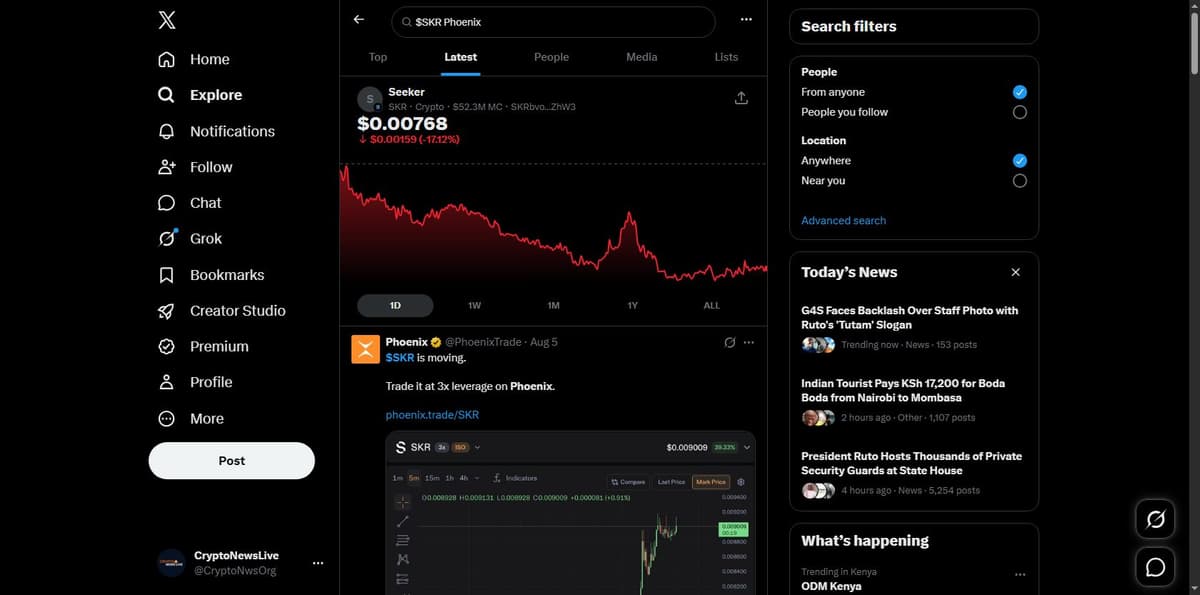
The Peak Came 75 Minutes Later
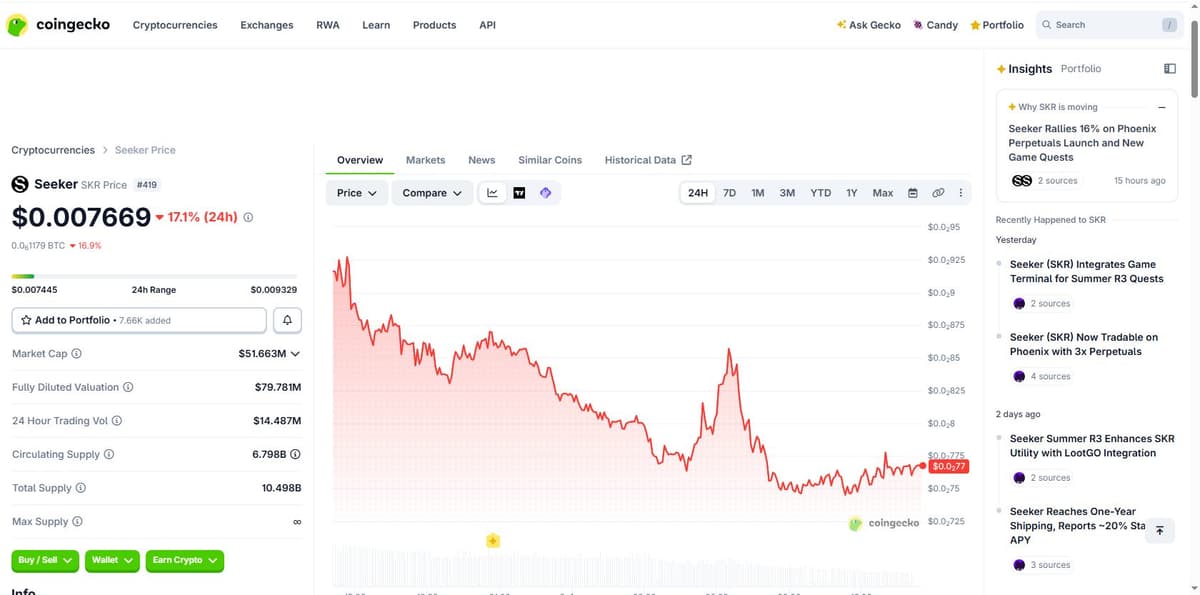
Price kept climbing after the post. $0.00919 by 3am. A high of $0.009706 at 4am, the top of the entire move, confirmed against CoinGecko’s own hourly price history for the token. Then it turned. Not sharply at first. A grind lower through the morning, a small bounce, another leg down. By the time this was written the token traded at $0.0077, down 17.1% on the day and roughly 20% off that 4am top.
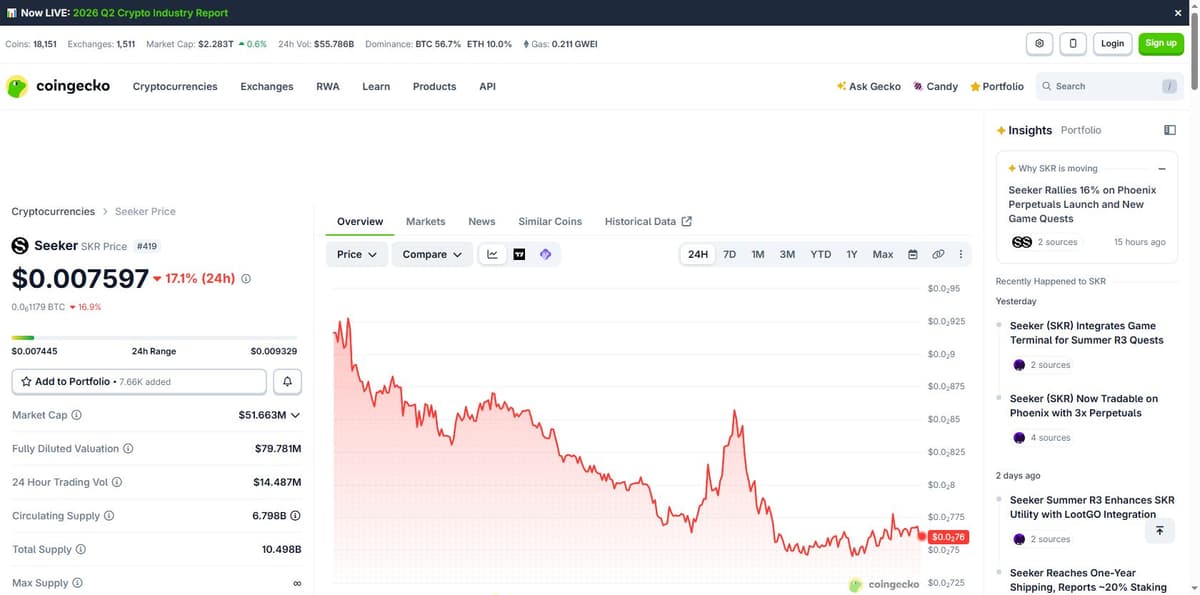
Nobody forced the leverage on anyone. Traders opted in. But the timing did the token no favors. Retail was already leaning long going into the top: Binance’s own top-trader data put the account-level long/short ratio at 2.05 to 1, per Coinglass. When SKR rolled over, the unwind hit those longs hardest. Of $95,110 liquidated across the market in 24 hours, $69,780 came from long positions and just $25,330 from shorts, a 73/27 split in favor of pain on the long side.
Futures Ran the Show, Not Spot
Three times more capital traded SKR futures than SKR spot over the same day, $42.26 million against $14.00 million, open interest sitting near $8 million against a market cap in the low fifty millions. That is a token whose price gets decided in the derivatives book first and the spot book second.
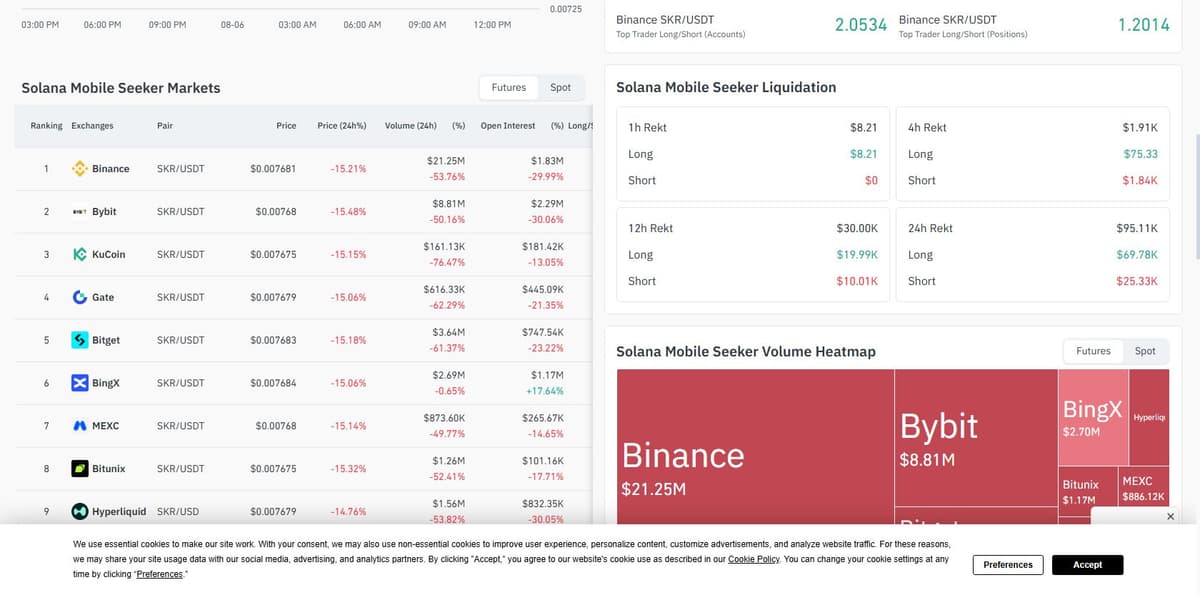
On-chain tells the same story from the other side. Seeker’s own Solana pools show barely $1.26 million in combined liquidity and $743,757 in 24 hour DEX volume, according to Solscan. Real trading happens on Upbit, Bithumb, Coinbase, Bybit, Kraken, KuCoin, Gate, Bitget and MEXC instead, a spread across nine-plus venues that most tokens outside the top 400 never get.
No Insider Wallet, No Unlock, No BTC Excuse
Three obvious suspects, checked and cleared. Bitcoin moved just 0.8% over the same 24 hours SKR fell 17%, and the seven day correlation between the two computed out to negative 0.04, functionally nothing. This was not a market-wide flush wearing a Seeker costume.
Team and Solana Labs allocations sit under a cliff that does not open until January 2027. No scheduled unlock landed this week. And the token’s on-chain authority belongs to a Squad Vault multisig, not a single wallet, with 37,694 total holders spread across the base per Solscan’s own count. Whatever dropped this token, it was not a lone insider cashing out.
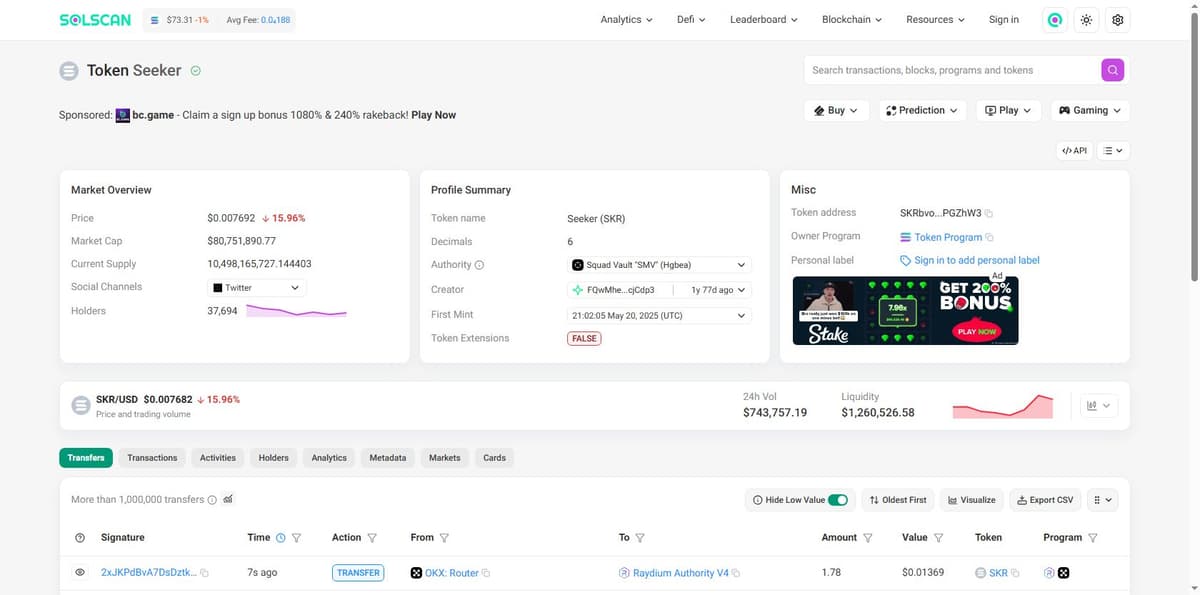
One background factor deserves a mention without being crowned the cause. Solana Mobile allocated $27 million in SKR to a second round of its Seeker Summer rewards campaign, with claims opening July 30. A large, ongoing incentive pool sitting a week upstream of a sharp reversal is exactly the kind of steady claim-and-sell pressure that does not show up as a single dramatic transaction, just a headwind under everything else.
The Chart Called It Three Times
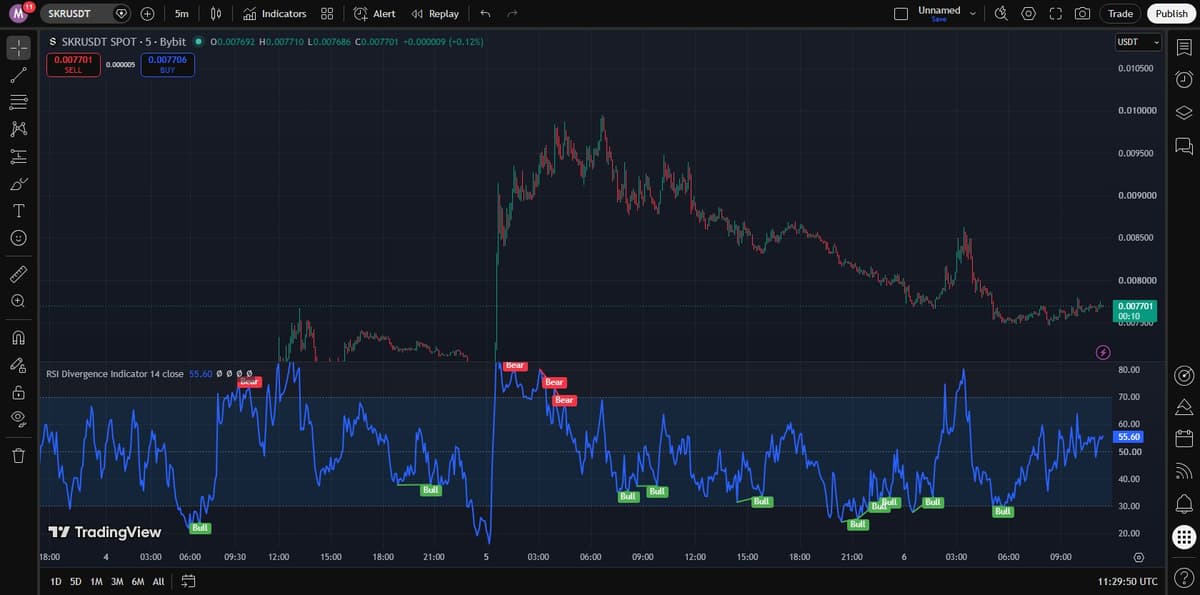
Technical readers had a warning before the reversal even started. Bybit’s SKRUSDT chart, run through TradingView’s RSI Divergence Indicator, printed three separate bearish divergence flags clustered right at the 4am peak, RSI failing to confirm the fresh price high. The signal has since cooled to a neutral 55.6, no fresh bullish divergence yet, no confirmation the bleed is done either.
If the Seeker Summer campaign keeps paying out through its stated August 30 close, fresh claimed tokens will keep landing on wallets with an easy exit across nine exchanges, a mechanical drip that argues for more of the same grind rather than a clean bottom. If instead the reward pool thins out and the 2:1 long crowd that just got flushed stays away from re-leveraging, the token has room to stabilize on the broad CEX distribution and multisig-controlled supply that never looked like the problem in the first place.