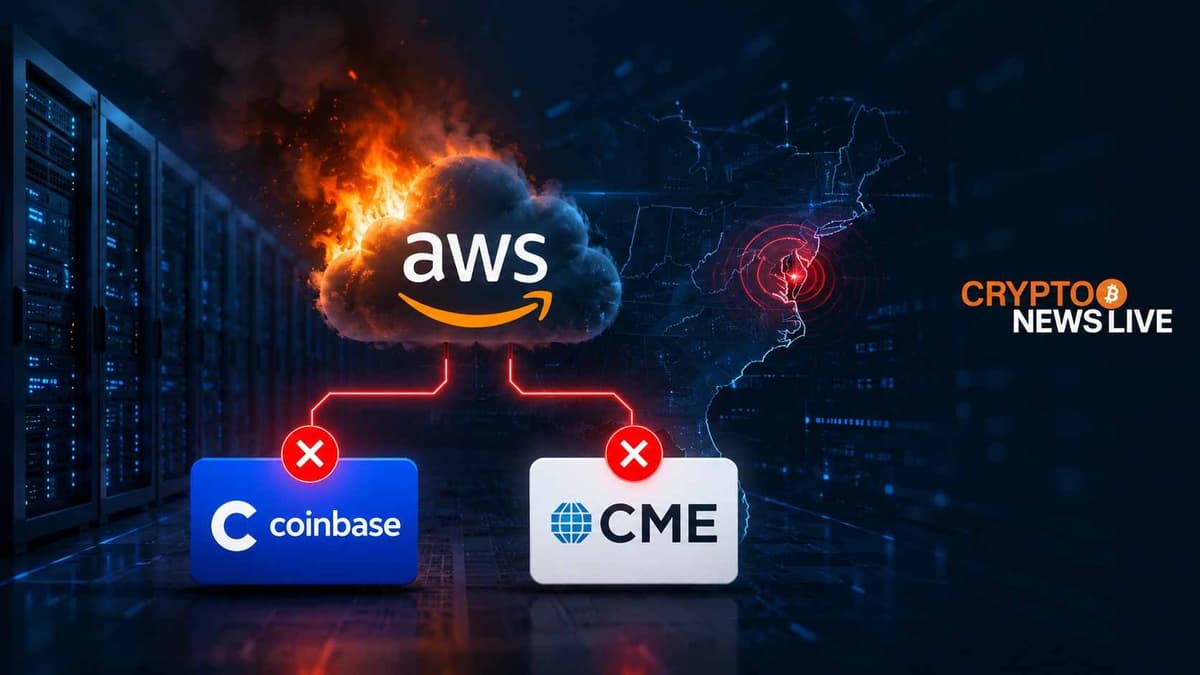
Coinbase traders could not execute orders for more than six hours on May 7. The reason had nothing to do with the markets. A single AWS data center in Northern Virginia overheated, and the fallout moved fast.
Amazon Web Services confirmed the problem came from availability zone use1-az4, part of its US-EAST-1 region. That facility is the oldest and largest AWS hub in the United States. The thermal event triggered a power loss. Hardware on the affected racks took damage.
Coinbase Freezes All Orders Mid-Session
“Coinbase experienced service disruptions due to increased temperatures in the affected Availability Zone (use1-az4) in the AWS US-EAST-1 Region. We will begin the process to re-enable trading on our markets shortly. All markets would be placed in Cancel Only mode before we move to re-enable trading.”
Cancel Only mode means exactly what it sounds like. Traders could pull existing orders. They could not place new ones. No market orders. No limit orders accepted.
Coinbase first flagged the issue around 6 PM Pacific time, pointing users to the AWS health dashboard for updates. The exchange was direct that funds were not at risk, though it gave no estimate on when full trading would return. Six hours passed before all markets came back online, around 1 AM PDT.
AWS by that point had shifted traffic away from the impacted zone for most services. More cooling capacity came online. Still, in a later update the company said restoring the remaining affected systems was taking longer than expected, and it had no timeline for full recovery.
Solana and ALEO sends and receives also ran into delays during that window. Fiat services stayed up.
CME Also Hit, Says Nothing About the Cause
The world’s largest derivatives marketplace ran into its own problems the same evening. CME Group posted a status update saying essential maintenance had been completed and users could log back into CME Direct. It did not name the cause. It did not say whether the AWS outage was involved.
According to Reuters, neither CME nor AWS responded to requests for comment outside regular business hours.
Worth noting: AWS engineers had detected the problem at 5:25 PM PDT on May 7. By 6:47 PM, they issued a warning that other AWS services depending on the affected EC2 instances and EBS volumes in that zone may also face impairments. The recovery effort on the remaining racks was still ongoing more than 12 hours after the incident began.
Coinbase had reported its Q1 2026 earnings the same day. The numbers showed a GAAP net loss of $394.1 million, its second consecutive quarterly loss. The company also cut 14% of its workforce as part of a shift to AI-driven operations. Hours after publishing those results, its trading platform went dark.
Traders on X Were Not Subtle About It
@Liberals_suckM wrote on X:
“This is INSANE. What a failed system. I’m switching to Kraken. Blame it on single region AWS dependency. Is there even a smart trader that cares working over there?”
@dennist40555848 posted on X:
“ive seen this same thing over and over for years with this place they have control of all our crypto and money and they do whatever they want with it we cant get back to trading like the rest of the world until they finish using it.”
@dariolega1970 flagged a specific concern on X:
“Amazon has nothing to do with this, they are letting you buy but not sell, figures.”
@axmbne put it shorter on X:
“Shit show. Why anybody uses Coinbase in APAC let alone in the US is beyond me.”
That last one matters. Coinbase’s Q1 report put its crypto trading market share at an all-time high of 8.6%. Retail derivatives revenue crossed 200 million dollars annualized. Prediction markets scaled to $100 million annualized in two months. Then the platform went down.
Not the First Time This Has Happened
AWS was hit by a major outage in October 2025. That one caused disruptions across thousands of platforms globally, including Snapchat and Reddit. It was the largest internet disruption recorded since the CrowdStrike malfunction in 2024 that knocked out hospital systems, banks, and airports.
A month after that, CME Group suffered one of its longest trading outages in years. Stocks, bonds, commodities, currencies. All halted for hours. CME blamed a cooling failure at CyrusOne data centers in Chicago.
Now the same pattern. A data center gets too hot. Financial platforms go down. No timeline for recovery.
The Northern Virginia facility sits at the center of U.S. internet infrastructure. When it fails, the blast radius is wide. Coinbase discovered that again on May 7, in the middle of the night, six hours after traders stopped being able to sell.
AWS has not published a post-incident report as of the time of publication.
UPDATE
After some few hours of us posting this article- coinbase posted on x that it has resolved the issue and everthing is running as expected