Bitcoin is pressing into a price zone with very little historical trading activity. That thinness cuts both ways.
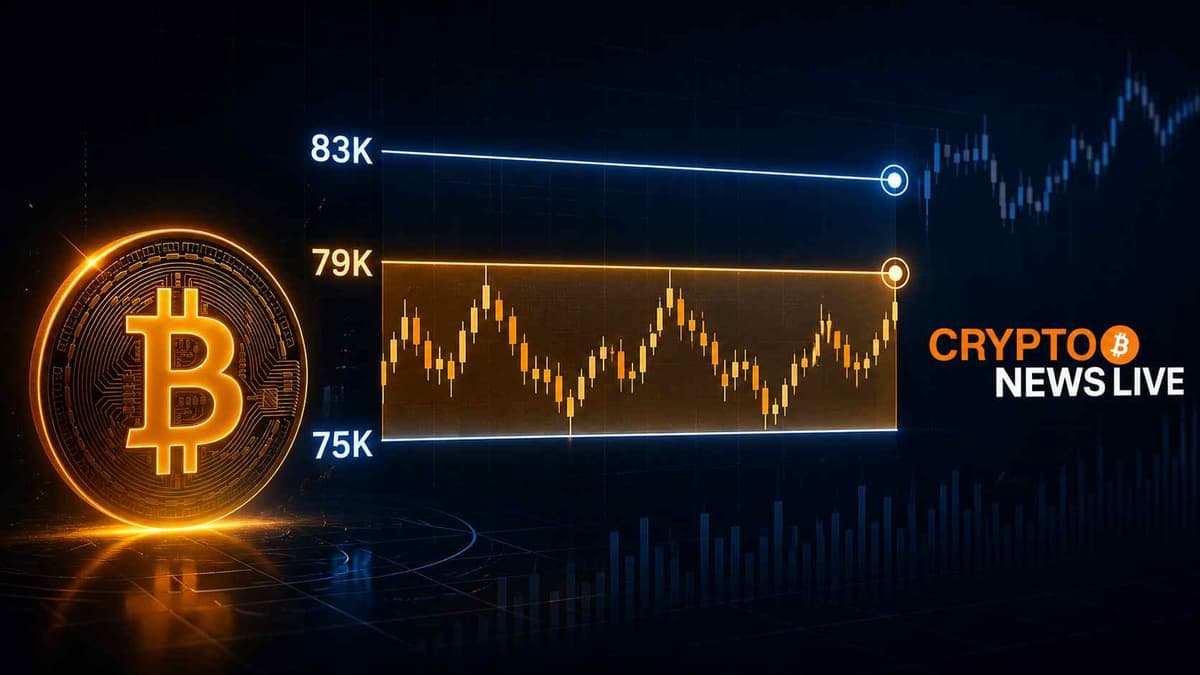
On-chain data shared April 26 by crypto analyst Darkfost on X shows BTC currently trading inside what the supply distribution heatmap marks as a white zone, a band running from roughly $75,000 to $83,000. White zones on such heatmaps indicate minimal past exchange activity. Fewer historical transactions in a price range means less anchored supply to absorb either buying or selling. The move through that band, when it comes, could be fast.
Two Cost-Basis Lines Both Say Resistance
The heatmap, which Darkfost posted on X, overlays three separate data sets onto the same chart: supply distribution clusters, the True Market Mean, and the Short-Term Holder (STH) Cost Basis. Right now, all three are pointing at the same ceiling.
The True Market Mean, a volume-weighted average that strips out dormant or lost coins, sits near $79,000. The STH Cost Basis, reflecting average entry prices for coins that moved in the last roughly five months, is also trending around that same level. Two independent cost-basis readings stacking at the same price is not something BTC has cleared without a fight in past cycles.
“Bitcoin is approaching an important confluence zone,” Darkfost said on X, noting the heatmap combines distribution clusters, the True Market Mean, and STH Cost Basis all in one read.
What makes this reading distinct from how other coverage has framed it, the $83,000 figure matters more than the $79,000 one.
The Coinbase Adjustment Changes the Ceiling
Standard STH cost basis calculations include all on-chain transfers. But Darkfost applies a specific adjustment: removing BTC flows tied to Coinbase, which regularly moves large internal balances that do not reflect real investor buying or selling decisions.
“Personally, my adjusted STH Cost Basis, accounting for BTC moved by Coinbase, is closer to $83,000,” Darkfost wrote on X.
That gap is significant. It means the real resistance from underwater short-term holders starts not at $79,000 but at the upper edge of the white zone itself. The whole band from $75,000 to $83,000 essentially becomes a compression area with walls at both ends. Not a gap to run through freely. A zone to grind through, or get rejected from entirely.
This matters most to anyone holding BTC bought between late 2024 and early 2025. Those holders are sitting near breakeven or small losses depending on entry price. A test of $79,000-$83,000 is when that group decides whether to cut exposure or hold for further gains.
What a Test of These Levels Will Signal
The setup Darkfost describes has three realistic near-term paths. A strong volume break above $83,000 would flip the entire white zone from resistance to support, which would read as a clean continuation signal. Rejection at $79,000 or $83,000 reopens the case for a liquidity sweep back toward the denser supply clusters sitting below $75,000.
The third path, and probably the nearest-term one, is sideways. Grinding inside the band until one side runs out of patience.
Darkfost’s note that BTC will need to test these levels soon is the core point. The setup does not resolve without price making a real attempt at $79,000. Whatever happens at that first touch, the reaction will be more informative than weeks of range trading below it.
Glassnode’s Cost Basis Distribution Heatmap tool, which tracks supply density across price levels, provides the underlying framework Darkfost uses for this type of read. The methodology is documented on the Glassnode platform.
BTC’s next major directional leg is likely to get decided inside a $8,000 range. That is the window. How it closes will tell the rest of 2026.