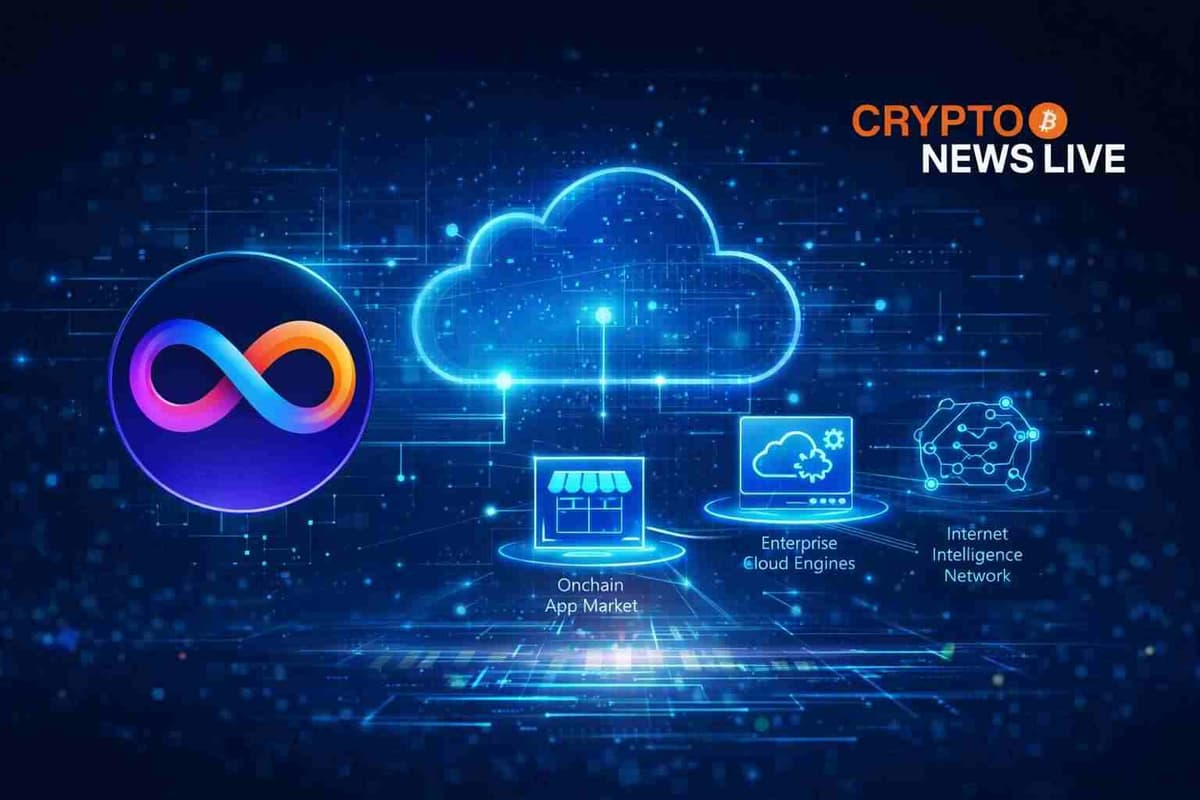
DFINITY’s Caffeine V3.0 is set to go live on the Internet Computer on April 7, bringing with it a stack of features that push ICP well beyond the crypto-native development audience it has served since Caffeine first launched in July 2025. The upgrade centers on natural language app building, but the scope of what ships alongside it runs considerably deeper.
Dominic Williams, DFINITY founder and chief scientist, announced the upgrade on X, describing it as “more than the new features it packs.” According to Williams on X, “what can be built on the Internet Computer through chat alone shall advance by a quantum leap.”
Open App Market Changes the Build Economy
One of the more consequential features arriving with V3.0 is a public App Market. For the first time, all Caffeine users will be able to publish apps to the market, allowing other users to install copies and remix them. Apps pulled from the market are mutable and can be changed after installation.
That last detail matters. It sets up a reuse model where individual builders get direct economic exposure to work they publish. Williams has confirmed monetization features are coming shortly after launch, which will feed into what DFINITY describes as an open-source onchain economy built around AI-driven development.
BSC News reported on X that the V3.0 upgrade “enables natural language-based application development” and introduces cloud engines that let enterprises deploy private subnets using a mix of sovereign nodes and AWS instances to hit specific throughput targets. The post on X from BSC News also flagged the Internet Intelligence Network as a key element, noting it would provide verifiable AI inference at costs below what centralized GPU clouds currently offer.
Cloud Engines and What They Actually Do
Cloud engines are, in structural terms, private subnets controlled via a configuration panel. Enterprises using them can select the nodes that power their environment, including cloud-on-cloud nodes running on AWS infrastructure alongside traditional sovereign hardware.
That flexibility addresses two problems that have kept enterprise cloud buyers away from decentralized infrastructure. First, regulatory compliance: nodes can be filtered by geography or jurisdiction, which matters for GDPR and similar frameworks. Second, throughput: query capacity scales horizontally by adding nodes, and update throughput scales by splitting engines, without requiring any changes to the underlying software.
Apps running on cloud engines still carry the tamperproof properties of the Internet Computer. There is no requirement for a dedicated security or systems administration team on the customer side, according to Williams.
Verifiable Inference and What IIN Adds
The Internet Intelligence Network is a separate proposal Williams says DFINITY will bring to the NNS governance system. It runs on community-operated hardware. The technical claim at the center of IIN is that inference will be verifiable, meaning the entity sending a prompt can confirm the result has not been altered by the nodes processing it.
Williams noted on X that in standard mode, “there will be no discernible difference in cost or performance.” Higher security modes, where every node checks inference independently, scale cost linearly but keep latency impact small. He described inference verification as “technically challenging and novel” and said the work will advance the current state of the art.
That verification piece distinguishes IIN from other decentralized GPU networks. Williams was direct on X about the difference: he described certain competing networks as using token appreciation to drive what he called unsustainable subsidization, a dynamic IIN is designed to avoid by deriving its cost advantage from the underlying technology.
The $1 Trillion Number Behind the Roadmap
Williams placed V3.0 inside a larger market frame. The global cloud market is predicted to reach $1 trillion in revenue during 2026, with $2 trillion projected by 2030. ICP’s case, as Williams laid it out on X, is that onchain cloud is the first genuinely new decentralized network functionality to carry mass-market potential after tokens and DeFi. And he argued it is happening exclusively on the Internet Computer.
Additional features on the roadmap include ICP Blob Storage, already available to Caffeine on an exclusive basis, which will eventually allow Caffeine apps to store data at what DFINITY calls the world’s best dollar-per-gigabyte rate. That would make the platform competitive for storage-heavy applications like photo sharing or platforms that archive recorded video.
A “Caffeine Snorkel” feature is also planned for a later stage. It would enable automatic migration of legacy applications from centralized infrastructure to the Internet Computer, lowering the barrier for businesses that want to move existing products rather than rebuild from scratch.