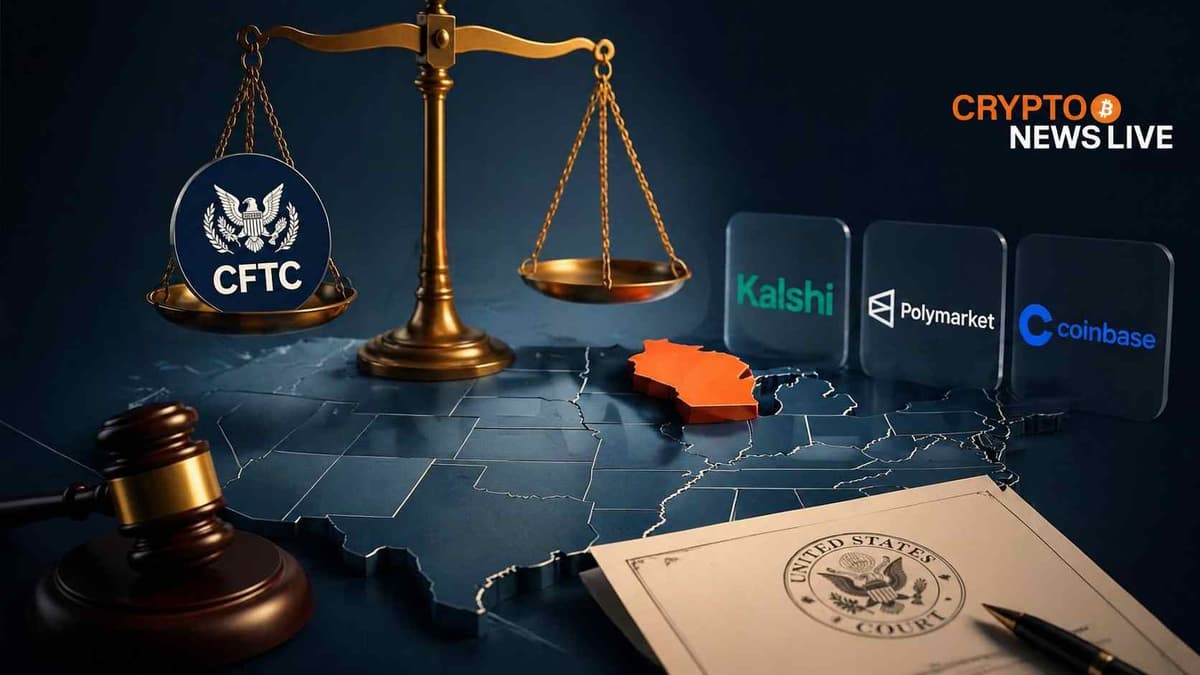
The Commodity Futures Trading Commission filed a federal lawsuit against Wisconsin on April 28, 2026, days after the state sued five CFTC prediction markets jurisdiction platforms it accused of running unlicensed gambling operations. The move follows a near-identical action against New York just days prior.
Wisconsin had filed civil suits on April 23 against Kalshi, Polymarket, Crypto.com, Robinhood, and Coinbase in Dane County. The state argued their sports-related event contracts violated state criminal gambling law under Wis. Stat. § 945.03(1m). Attorney General Josh Kaul said the companies were facilitating illegal sports betting regardless of how they labeled the products.
Wisconsin Is Not the First. Not Even Close.
The CFTC has now filed lawsuits against Connecticut, Illinois, Arizona, New York, and Wisconsin. A federal court in Arizona issued a temporary restraining order blocking the state’s criminal prosecution of a CFTC-regulated company, the Commission confirmed. That case, still active, gives a preview of how federal courts may respond to state-level enforcement.
Legal disputes now span at least 16 states, with cases involving cease-and-desist orders, civil suits, and in Arizona’s case, attempted criminal prosecution. The CFTC has also filed amicus briefs in the U.S. Court of Appeals for the Ninth Circuit and the Supreme Judicial Court of Massachusetts. None of the top outlets covering the Wisconsin lawsuit mapped this full picture.
CFTC Chairman Michael S. Selig addressed Wisconsin directly. As Selig wrote on X, according to Chairman Selig on X:
“Today, the CFTC sued the State of Wisconsin for encroaching on its exclusive legal authority over prediction markets. We won’t be intimidated by overzealous states seeking to nullify federal law.”
The Core Fight: Gambling Law vs. Federal Derivatives Oversight
Congress gave the CFTC exclusive jurisdiction over event contracts traded on designated contract markets decades ago. The Commission says states cannot override that by reclassifying the products as bets under local gambling statutes. Wisconsin is not buying that argument. Kaul said the companies’ own marketing betrays them.
Kalshi’s Instagram ads called the platform “The First Nationwide Legal Sports Betting Platform.” Polymarket described itself as a place where users “bet on the outcome of future events.” Wisconsin prosecutors used that language directly in their filings. The platforms say those words are marketing shorthand, not legal definitions.
Coinbase Chief Legal Officer Paul Grewal pushed back hard on the state’s position. He said the Wisconsin suit is exactly the regulatory patchwork Congress replaced when it created the CFTC in the first place. Grewal added that Congress intended prediction and derivatives markets to operate under a single national framework, not be carved up across 50 states by local gaming regulators.
Third Circuit Already Sided With Kalshi
The Third Circuit ruled earlier in 2026 that the CFTC’s decision not to block Kalshi’s contracts effectively settled the jurisdictional question in Kalshi’s favor. That ruling has not stopped states from filing. Wisconsin, New York, and others have pressed ahead anyway, creating a direct conflict between federal appellate decisions and active state enforcement actions.
Robinhood and Coinbase both route prediction market orders through Kalshi’s platform. That makes them co-defendants in Wisconsin’s third complaint, even though neither company operates an independent prediction market. Both said their products fall under federal oversight and they intend to fight the claims.
The CFTC’s official press release stated Chairman Selig’s position clearly: states cannot circumvent the directive of Congress. Selig said the message to Wisconsin is the same one already delivered to New York, Arizona, and others — interfere with federal financial market regulation and the CFTC will sue.
What Happens Next
With active litigation in at least six states and a federal appellate ruling already in the platforms’ favor, the case is widely expected to reach the U.S. Supreme Court. A Supreme Court ruling would determine once and for all whether event contracts are federally regulated financial instruments or state-regulated bets. Until then, platforms operate under legal uncertainty in multiple jurisdictions simultaneously.
There is a separate layer to this. Wisconsin lawmakers recently passed a bill that could bring licensed online sports betting to the state, but tribal negotiations and a long legislative path remain. That process, observers note, could take years. In the gap between where state law is now and where the platforms operate today, the lawsuits live.