Chainlink LINK address activity just hit levels not seen since September 2025. On May 9th, 282,170 unique LINK addresses were active on the network. The following day brought 264,090 more. Both figures, reported by SantimentData on X, represent the two highest active address days on the Chainlink network in eight months.
The timing lines up with something that happened two days prior. Not a tweet. Not a listing. An infrastructure decision worth hundreds of millions of dollars.
Solv Protocol Pulls $700M Away From LayerZero
On May 7th, Solv Protocol confirmed it would phase out LayerZero bridge support for SolvBTC and xSolvBTC across Corn, Berachain, Rootstock, and TAC. Over $700 million in tokenized Bitcoin assets would now route exclusively through Chainlink’s Cross-Chain Interoperability Protocol.
Will Wang, Solv’s Chief Technology Officer, said the switch came down to one thing.
“Security is the core of everything we build at Solv, and our migration to Chainlink CCIP represents our highest commitment to that principle.”
The decision followed a $292 million exploit on a LayerZero-powered Kelp DAO bridge in April. Attackers, suspected to be North Korea’s Lazarus Group, drained 116,500 rsETH by targeting a single-verifier configuration. LayerZero and Kelp DAO then publicly blamed each other for the setup. Kelp says the 1-of-1 verifier arrangement was LayerZero’s own onboarding default. LayerZero says Kelp chose it against recommendation.
Kelp had already announced plans to move its rsETH infrastructure to Chainlink CCIP before Solv made its own announcement. Together, both migrations shift close to $1 billion in DeFi assets away from LayerZero.
Johann Eid, Chief Business Officer at Chainlink Labs, described what’s happening across the industry.
“We are speaking to many teams across the industry and there is a clear and accelerating trend where protocols like Solv are migrating to Chainlink in a flight to quality reminiscent of the rapid shifts during DeFi summer.”
Active Address Data Points to Real Utilization
The on-chain numbers from Santiment are harder to dismiss now that the migration context is clear. A spike in unique active addresses does not come from speculation alone. Smart contract interactions, bridge routing changes, and protocol-level activity all contribute to that metric moving the way it did on May 9th and 10th.
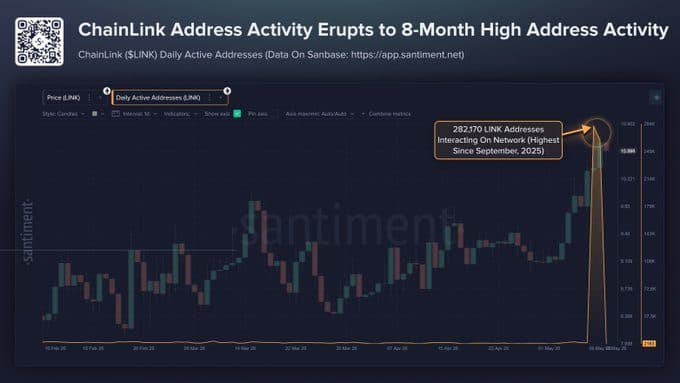
According to SantimentData on X, the network had not seen activity at these levels since September 2025.
When metrics like this erupt this sharply after months of relative quiet, it almost always means something happened at the protocol level. That’s the framing Santiment put on it directly. Not price action. Protocol activity.
Whale behavior tells a similar story. SantimentData on X also reported that wallets holding between 100,000 and 10 million LINK added 32.93 million coins in just 30 days. That’s a 7.7% supply increase concentrated in those wallet tiers alone.
LayerZero Fallout Keeps Spreading
The Kelp DAO exploit did more than cost one protocol $292 million. It forced every DeFi team running on LayerZero’s OFT standard to revisit their own configurations. Forty-seven percent of LayerZero applications reportedly use the single-verifier setup Kelp was running. LayerZero has since said it will no longer sign messages for apps still using that model.
Chainlink’s CCIP runs three independent oracle networks per cross-chain route. If one path is compromised, the other two stay intact. That design is what Solv and Kelp both cited when explaining the switch.
The Chainlink reserve also added LINK coins worth $1.1 million recently, while roughly 13.5 million LINK coins exited crypto exchanges, creating a tighter available supply according to data cited by ETHNews.
LINK was trading near $10.52 as of May 11th, up roughly 13% from $9.32 one week prior, based on Coinbase data.