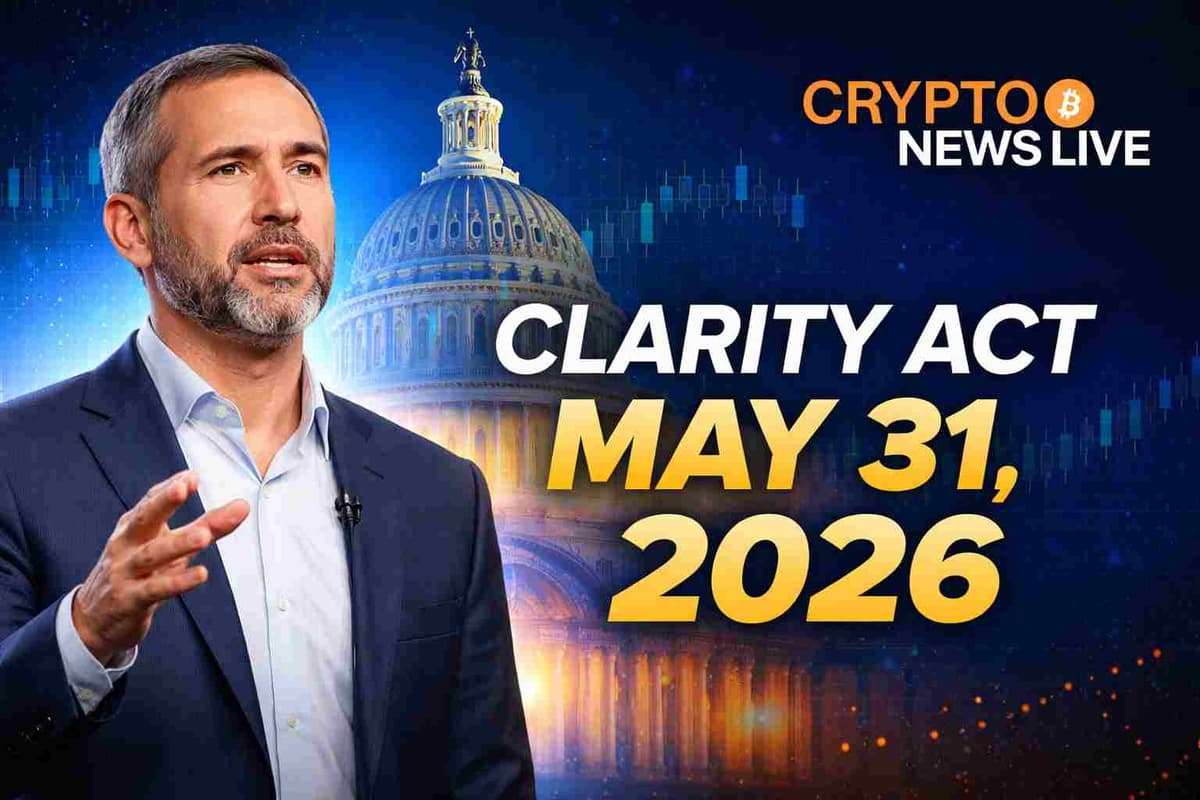
The CLARITY Act may be closer to passage than the Senate calendar suggests. Ripple CEO Brad Garlinghouse, speaking to journalist Jax Alemany in a Semafor interview, offered a window into the psychology he believes will drive the bill across the finish line before summer.
“When people are at their peak frustration, that’s when they finally compromise, and it gets done,” Garlinghouse told @JaxAlemany, as reported by @semafor on X. “I think we’re there. I think we’re there.”
He has moved his target date for Senate passage from April 30 to May 31, 2026. Not a retreat, by his framing. A recalibration based on how Washington negotiations actually resolve.
A Joint Statement That Changed the Calculus, but Not the Risk
Garlinghouse was deliberate in separating two things most commentary has treated as interchangeable: the regulatory relief the industry already received, and the permanent legislative protection it still needs.
The September 2025 joint statement from SEC Chair Paul Atkins and CFTC Acting Chair Caroline Pham drew genuine acknowledgment from him. The agencies produced a coherent token taxonomy covering digital commodities, stablecoins, and digital collectibles. Years of jurisdictional confusion compressed into a single harmonization document.
But Garlinghouse drew a hard line.
“I think what happened with the SEC and CFTC coming together with a joint statement was truly groundbreaking,” he said in the Semafor interview. “And from my point of view, it ended an era of lawfare against this industry. But without codified legislative permanence, you still have the risk that the next version of the SEC comes back to Gensler’s unlawful war on crypto.”
Regulatory interpretations reverse. That is the core problem. A joint statement from two chairs who serve at the pleasure of an administration is not the same instrument as statute. Garlinghouse made that distinction explicit, and it explains why he continues pushing for the bill despite the goodwill already extended by the current regulators.
The Stablecoin Standoff and the Senate’s Unresolved Fight
The Senate Banking Committee postponed its January 2026 markup after more than 100 amendments were filed. The session has not been rescheduled. The primary obstacle running through every stalled round of negotiations is stablecoin yield rules, with traditional banks and crypto firms holding opposing positions on whether digital assets paying returns should face the same regulatory treatment as bank deposits.
Senator Cynthia Lummis of Wyoming, one of the bill’s most consistent Republican advocates, confirmed this month that bipartisan alignment remains a precondition for any floor vote. Prediction market platform Polymarket has tracked odds of CLARITY Act passage in 2026 fluctuating between 60% and 82%, driven by the rhythm of White House negotiation sessions rather than any Senate action.
Garlinghouse acknowledged his earlier 80% confidence estimate for an April 30 passage no longer holds. He attributed the extension to continued bipartisan negotiations rather than any weakening of political will.
Why Corporate Treasurers Are Watching the Same Deadline
There is a layer to this debate that the legislative coverage rarely surfaces. The CLARITY Act is not only about who regulates Bitcoin futures or how token taxonomy gets written into law.
For companies running cross-border payment operations, the bill’s resolution has direct operational weight. Finance and treasury professional Reece Merrick put the problem plainly in a post on X: traditional cross-border payment infrastructure still carries one-to-three day settlement times, fees that eat into margins on every transfer, and liquidity locked in nostro and vostro accounts with zero visibility mid-transfer.
“The CFOs winning on global operations are already making the switch,” Merrick wrote on X. “And @Ripple will guide them through it.”
XRP and RLUSD already function in those payment corridors. The settlement speed and cost profile are documented. The compliance ambiguity is the barrier that regulatory clarity would remove. Without a legislative framework defining what digital assets are and who governs them, institutions operating in regulated jurisdictions carry exposure every time they route a payment through non-traditional rails, regardless of how efficient those rails are.
That is the real-world stakes running underneath the Senate’s timeline debate.
Anti-Crypto Politics and the Midterm Calculation
Garlinghouse touched on a dynamic that has shifted the political math in Washington since the last election cycle. Being anti-crypto no longer generates votes. Being pro-crypto, in districts with meaningful levels of direct and indirect exposure to the industry, increasingly does.
“What we’ve seen as we come up to midterms is being anti-crypto doesn’t get you any votes,” he said in the Semafor interview. “There’s a lot of people who care about this industry who are directly or indirectly involved.”
That calculation is now visible to Senate negotiators on both sides. Treasury Secretary Scott Bessent has described passage as a spring 2026 target. The White House set a March 1 deadline for a stablecoin yield compromise. That deadline passed without a public resolution. Negotiations, both sides said, remain active.
Garlinghouse’s May 31 window is less a prediction than a read of how Washington actually works. Not through consensus building, but through accumulated exhaustion. His position: the Senate is already there.