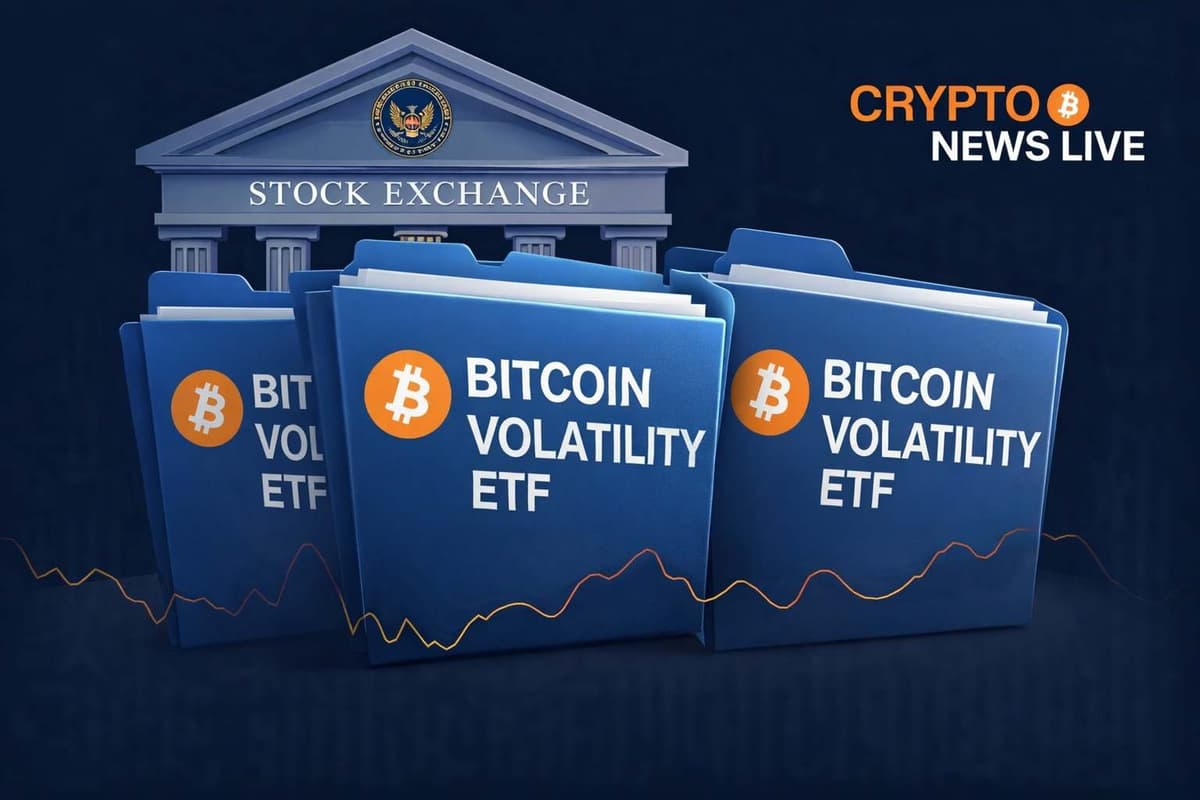
CoinShares has filed registration documents with the U.S. Securities and Exchange Commission for three exchange-traded funds built around Bitcoin volatility — not Bitcoin itself. The filing, submitted March 23, 2026, covers a base fund under ticker CBIX, a leveraged variant, and an inverse variant. All three would trade on Nasdaq.
The suite targets the CME CF Bitcoin Volatility Index, known as the BVX. That index measures implied volatility in CME’s Bitcoin options market over a forward 30-day window — essentially the Bitcoin equivalent of the VIX.
As BSCNews reported on X, according to BSCNews on X, @BSCNews:
“No existing ETF currently offers direct exposure to Bitcoin volatility. The BVX measures implied volatility in CME’s Bitcoin options market over a 30-day window, essentially a $BTC equivalent of the VIX.”
A Bet on Bitcoin Swings, Not Bitcoin
The structure sets these funds apart. Investors would not hold Bitcoin directly. They would not even track Bitcoin’s price. Instead, the funds gain exposure through Bitcoin Volatility Futures Contracts — cash-settled instruments tied to the BVX, traded on CME exchanges registered with the CFTC.
The base fund, CoinShares Bitcoin Volatility ETF, seeks long-term capital appreciation through managed exposure to those futures contracts, per SEC registration documents. Remaining assets go into collateral investments — U.S. Treasuries, commercial paper, and other high-quality securities that serve as margin.
Valkyrie Funds LLC acts as investment adviser under the CoinShares Valkyrie banner. Vident Advisory, doing business as Vident Asset Management, serves as sub-adviser for day-to-day portfolio management.
The 75-day SEC effective timer started March 23, according to BSCNews on X. That puts potential trading as early as June 2026 — assuming no pushback from regulators.
No Equivalent Product Exists Yet
That absence of competition is the story. Bitcoin spot ETFs arrived, then Bitcoin futures ETFs. Volatility as a standalone asset class, though — that gap has not been filled on any U.S. exchange.
The BVX itself is calculated and published once per second by CF Benchmarks Ltd. It uses orderbook data from CME Bitcoin Futures and Options contracts, aggregating liquidity from both standard and micro-sized contracts, per the EDGAR filing. The calculation applies a variance swap replication technique, converting option price data from multiple strikes and maturities into a constant 30-day volatility measure.
The funds gain BVX exposure indirectly through a Cayman Islands subsidiary. That structure is tax-driven. To qualify as a regulated investment company under the U.S. tax code, the Fund must keep subsidiary exposure under 25% of total assets at each quarter end. That may periodically pull the fund’s performance away from the index it tracks.
Rolling Costs and the Contango Problem
Volatility futures carry a structural headwind. When contracts approach expiration, the fund sells them and buys longer-dated ones — a process called rolling. If the market is in contango, meaning far-dated contracts cost more than near-dated ones, each roll costs money. The prospectus flags this as a persistent risk that could cause the funds to underperform the BVX over time.
Portfolio managers Bill Cannon of CoinShares Valkyrie, Rafael Zayas and Austin Wen of Vident will handle day-to-day management across the three funds. Each has served in that capacity since inception, per the filing.
The leveraged and inverse variants add another layer. Leveraged products amplify both gains and losses. The inverse variant is designed to profit when Bitcoin volatility falls — a tool more suited to short-term positioning than long-term holding.
BSCNews noted on X that the funds “would let investors profit from rising or falling Bitcoin volatility without holding the asset.” The filing itself warns that investors could lose their full investment in a single day.
Regulatory review now determines the timeline. No SEC action before June 2026 means the funds begin trading. Any challenge resets the clock.