
Ethereum is trading at a technically sensitive juncture. Two separate on-chain and price-structure signals are pointing to the same conclusion: the path ahead hinges on whether ETH can reclaim ground it lost months ago.
The MVRV ratio, which compares Ethereum’s current market value against the aggregate cost basis of all circulating coins, dropped to approximately 0.78 in late February 2026. That reading puts it below the 0.80 pricing band, a level that has coincided with previous cycle lows going back several years. According to @alicharts on X, ETH tends to bottom near that 0.80 MVRV band before launching a new bull run once price breaks back above the Realized Price.
The Realized Price itself, which reflects the average acquisition value of every coin in circulation, currently sits between $2,000 and $2,100. ETH spot price is trading in close proximity to that level. It is one of the rarer convergence points in Ethereum’s history. The last times this happened were during the 2018 bear market and again in mid-2022.
Below the Band Where Cycles Have Turned
The MVRV Pricing Bands model sets dynamic valuation thresholds at 0.80, 1.0, 2.4, and 3.2. When the ratio falls below 0.80, the average holder is sitting at a net unrealized loss. Selling pressure from that cohort tends to fade as losses peak, which has historically preceded recoveries. The reading at 0.78 is consistent with the sub-0.80 dips seen during prior cycle lows in 2020 and early 2023.
ETH briefly broke below $1,959 during the February drawdown before recovering toward the $2,040-$2,050 range. That recovery moved price back above the 0.80 band temporarily. Whether it holds there remains the question traders are watching.
On the $2,100-$2,250 range specifically, the technical picture is less forgiving. @Crypto_Scient on X laid out the structure bluntly:
“$ETH has spent nearly 4 years trying to find balance in the $2,100-$2,250 region. Every interaction with this level has led to aggressive reactions, either to the upside or downside.”
That zone was lost as support in February. Since then, it has been flipping into resistance. Price is currently consolidating below it.
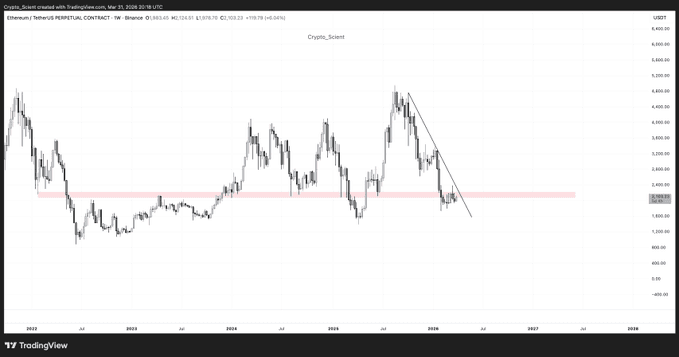
As Crypto_Scient noted on X, while ETH remains under the range and inside a macro downtrend, the price action is weak. No bottom confirmation, the post argued, comes without first seeing acceptance back above key levels.
Four Years of Contested Ground
The $2,100-$2,250 band is not a recent development. ETH has tested that range repeatedly since the 2021-2022 cycle turned. Each visit has produced a sharp reaction. The zone was support before February, then broke, and now resistance is building there again. It is what makes this particular consolidation period different from simple sideways chop.
Price compression below a multi-year contested zone, combined with an MVRV reading in historically capitulatory territory, puts ETH in a position where the next directional move carries weight. A recovery that fails to clear $2,100 with conviction leaves the structure bearish. A clean break above $2,250 shifts the reading.
The RSI on the daily chart has been hovering near neutral, around 49-55 depending on the session. That reading reflects the same indecision visible in price. No clear momentum in either direction yet.
What the On-Chain Data Says
The MVRV at 0.78 reflects something specific: the average ETH holder bought at a higher price than where the asset currently trades. That is a loss-dominant state across the network. Historically, sustained periods in that territory have been short. Either price recovers quickly, or a deeper capitulation follows before the eventual turn.
Negative MVRV territory, defined as the Santiment-tracked version, briefly reached -27% in February 2026. It has since recovered to approximately -11%. That recovery from the most extreme reading is one of the conditions that, in past cycles, came just before a sustained rebound. The caveat is timing, since the magnitude of the rebound and the speed of recovery have varied considerably.
Long-term holder NUPL, another metric tracking the net profitability of coins held for extended periods, is close to zero. That indicates long-term holders are near breakeven in aggregate. Combined with the realized price convergence, these are the on-chain conditions that have historically defined late-cycle pain rather than fresh-cycle breakdown. The data, taken together, aligns with the picture both @alicharts and @Crypto_Scient outlined on X.
The next meaningful test for Ethereum is acceptance above $2,100. Without it, the structure stays weak regardless of what on-chain indicators suggest about longer-term positioning.
Key Takeaways:
- ETH’s MVRV ratio dropped to 0.78, entering a zone that has historically aligned with major cycle lows.
- The $2,100-$2,250 band has been contested for nearly four years, now acting as firm resistance.
- No confirmed reversal signal is present until ETH reclaims and holds above that key range.