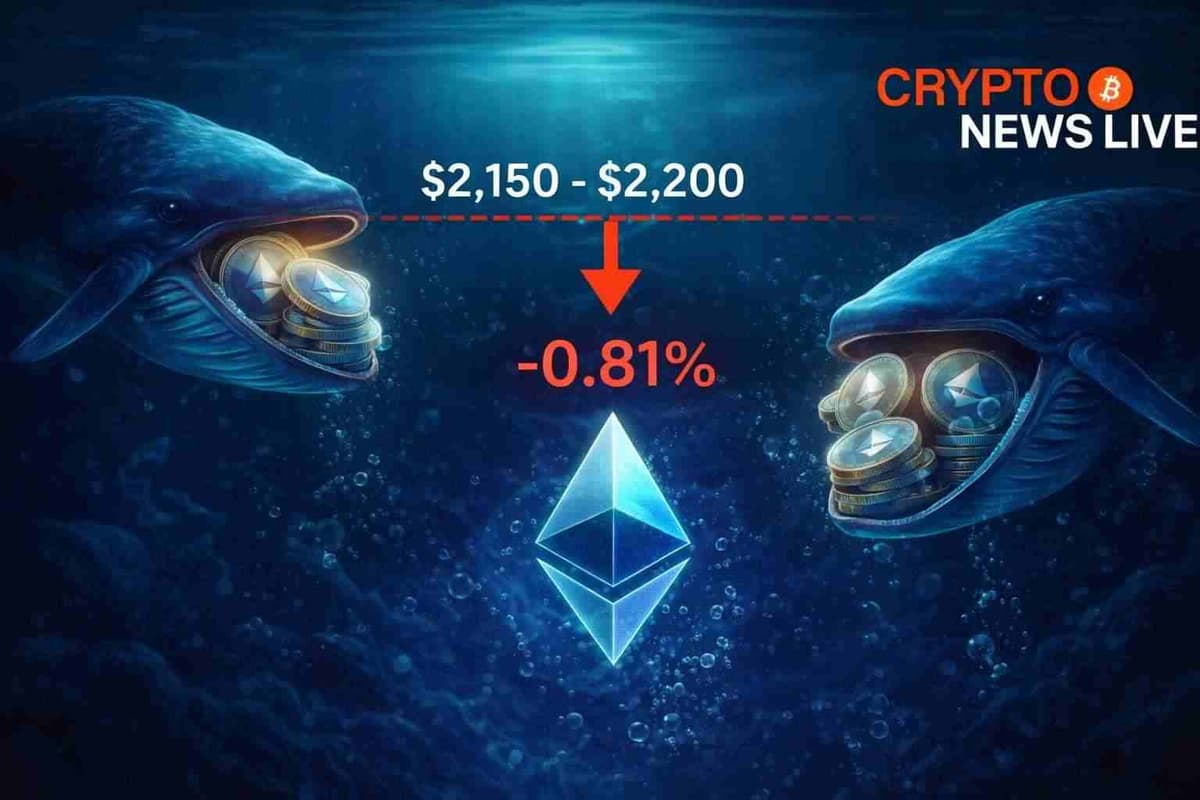
Ethereum got rejected from the $2,150 to $2,200 resistance zone again. That much is visible on every chart. What is less discussed is why large holders may actually want price to drop back toward $2,000 rather than hold above it.
Crypto analyst Ted Pillows flagged the rejection directly, writing on X that as long as the $2,000 support zone holds, ETH could set up another move higher. But losing that level, he said, opens the door to a new yearly low.
The Number Whales Are Watching
Trader CW8900 put a sharper edge on it. According to CW8900 on X:
“ETH whales will aim to liquidate retail investor’s high-leverage long positions around $2,000.”
That framing changes the conversation. Round numbers like $2,000 tend to attract retail longs. High leverage concentrates at those levels. When large holders push price into that zone, stop-losses and forced liquidations cascade. Whales then absorb the cheaper coins as retail positions get wiped.
It is not a new playbook. It has shown up at major support levels across multiple ETH cycles.
Underwater and Still in Control
Large Ethereum holders are not in profit right now. CryptosR_Us laid out the situation on X, noting that ETH whales are sitting at a loss and that two outcomes typically follow from that position.
“Every cycle, the biggest opportunities came when smart money was underwater. The ones who bought those moments never looked back. History isn’t repeating but it’s definitely rhyming.”
They either capitulate and sell into the decline. Or they absorb the loss and build bigger positions while price is low. Both scenarios play out differently for retail traders. One ends in a deeper flush. The other sets up a recovery leg most people miss the entry for.
What Breaking $2,000 Actually Means
The $2,150 to $2,200 zone has rejected ETH more than once. Sellers up there are consistent. Buyers have not been able to clear it with any real force.
Ted Pillows noted on X that the next key level below is around $1,800 to $1,850 if $2,000 does not hold. That would mark a new yearly low for Ethereum and push a larger share of holders even deeper into unrealized losses.
The dynamic CW8900 described makes that scenario more mechanical than emotional. If leveraged retail longs are stacked at $2,000, the incentive to push through that level exists regardless of longer-term accumulation intent.
Whether whales use this moment to dump or double down, the $2,000 zone remains the pivot. Everything above it stays in play. Everything below it changes the structure of this move entirely.