
Ethereum pulled back roughly 10% from its recent high above $2,450 and slipped below the $2,300 zone on April 30. The drop did not go unnoticed. Within a single hour of ETH trading under that level, taker buy volume on Binance surged past $1 billion, according to CryptoQuant contributor Darkfost.
The timing was not ordinary. The Federal Reserve had just wrapped up what is widely expected to be Jerome Powell’s final press conference as chair — holding the benchmark funds rate unchanged at 3.5% to 3.75% for the third consecutive meeting.
$1B Hour and an OKX Echo
On OKX, a parallel reaction appeared almost simultaneously. Nearly $20M in buying flows hit within the same one-hour window, Darkfost noted in the post on X.
According to Darkfost, on X: “Within just one hour, Taker Buy Volume surged above $1B on Binance. A similar reaction was also seen on OKX, where nearly $20M in buying flows were recorded over the same period.”
That cross-exchange response at a shared price level points to something beyond random order flow. Buyers on two of the world’s largest crypto derivatives venues stepped in hard, at the same moment, around the same price. ETH was still trading inside a range structure at the time. The earlier rebound above $2,450 had already corrected, and the move below $2,300 brought fresh interest.
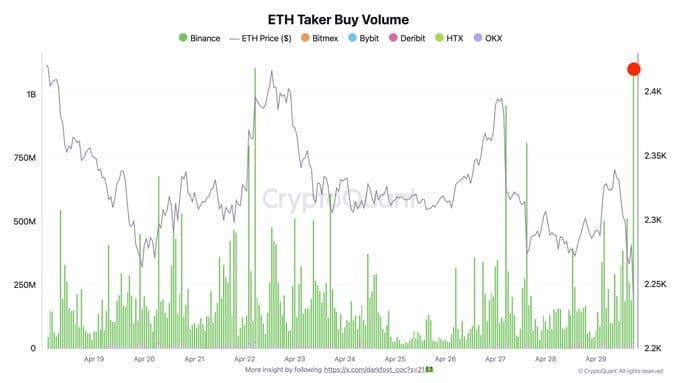
Darkfost’s read: “This suggests that at these price levels, some investors aggressively stepped in on the long side, looking to take advantage of the pullback.”
Powell’s Exit and Four Dissenters
The Fed’s April 29 decision carried more weight than a routine hold. The FOMC voted 8 to 4 — the first four-dissent outcome since October 1992, per Trading Economics. Three of those four dissenters objected not to holding rates, but to language in the statement that implied future cuts. The fourth, Governor Stephen Miran, pushed for a 25 basis point reduction.
Ellen Zentner, chief economic strategist at Morgan Stanley Wealth Management, said Powell “sounded consistently cautious” and that the current backdrop of firm growth and sticky inflation “doesn’t justify lower rates.” The Fed’s own statement flagged elevated inflation, linking it in part to rising global energy prices tied to the Middle East conflict.
That backdrop makes the Binance spike more interesting. The Fed’s tone was not neutral. It was tilted toward keeping rates higher for longer. Markets are currently pricing no changes through the rest of 2026 and into 2027, according to CNBC’s reporting on the April 29 meeting. Despite that, the $1 billion buy surge on ETH happened anyway.
Range Structure Still Intact
ETH has not broken out. Darkfost’s chart from CryptoQuant shows the asset has been oscillating between levels, with the recent spike above $2,450 followed by the correction now underway. The $2,300 zone has attracted buying interest before. Whether this hour’s flow data translates into sustained support is a separate question.
What the data does show is that at current price levels, some buyers are not waiting. They are taking the offer. That distinction — taker buy volume, not passive limit orders — means these were aggressive market buys, not bids sitting below price waiting to be filled.
CPI data released in late April showed headline inflation at 3.3% year-over-year, the highest reading since May 2024, driven largely by energy costs. That figure sits well above the Fed’s 2% target. The Ethereum derivatives complex, per Darkfost’s earlier work on this cycle, spent most of 2025 dominated by sell-side pressure — net taker volume had turned deeply negative at ETH’s all-time high near $5,000 in late 2025. The current setup diverges from that pattern.
ETH was trading near $2,245 as of April 30, down 3.6% on the day, per CoinGecko.