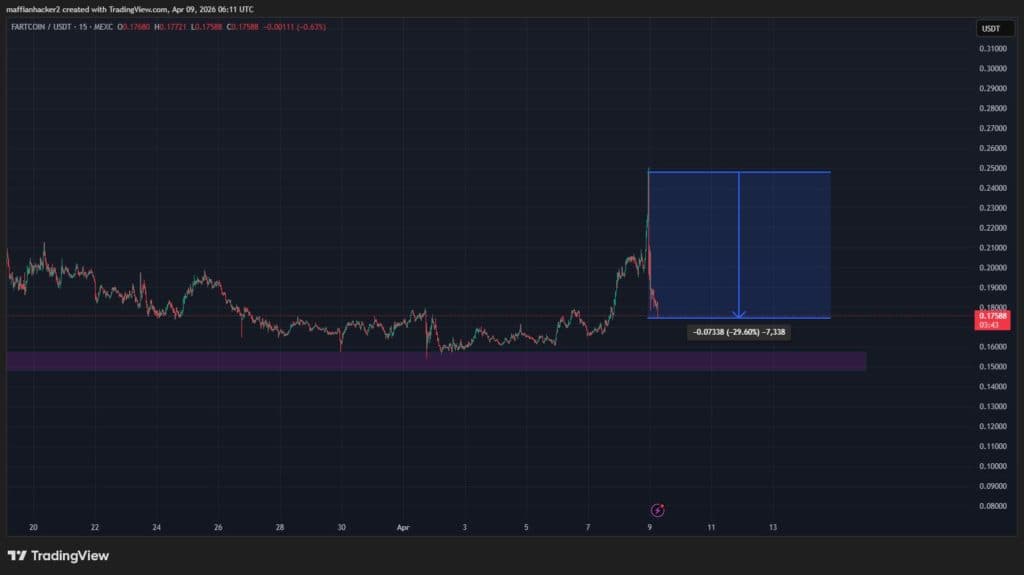
Fartcoin flash crash hit hard on April 9. The token had been climbing steadily since April 6, building up a 57% gain over three sessions, peaking at $0.252 intraday. Then at exactly 7:00 a.m., it lost more than 20% in five minutes. Total drawdown reached 26%, with the price bottoming below $0.18 and wiping nearly all of the recent gains.
The drop was not random. On-chain monitoring reported by Lookonchain ties the trade to a coordinated team that ran the same playbook six days earlier when XPL crashed 40% on April 3 morning.
The Wallets That Keep Showing Up
Both incidents trace back to two root addresses: 0xBc1D9760bd6ca468CA9fB5Ff2CFbEAC35d86c973 and 0x3dBE077e7986657E95e1CC50089f17a5a4AF0AaE. According to Lookonchain, the team began loading into Fartcoin shortly after the XPL trade closed out. Classic rotation. Same source of funds, different token, same structure.
The setup went like this. Before the rally, the group funneled capital into Hyperliquid through multiple wallets and opened high-leverage long positions. Once those longs were deep in profit, they pulled all margin out, dragging liquidation prices up toward the current spot level. Then they hit spot across other venues simultaneously, crashing price from both directions at once.
At 7:00 a.m., six addresses withdrew funds at the same time to the same liquidation threshold, roughly $0.22. That triggered $22.83 million in batch liquidations. Traders with larger positions who had chased the rally were collectively taken out for $38.88 million, data from Lookonchain shows.
HLP Absorbs the Damage
Security firm PeckShieldAlert flagged on X that HLP finished the 24-hour window down approximately $1.5 million. The attacker had built a $15 million Fartcoin long across four wallets, totaling 145.24 million tokens. When liquidation hit, Hyperliquid’s ADL mechanism forced HLP to absorb the position directly, inheriting the toxic bag and the resulting bad debt.
According to PeckShieldAlert, on X, the paper loss from the attack sits at around $3 million but the team likely walked away with a net gain through cross-venue hedging on other platforms. It’s the same trick as XPL. Burn something on Hyperliquid, profit somewhere else.
Post-crash, two secondary addresses opened fresh high-leverage longs within an hour with tight liquidation levels. Both, traced back to 0xBc1D, were fully liquidated by 7:52 a.m., pushing price down another leg.
Low Liquidity, Same Script
The thin-liquidity environment was the point, not a side effect. Fartcoin’s market is shallow enough that a coordinated $22.83M batch liquidation moves price fast, which is exactly what the team needed. Lookonchain data shows this is the exact same mechanic used against XPL, just scaled to a bigger position.
What stands out here is the timing precision. Six wallets pulling funds simultaneously to an identical liquidation level does not happen by accident. That level of coordination across wallets pointing to a single root address is what on-chain monitoring firms flagged as the confirmation this was deliberate, not a spontaneous market move.
HLP’s structural problem is unchanged. It inherits positions when no one else will take them, which makes it the default loser in any planned suicide liquidation. PeckShieldAlert, on X, described the mechanism plainly: attacker builds the long, triggers liquidation, HLP gets the bag. The $1.5 million loss is the cost of being the backstop.
Fartcoin was trading around $0.177 at time of writing, still well below the pre-crash high of $0.252. The chart on MEXC shows a near-vertical drop of 29.60% from peak to trough, with the token attempting a slow recovery in the hours following the crash.