The Strait of Hormuz reopened. ETH exploded. Then Iran’s Parliamentary Speaker stepped in and made it clear the situation is far from settled.
Ethereum posted one of its sharpest single-hour moves in recent months after Iran’s Foreign Minister Seyed Abbas Araghchi declared the waterway fully open to commercial traffic during the ongoing ceasefire period. The market reacted instantly. But a set of statements coming out of Tehran the same day pointed to a very different read on how long that opening would last.
$1.72B in One Hour on Binance Alone
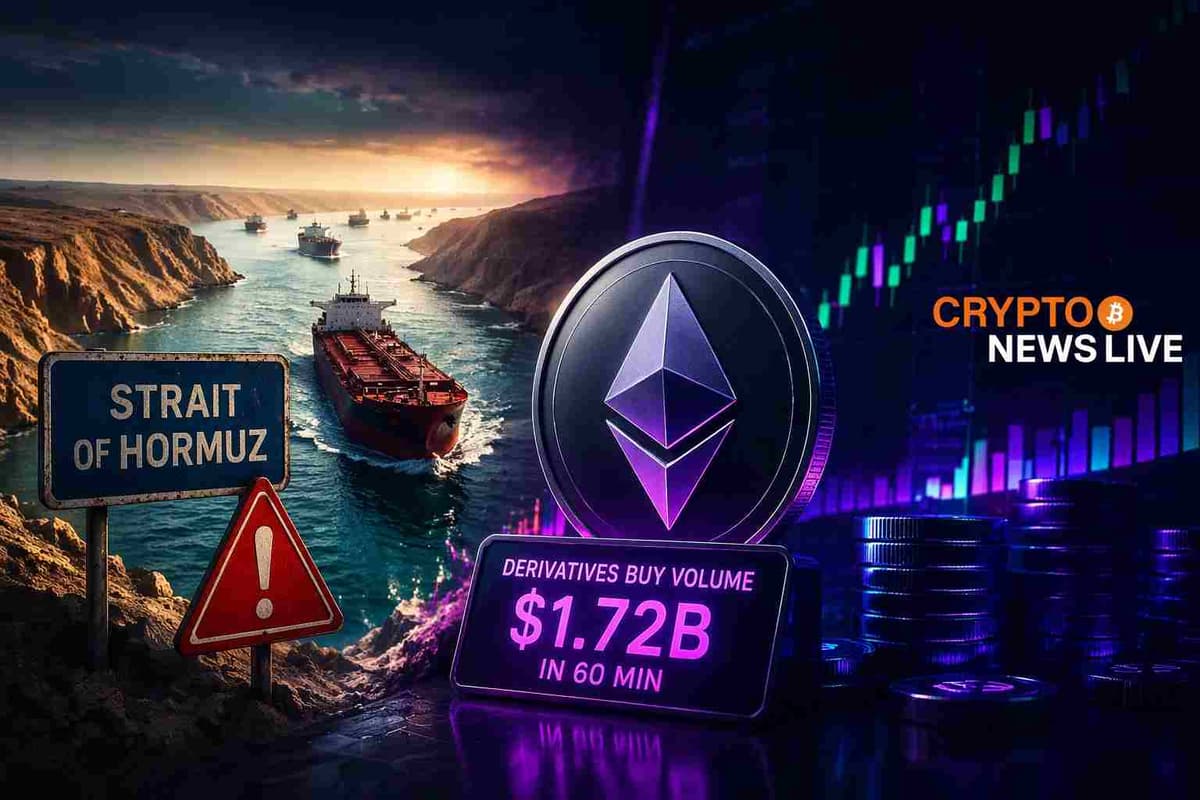
On-chain analytics account Darkfost on X posted data from CryptoQuant showing Binance recorded more than $1.72B in Ethereum derivatives buy volume within a single hour following the reopening announcement. That figure was described as “particularly notable” given how compressed the timeframe was.
The buying pressure triggered a short squeeze that magnified the initial rally. According to the CryptoQuant report cited by Darkfost, approximately $24 million in short positions were liquidated almost instantly, accelerating the upward move beyond what the spot buying alone would have produced. The squeeze was fast and mechanical. Shorts got caught, positions closed automatically, and price pushed further.
Bitcoin also responded. As covered in a prior CryptoNewsLive report, BTC crossed $78,000 after the announcement while oil slid sharply on reduced supply-shock fears.
Ghalibaf’s Warning Cuts Through the Rally Narrative
Iranian Parliamentary Speaker Mohammad Baqer Ghalibaf published a series of posts on X that same period, and the tone was nothing like what the ceasefire headlines suggested.
In the first post, Ghalibaf stated on X that the U.S. President made seven claims in a single hour, all seven false. He added that those who did not win the war through deception will not get far in negotiations either. Then came the line that matters most to anyone trading the Hormuz narrative:
“With the continuation of the blockade, the Strait of Hormuz will not remain open.”
In a follow-up post, Ghalibaf wrote on X that passage would be conducted based on a “designated route” and only with “Iranian authorization.” He was direct about who controls the outcome:
“Whether the Strait is open or closed and the regulations governing it will be determined by the field, not by social media.”
That is not ambiguous language from a mid-level official. Ghalibaf is Speaker of the Iranian Parliament, the second most powerful legislative figure in the country. His statements were pointed and sequential, not off-the-cuff.
Iran Frames This as an Information War
A third post from Ghalibaf on X pushed back on the entire media framing of the reopening:
“Media warfare and engineering public opinion are an important part of war, and the Iranian nation is not affected by these tricks.”
He directed readers toward the Iranian Foreign Ministry spokesperson’s recent interview as the authoritative source on negotiation status. That framing is important. Tehran’s official position and what traders acted on appear to be two different things.
The ETH short squeeze was real. The $24M in liquidations happened. So did the $1.72B buy volume on Binance within 60 minutes. None of that is in dispute.
What Ghalibaf’s statements put into question is whether the market priced in a more durable resolution than what Iran’s own leadership was communicating publicly in the same window. The ceasefire remains time-limited. The blockade, per Ghalibaf, is the actual variable that determines the Strait’s future status. Not peace talks. Not social media.
What the Short Squeeze Actually Measured
Short squeezes of this scale do not just reflect sentiment. They reflect positioning. A large number of traders were short ETH heading into the announcement, and the Hormuz reopening became the catalyst that forced their exits simultaneously.
$24M in liquidations in under an hour is concentrated. It means traders who had bet on continued geopolitical stress were fully exposed when the news broke, and the automated liquidation cascade compounded the move initiated by the $1.72B in derivatives buying. CryptoQuant’s data, flagged by Darkfost on X, described the move as “violent,” and on-chain, that word fits.
The price action was real. Whether the geopolitical shift that triggered it holds is a different question, and Ghalibaf’s statements from Tehran suggest not everyone in the Iranian government considers that question settled.