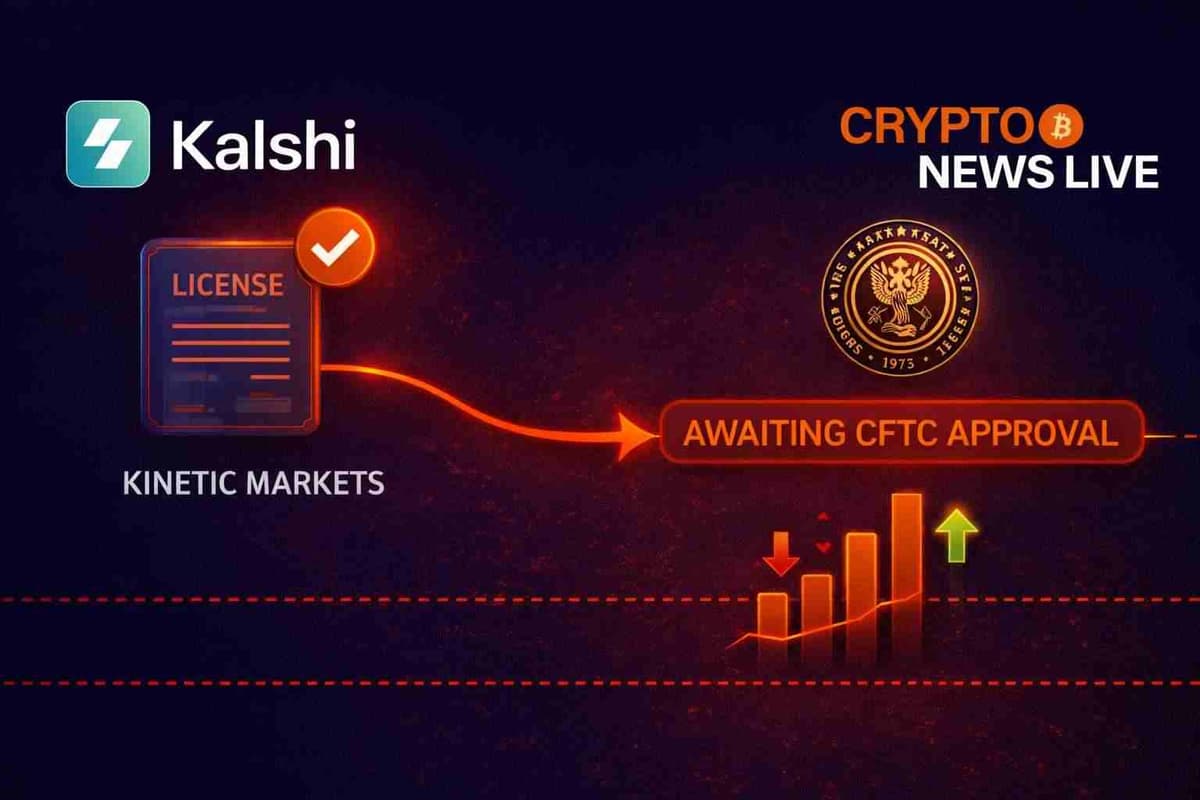
Kalshi push into institutional finance just got regulatory teeth. The prediction market platform secured approval to operate a futures commission merchant through an affiliate called Kinetic Markets LLC, according to a March 24 filing with the National Futures Association. The filing lists Kinetic Markets as both an FCM and a swap firm.
Kalshi Inc. holds a 10% or greater financial interest in the entity. Co-founders Tarek Mansour and Luana Lopes Lara are named as indirect owners, with Lior Samuel Hirschfeld serving as CEO of Kinetic, Sam Rosner as CFO, and Joshua Andrew Beardsley as chief compliance officer. Bloomberg was first to report on the NFA filing.
Kinetic Markets Clears NFA Registration
According to @BSCNews on X, Kalshi margin trading access for professional clients had been cleared through Kinetic Markets, which received the futures commission merchant license from the National Futures Association.
Until now, Kalshi operated on a fully collateralized model, requiring traders to post 100% of a contract’s value before entering a position. Margin trading changes that. Participants will be able to hold positions by posting only a fraction of the total value as collateral, freeing up capital for other use.
Kalshi CEO Tarek Mansour stated that introducing margin trading is a top priority, noting that requiring full collateral for hedging positions is considered too costly for institutional participants. Capital efficiency is the argument Kalshi is making to draw hedge funds and prop desks in.
Full Collateral Model Gets Left Behind
The margin feature could be rolled out first for new products rather than core event contracts. That sequencing suggests the company is treading carefully, keeping its flagship prediction contracts separate until the regulatory framework is fully settled.
One gate remains open. Kalshi must still obtain regulatory approvals from the Commodity Futures Trading Commission for changes to its rulebooks to allow for non-fully collateralized trading. The NFA registration clears the structural path, but the CFTC holds the final switch.
The company filed for FCM registration in late 2025, and the NFA confirmed the approval this week. That puts nearly four months between filing and clearance.
CFTC Sign-Off Still Pending
US regulations would require users accessing margin products on Kalshi to undergo additional identity checks, such as providing employer information. Those requirements sit against a backdrop of insider trading scrutiny that has followed the prediction market sector’s rapid expansion.
Retail traders have turned prediction markets into one of the fastest-growing corners of finance, with weekly notional volume hitting a record high of more than $3 billion on Kalshi earlier this month. But it is the professional side that Kalshi is now moving hard to capture.
“Institutions want to see certainty, liquidity, the ability to margin,” said Toby Moskowitz, a finance professor at the Yale School of Management and a principal at AQR Capital Management.
Institutions Already Circling
Kalshi signed a clearing and infrastructure deal with Fidelity Information Services, announced a data integration with Ark Invest on March 26, 2026, and completed an earlier integration with Tradeweb. Each partnership reflects the same institutional direction.
Earlier this month, the company closed a funding round at a $22 billion valuation, raising over $1 billion. The capital raise and the FCM license together signal a platform building for a different kind of client than the retail bettor who drove early volumes.
Competitors, including crypto-native prediction markets like Polymarket, do not offer margin trading and instead operate with fully collateralized positions. That gap could prove significant if institutional adoption accelerates.