XRP institutional infrastructure was never the problem, according to Michael Arrington. The Arrington Capital founder sat down for RippleXDev’s Onchain Economy series and laid out a case he has been sitting on since 2017 — that the market got Ripple wrong from the beginning, and the company’s current build-out is the proof.
The full episode dropped on YouTube this week. Arrington, who first bought XRP when it traded between 3 and 5 cents, described the standard criticism as a kind of selective blindness that has followed the asset through its entire history.
“Ripple and XRP have been completely misunderstood in the last decade. Skeptics of XRP would call it the corporate coin, the banking coin,” Arrington said in the episode.
He did not frame this as a complaint. He framed it as an opportunity.
What He Said About Ripple’s Direction
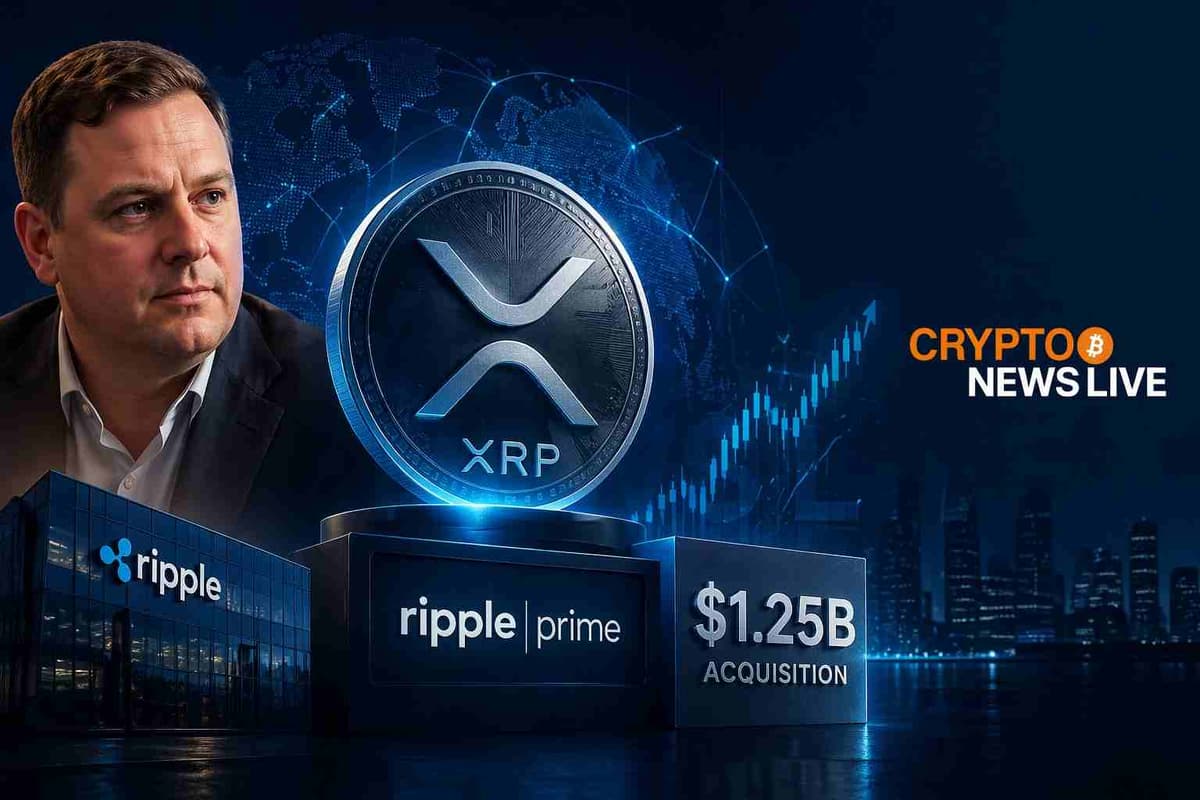
Arrington pointed directly to Ripple’s acquisition strategy as the clearest signal of where the company is going. The Hidden Road deal — a $1.25 billion buy that closed in October 2025 and has since been rebranded Ripple Prime — was his main example. He described it as something the crypto space has needed for years but never had in a form that actually worked.
“Prime brokers are a dime a dozen in the real world, but in crypto, we’ve never found one that’s very good,” Arrington said during the Onchain Economy episode. “It’s going to be a huge business and like a backbone of what Ripple and XRP become.”
Ripple Prime now clears over $3 trillion annually across markets. It serves more than 300 institutional clients. BNY Mellon was announced as the primary reserve custodian for RLUSD, Ripple’s stablecoin, which is set to function as collateral within the prime brokerage’s structure.
That last detail is not a small footnote. Traditional hedge funds require collateral to take complex positions. Getting RLUSD into that stack puts Ripple’s stablecoin inside the actual mechanics of institutional trading, not just alongside it.
The Execution Argument
Arrington’s broader point was not really about XRP’s price or tokenomics. It was about whether Ripple does what it says it will do. His answer is yes, and has been since before most people were paying attention.
He pointed to founder Chris Larsen’s original foresight and what he described as Brad Garlinghouse’s consistent execution as the reason he believes the build is real. Ripple spent approximately $2.45 billion on three major acquisitions in 2025 alone — Hidden Road at $1.25 billion, Rail at $200 million for stablecoin payments, and GTreasury at $1 billion for treasury management.
A fund that moved north of $50 million in XRP in roughly two seconds for 30 cents in fees is not an abstraction. Arrington told that story earlier this year to illustrate XRP’s utility at the institutional level. Ripple Prime is the infrastructure version of that same argument.
“If Ripple, which is very mission focused, has shown that over at least the last decade, can continue to hyperfocus on what their mission is and then execute on that — there is no upper limit on the value of that ecosystem in general,” Arrington said in the Onchain Economy episode.
What Arrington Capital Is Watching Now
According to RippleXDev on X, the episode also covered Arrington’s view that RLUSD and Ripple’s growing stablecoin push will drive a new wave of startups building on the XRP Ledger. He said Arrington Capital intends to invest in that evolution.
The firm manages over $1 billion in assets. Its first fund, originally named Arrington XRP Capital, was denominated entirely in XRP — not in dollars. That structural decision was itself a statement about where Arrington believed the asset was heading.
He has not changed that view. What has changed is how much of the infrastructure to support it actually exists now.