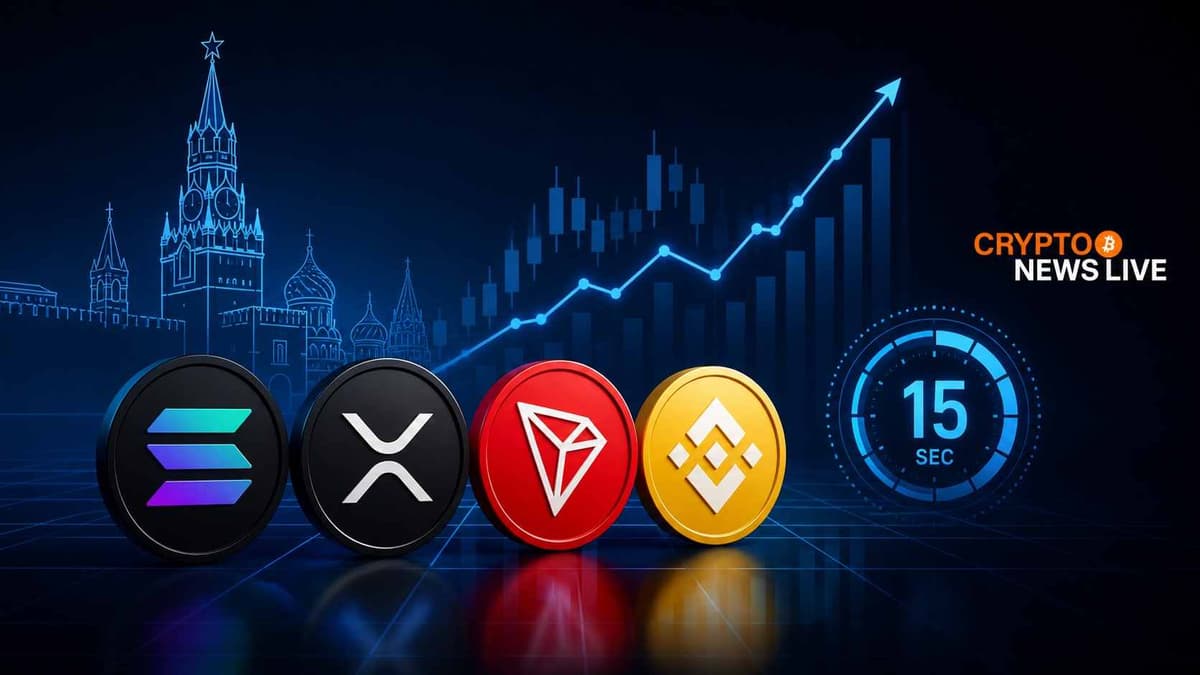
Moscow Exchange will begin calculating and publishing indices for Solana, Ripple, Tron, and Binance Coin on May 13, 2026, according to an official announcement from the exchange. The move brings Russia’s largest trading venue to six Moscow Exchange crypto indices in total, up from two.
The exchange already publishes the Bitcoin index (MOEXBTC) and the Ethereum index (MOEXETH). Bitcoin tracking started in June 2025, Ethereum followed in October 2025. Now four more join: MOEXSOL, MOEXXRP, MOEXTRX, and MOEXBNB.
BNB Gets a Ticker Russia Didn’t Plan Out Loud
BNB’s inclusion is the detail most coverage skipped. When MOEX first signaled index expansion in February 2026, senior manager Maria Silkina named Solana, Ripple, and Tron publicly on RBC radio. Binance Coin wasn’t part of that conversation.
Its addition to the May 13 lineup makes four altcoins launching simultaneously. That’s a faster rollout than what the February announcement suggested.
MOEX said the exchange plans to push the total count of digital currency indices to ten going forward. No timeline was attached to that target.
How the Pricing Actually Works
Data for all foreign digital currency indices will come from four crypto exchanges in fixed proportions. Binance supplies 50% of the pricing input. Bybit contributes 20%. OKX and Bitget each account for 15%.
That weighting structure applies to all six indices, not just the new ones. The Bitcoin and Ethereum indices will use the same four-source model going forward.
What changes more sharply on May 13 is the calculation frequency. Right now, MOEX publishes digital currency indices once daily, no later than 6:00 PM. Starting May 13, every index gets updated every 15 seconds throughout the trading day, including weekend sessions. That is a significant shift in how price data flows through Russia’s formal financial infrastructure.
What Qualified Investors Actually Get
Access to these instruments stays restricted to qualified investors under Bank of Russia rules, the same framework that governs existing BTC and ETH futures on the exchange. The indices are built as underlying assets for future financial products, MOEX confirmed in the announcement.
Russia’s State Duma is expected to finalize broader crypto legislation by July 1, 2026. That framework, according to Anatoly Aksakov, head of the State Duma Committee on Financial Markets, would create a two-tier system allowing non-qualified retail investors limited crypto exposure capped at 300,000 rubles, roughly $4,000 per year, while qualified investors face no cap.
Until that legislation lands, the new indices serve the professional investor segment only.
MOEX describes itself as Russia’s only multifunctional exchange for stocks, bonds, derivatives, currencies, money market instruments, and commodities. It calculates over 400 financial market indicators across multiple asset classes. The digital currency index suite is a newer layer on that infrastructure.
The May 13 date is now confirmed. Six indices go live. The path to ten is open but undated.