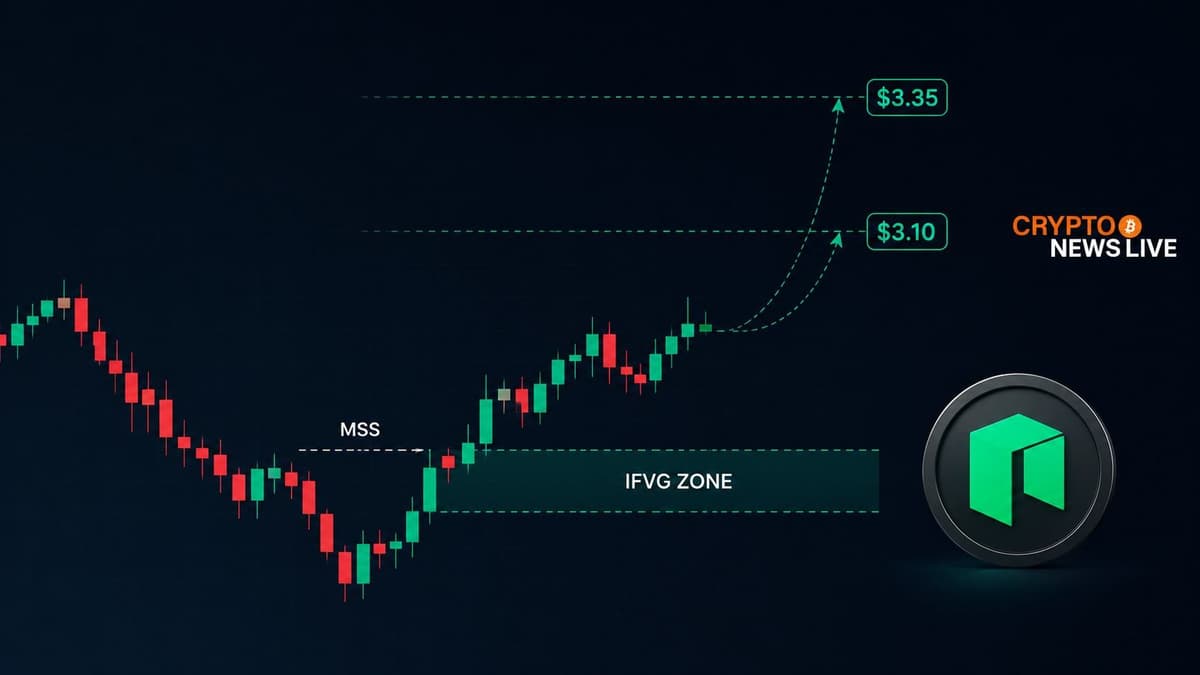
NEO is trading at $2.938 on Binance as of May 7, 2026, sitting directly above an Inversion Fair Value Gap zone that the daily chart has been building toward for weeks. The structure is not accidental. Clean lows were swept in late April, a Market Structure Shift confirmed in March, and since then the coin has been compressing in a range that technical traders read as accumulation before expansion.
The setup drew attention from CryptoPatel on X, who laid out the full daily timeframe structure for NEO with named targets and a defined invalidation level. Two price targets were stated: $3.10 as the first buy-side liquidity pocket and $3.35 as the external liquidity sitting above. Invalidation is a daily close below $2.68.
IFVG Zone Is the Line That Matters
The Inversion Fair Value Gap visible in blue on the TradingView chart is where price moved through an inefficiency too fast to fill resting orders. Now price has returned to that zone. That return is what Smart Money structure traders treat as a demand confirmation. It is not just a support label. It is where absorbed selling pressure is expected to give way to continuation higher.
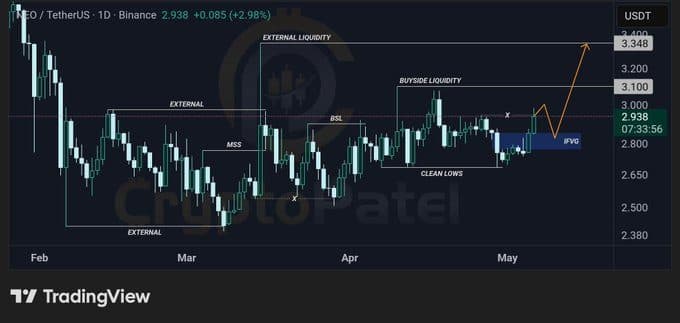
CryptoPatel described the structure on X as a consolidation following a bullish market shift, with the IFVG acting as the demand anchor. The Market Structure Shift, visible on the chart from the March low, was confirmed after NEO swept external lows near $2.38 on the left side of the chart. That sweep cleared sell-side liquidity. What followed was the BSL break and the shift in directional bias.
The chart shows two distinct liquidity targets overhead. Buy-side liquidity rests near $3.10, the first level CryptoPatel named. External liquidity sits higher at $3.348, which is the second and larger target on the projected path drawn on the chart. The orange arrow on the shared TradingView setup traces a two-step move: a dip into the IFVG first, then a push toward $3.10, then extension toward $3.35.
Entry Conditions and What the Chart Requires
CryptoPatel was specific about how the trade should be approached. According to his post on X:
“Bullish bias. Wait for retracement into the IFVG zone and confirmation (LTF bullish structure / displacement) before entering toward buy-side liquidity.”
That means no chasing. A lower timeframe bullish structure or a displacement candle is the required trigger before sizing into the position. The setup is patient by design.
The invalidation is equally clean. A daily close below $2.68 removes the bullish read entirely. That level sits just below the IFVG zone and below the 50% structure reference CryptoPatel identified as the floor for this thesis. If price closes there on the daily, the accumulation structure breaks down.
What the chart also shows is that sell-side liquidity below current price remains intact. Clean lows are still in place, which means the downside has not been fully cleared. That is part of why the IFVG entry matters. Entering there keeps risk defined against a level that, if broken, signals something structurally different is playing out.
Why the $2.68 Level Is Not Arbitrary
The $2.68 invalidation is not a round number picked loosely. It sits below the IFVG demand zone and below the structural low that formed after the MSS was confirmed. A daily close there means price has fully rejected the demand zone and likely returned to seek lower liquidity. CryptoPatel flagged it as the hard line.
NEO has been ranging with compressed price action since the MSS in March. That compression, combined with the IFVG sitting directly at current price and buy-side pools stacked above at $3.10 and $3.35, makes the current zone a decision point. Either the demand holds and price begins the move CryptoPatel mapped, or $2.68 gives way and the thesis is done.
The structure is defined. The risk is named. The targets are clear.