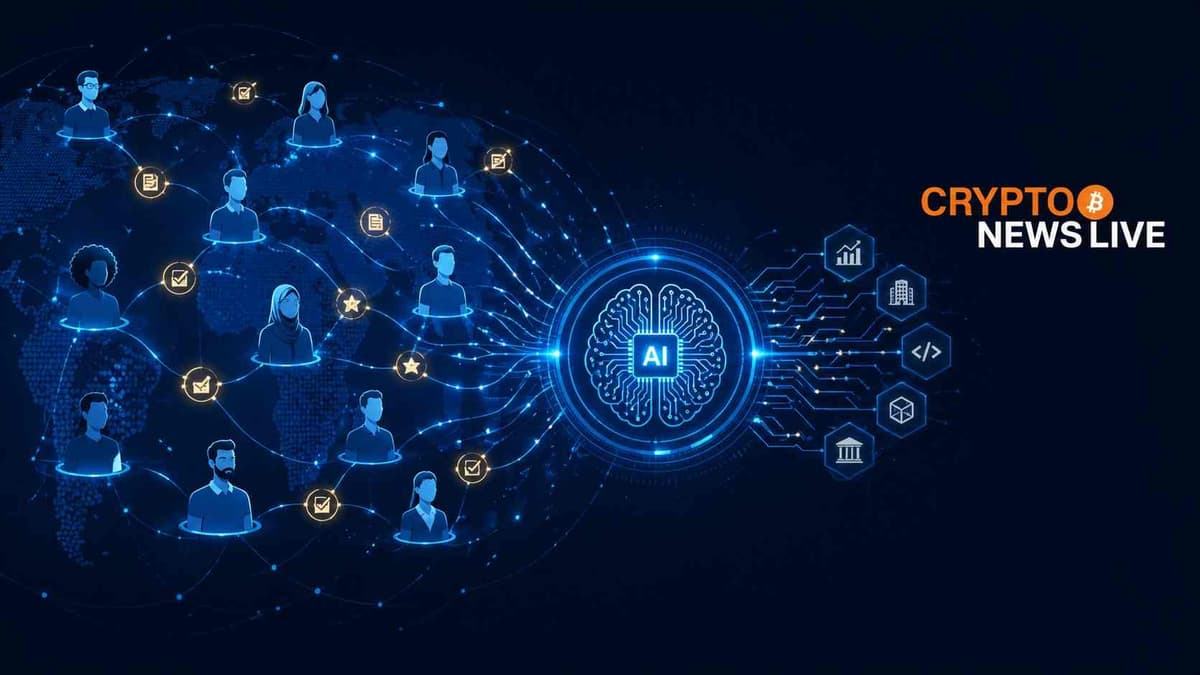
The race to build better AI has hit a wall. Not a compute wall. A human one.
Getting real people to label data, verify outputs, and catch what models get wrong is still one of the hardest operational problems in machine learning. Most companies either underpay for it, get bots, or both. Pi Network says it has already built the answer, and it has half a billion completed tasks to back that up.
According to the Pi Core Team on X, AI companies can now access Pi’s human input infrastructure through the network’s over 18 million identity-verified Pioneers. The announcement points directly at three things AI developers need: model improvement, inference quality tuning, and data labeling at scale.
What 526 Million Tasks Actually Means
The number that keeps appearing in Pi’s official blog post is 526 million. That is the count of validation tasks completed inside Pi’s own KYC system by just over one million verified individuals. Those people worked across more than 200 countries. They were paid directly in Pi tokens through the network’s blockchain infrastructure.
No fiat. No cross-border payment friction. No intermediary fees stacked on top of worker payouts.
That last part matters for AI companies more than it might first appear. Platforms like Amazon Mechanical Turk charge requester fees on top of every worker payment. At millions of tasks, that overhead compounds fast. Pi’s model pushes compensation through blockchain rails, cutting out the layer that traditional platforms charge for. The Pi Network blog notes that paying through Pi may compare favorably to fiat alternatives precisely because of reduced overhead on small, high-volume payouts.
The Pi Core Team posted on X that the KYC work alone proves the workforce’s “capability, consistency and scale” in areas that require human judgment.
Why Robotics Makes This Bigger Than Standard AI Labeling
Standard text and image labeling gets most of the attention in AI data conversations. Pi’s announcement points to something further out: robotics and physical AI.
“A future breakthrough may depend on foundation models trained on massive amounts of human-generated data about physical environments,” the Pi blog states, drawing a parallel to how internet-scale data enabled large language models like ChatGPT.
That framing puts Pi’s workforce pitch in a different category from typical labeling platforms. If physical AI needs the same kind of massive human-generated dataset that text AI needed, the demand for verified, globally distributed human contributors is going to be several orders of magnitude larger than what current platforms handle.
Pi is saying its 18 million verified users are that pool. The 526 million tasks are the proof it can actually mobilize them.
The Token Payment Angle No One Else Is Building
This is where Pi’s model gets genuinely different from anything Mechanical Turk or similar platforms offer.
Through Pi Launchpad, companies can compensate workforce contributors in the company’s own token rather than in Pi or cash. Launchpad is currently iterating on Testnet. The commercial logic is direct: workers who receive a company’s token for completing tasks have a built-in reason to become users of that company’s product. Labor cost becomes user acquisition.
The Pi blog puts it plainly, stating that a Launchpad token can reduce costs by allowing rewards, participation, and user growth to be funded through the token rather than drawn entirely from cash. That token can also function inside the product itself, whether as payment, access, or governance.
For early-stage AI companies burning cash on human labeling while also trying to grow a user base, that structure is worth paying attention to. One budget line doing two jobs.
The Authentication Layer That Makes the Workforce Usable
Scale alone does not make a workforce valuable. Bots and fraudulent accounts have long contaminated human-in-the-loop systems, producing training signals that actively degrade model quality.
Pi’s answer is KYC at the entry point. Every one of the 18 million Pioneers went through an identity verification process combining AI automation with human review. That process is how the 526 million tasks got done in the first place: human validators checking other humans’ identity documents.
According to the Pi Core Team’s post on X, the result is a workforce where AI companies can reduce exposure to bots, fraud, and unverifiable labor from the start. Every contributor already holds an active Pi wallet too, removing the onboarding step that usually delays deployment of new distributed labor setups.
A global base also brings localization built in. Human judgment from contributors in Southeast Asia, Sub-Saharan Africa, and Latin America looks different from judgment drawn primarily from North American or Western European panels. For AI products targeting real-world, multinational use, that geographic spread is an actual advantage, not just a headline number.