Bitcoin Pizza Day has long served as a symbolic checkpoint for the industry — a reminder of how far digital assets have come from their earliest use case as a medium of exchange.
In 2026, cloud mining platform BeMine is turning that narrative into user growth.
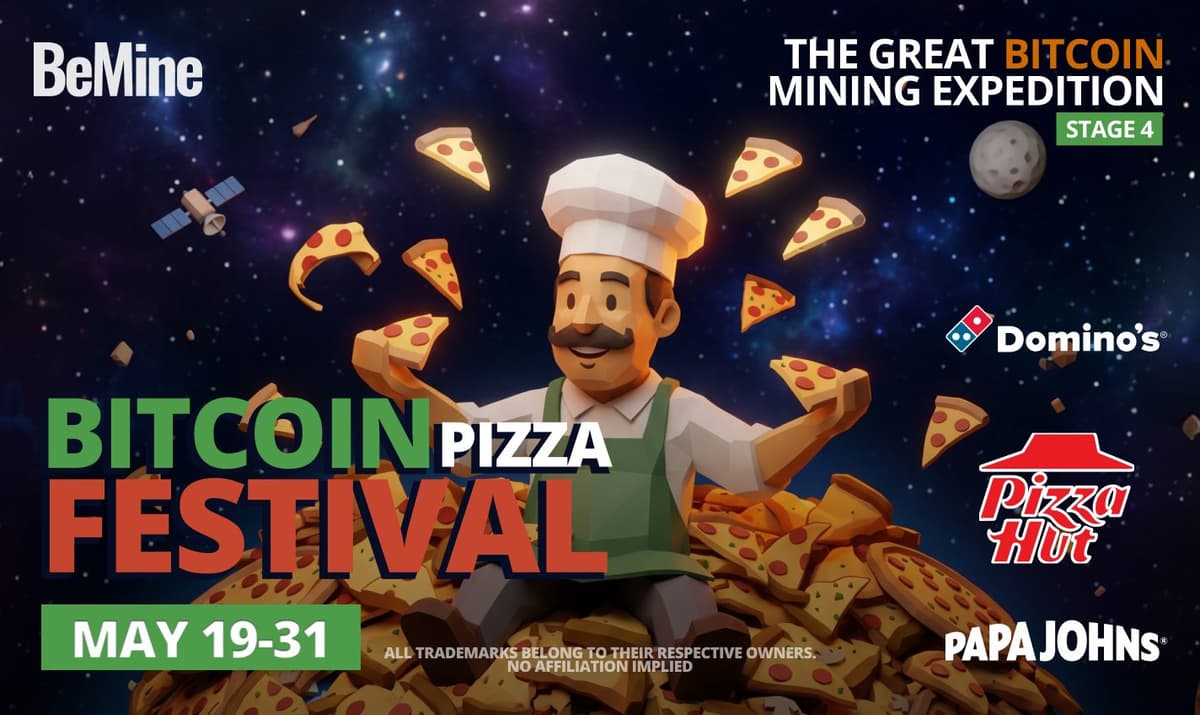
Through its Bitcoin Pizza Fest campaign, the company is structuring a set of incentives around the original premise of the first real-world Bitcoin transaction: exchanging BTC for pizza. The idea is straightforward — recreate a familiar action, attach a crypto-native reward, and use that as an entry point into a broader product ecosystem.
Are Consumer Brands Catching the Crypto Wave?
One of the more visible shifts in crypto today is how it intersects with everyday consumer behavior.
For most of its history, the industry has operated in a relatively closed loop — exchanges, wallets, protocols. Mass adoption has always been the stated goal, but the connection to everyday consumer experiences remained limited.
That is starting to change.
“If you look at how Bitcoin entered the real world, it didn’t happen through infrastructure — it happened through a simple purchase,” said BeMine’s CEO Kiryu Artemev. “In that sense, collaborations between crypto platforms and consumer brands aren’t just marketing. They’re a continuation of that original idea — bringing digital assets into everyday transactions.”
Campaigns built around recognizable brands — in this case, global pizza chains — signal a shift from abstract adoption narratives to something more tangible.
For BeMine, this is not just an experiment in user acquisition, but a step toward embedding crypto into familiar user flows.
“We see this as a natural next stage,” Kiryu Artemev added. “And we’re deliberately early here. The sooner crypto connects to real-world habits, the faster adoption stops being a concept and becomes behavior.”
Infrastructure as the Enabler
BeMine’s core product — fractional access to ASIC mining capacity — is built t reduce operational complexity. Users don’t need to manage hardware or configure infrastructure; instead, they interact with mining as a service.
That abstraction matters most in a campaign context.
The company reports over 400,000 registered users, with steady annual growth. At that scale, marketing initiatives are less about testing demand and more about managing it — making sure spikes in traffic, onboarding, and reward distribution can be absorbed without friction.
According to BeMine, previous campaign cycles have already drawn strong participation», particularly where user-generated content and simple incentives are involved. For Bitcoin Pizza Fest, the expectation is a comparable lift in both new user registrations and re-engagement from the existing base.
There is also a more practical consideration: verification.
Campaigns built around social posts and purchase receipts introduce a manual layer that doesn’t fully disappear with automation. BeMine says it is expanding its moderation and support capacity accordingly.
Internally, the expectation is clear — if participation follows prior trends, the volume will be significant.
Or, put more simply: the system may scale automatically, but someone still has to review the pizza.
Campaign Structure
Running from May 18 to May 31, Bitcoin Pizza Fest is organized around two primary participation paths:
- Share Your Slice
Users post a photo of pizza on X or Instagram, tag @bemineclub, and include #ProofOfPizza, then submit the link via the platform.In return, they receive temporary access to mining capacity — a fractional share of an Antminer S23 for seven days. Participation is capped at 2205 ASIC slots. - Proof of Pizza
Users who purchase pizza from participating chains — Domino’s Pizza, Pizza Hut, Papa John’s, or New York Pizza — can upload their receipt and receive $10 in BTC, credited directly to their account.

From Cultural Reference to Acquisition Channel
Bitcoin Pizza Day is often treated as a retrospective moment — a way to reflect on early adoption.
What campaigns like Bitcoin Pizza Fest suggest is a different use case: turning that narrative into a repeatable acquisition model.
By pairing a widely recognized story with a low-friction action and an immediate incentive, BeMine is effectively testing how offline consumer behavior can feed into crypto onboarding at scale.Whether this approach extends beyond campaign cycles remains an open question. But if prior participation patterns are any indication, demand is unlikely to be the constraint.