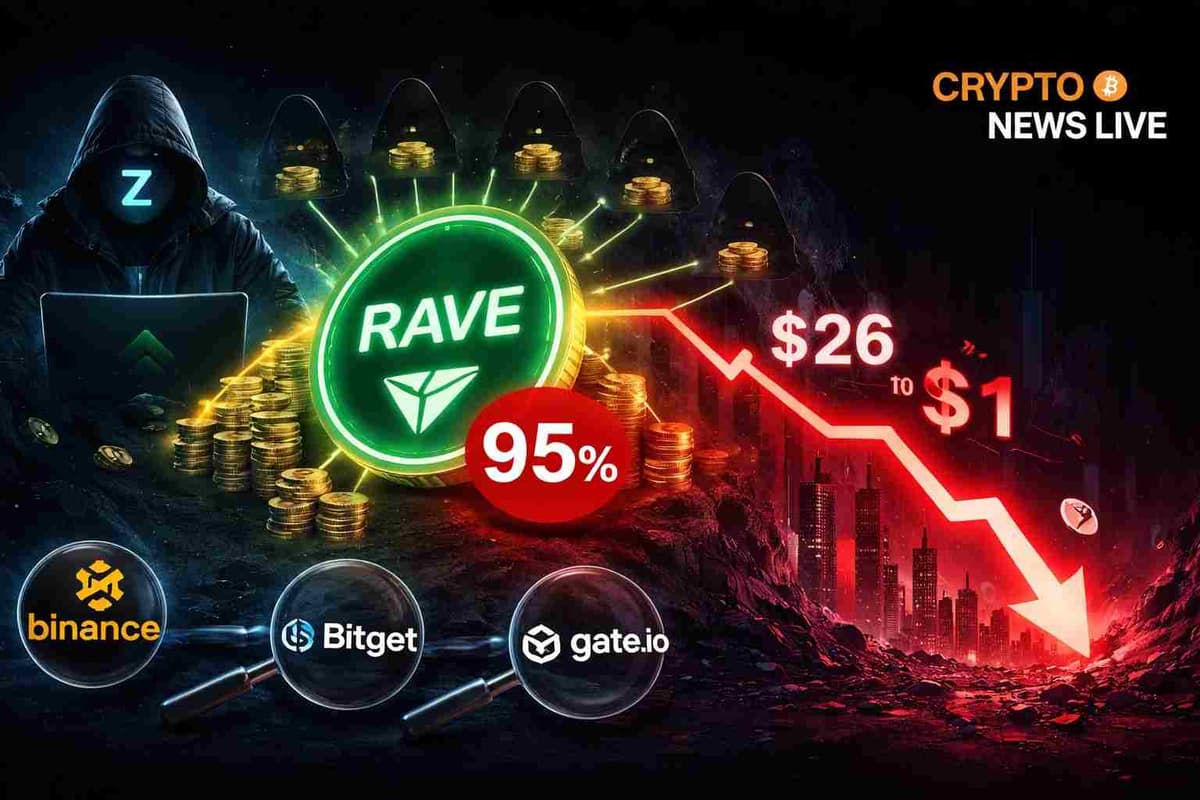
RAVE token manipulation did not happen quietly. It happened in full view of three major exchanges, across traceable on-chain addresses, and it wiped $6 billion in market cap in a single day before Binance, Bitget, or Gate said a word publicly.
On April 18, 2026, ZachXBT posted a detailed thread on X laying out what he called one of the most blatant cases of insider-driven price action seen on a major centralized exchange. RAVE had launched in December 2025 on Binance Alpha with a total supply of 1 billion tokens. Within 11 days of its all-time high, it had briefly cracked the global top 15 by market cap, surpassing Litecoin and Avalanche. Then it fell 95%, from $26 to around $1, in under 24 hours.
Nine Wallets. One Billion Tokens. Almost All of It Controlled.
The core of what ZachXBT published was a list of nine wallet addresses he says are tied to the initial RAVE distribution, collectively holding approximately 95% of total supply:
0x9831156F1a6E506Fca41503590b42F07c2e80f54 0x8Ed6245C3276307E1A9D9Dc872E98A0E770070fd 0x6020656d1EF182173E45D4Fc375BDD5a48c674B0 0x2664cB80a5ee7D8EC05fe7C752dD62E078056E6d 0x2D81F8AeBf3e58A5e638006c9fd8F38C5220ecab 0x31694d761A8e851cFFbCd286aC54D01e5Ce5aFe6 0x0A1F07993a51CcEb4f52CA67765AECeADDA790d7 0xEB74Df8588cFC1C179Df4bd96C0bB8B227B9bE92 0x53d7d52301366DC14E1916b14eFeC1aDD8F3487b
Only about 24% of the total token supply was in active circulation at the time of the peak. That left a small group of addresses in a position to move price with relatively little capital. And that is exactly what the on-chain record shows.
Before the price surge started, wallets connected to the RaveDAO deployer moved 18.58 million RAVE tokens to Bitget without any public announcement or disclosure. The token was still trading below $0.50. Ten hours later, the rally began. With 74% of traders on Binance holding short positions at that point, insiders then pulled 29.78 million tokens back off Bitget, draining the exchange’s sell-side pressure entirely. The resulting squeeze drove RAVE from $0.27 to over $14 in seven days, eventually peaking near $28.
The Number That Gives It Away
ZachXBT pointed to one figure from CoinGlass that he said makes the picture impossible to explain away: $6 billion in market cap was erased on just $52 million of 24-hour liquidations. That ratio does not exist in a market that built its value organically. It points directly to a valuation that was manufactured, held up by concentrated supply, and unsustainable the moment the exits opened.
On-chain data cited in the investigation also shows roughly $42 million in RAVE flowing into Bitget during the run-up, followed by $32 million being pulled back out before the crash. Stripping that volume off the order books eliminated whatever selling pressure could have cushioned the drop.
ZachXBT also flagged what he described as suspicious CEX activity in April 2026 tied specifically to RaveDAO team addresses on-chain. For Bitget, he named addresses 0x2dc20f2180582172f5450c5d71e23fa438a7031b, 0xa3a02aeb97fc1737c66f50d07d024799c137891d, and 0x2d95eb42525e6087e0cb7869f98da6838ed2e743. For Gate, address 0x31711246b05d71e9eda5e38a3abb654020ee3353. He said this activity potentially contradicts RaveDAO’s public denial of involvement.
April 13, April 14, Then April 18
Before publishing anything publicly, ZachXBT contacted RaveDAO co-founder Yemu Xu, known on X as wildwoomoo, on April 13 and again on April 14. No response came from either outreach.
At 7:26 am UTC on April 18, ZachXBT posted his first public call to action, naming Binance, Bitget, and Gate and offering a $10,000 personal bounty for anyone providing non-public information with supporting evidence of who was responsible. By 10:56 am UTC the same day, he had raised that figure to $25,000 after contributions from others in the community.
Gracy Chen, CEO of Bitget, on X posted at 11:18 am UTC, saying the exchange had begun looking into $RAVE and appreciated the alert.
Richard Teng, co-CEO of Binance, on X followed at 2:08 pm UTC, confirming Binance was actively reviewing the situation and that the exchange was committed to examining all forms of trading misconduct.
Three minutes after Binance acknowledged the investigation, at 3:06 pm UTC, RaveDAO posted a thread on X stating the team had no involvement in the price action. Gate acknowledged the call to action at 4:19 pm UTC, making it the third exchange in under nine hours to open a formal review.
RaveDAO’s Statement and What It Actually Confirms
RaveDAO on X said the team had no part in the recent price movement, adding that the project’s attention remained on its core mission of linking live music events to Web3 adoption. The project also confirmed in the same thread that it does plan to sell portions of unlocked tokens based on its token release schedule, framing those sales as measured and publicly disclosed in advance.
That last point matters. ZachXBT’s position in his X thread was direct: given the degree of supply concentration, the team at minimum knows exactly who drove this price action. Even if they were not the direct actors, the wallets are traceable, the connections are documented, and silence is its own answer.
The $25,000 bounty remains active. Every message received so far contained unverified claims. None met the stated threshold of non-public information backed by supporting evidence.
Not Just RAVE. A Broader Pattern.
In the same X thread, ZachXBT named six other tokens he considers to have highly questionable price behavior on major centralized exchanges: SIREN, MYX, COAI, M, PIPPIN, and RIVER. RAVE, he said, was simply the most obvious case, reaching a top-15 market cap position within ten days of launch before collapsing 95% in hours.
SIREN has since also lost more than 70% of its value in a single day after investigators flagged a wallet cluster holding roughly half its supply.
ZachXBT noted that he held no position in RAVE at any point during this event. Had he entered a trade, the crash would have liquidated him. He also stated he had no way to predict if or when exchanges would respond publicly, which is itself a problem. Each day an exchange delays acting on manipulation of this type, retail traders absorb losses while the platforms collect fees on the same volume generating those losses. The outcome does not shift based on whether the intent was deliberate.
Investigations at Binance, Bitget, and Gate are ongoing. No public findings have been released.