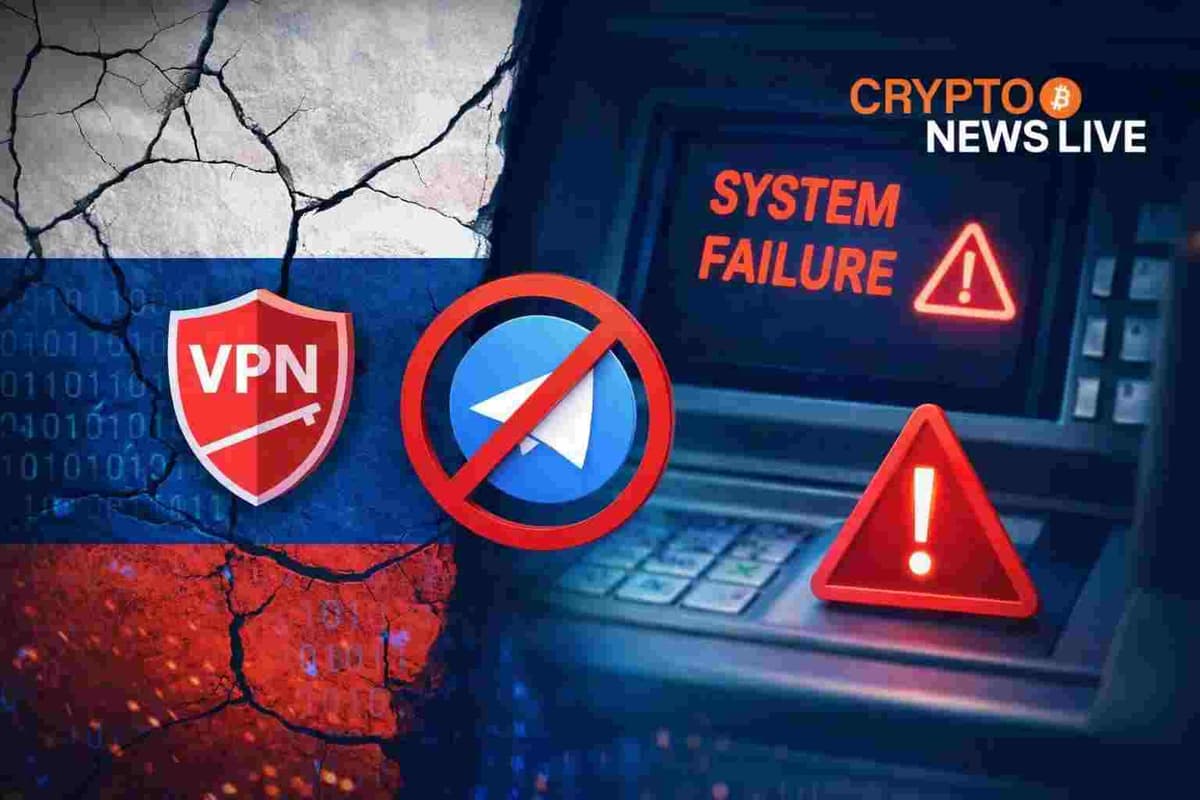
Russia tried to cut off Telegram. It cut off its own banks instead.
Telegram founder Pavel Durov said Friday’s nationwide banking disruption was a direct result of Russia’s aggressive push to block virtual private networks, the primary tool Russians use to access the banned messaging app. The Moscow metro briefly had to open its turnstiles without payment. A regional zoo turned cash-only. Sberbank, Russia’s largest commercial bank, confirmed a technical issue but gave no details.
Durov posted the numbers on X. Over 65 million Russians use Telegram daily despite the official ban, with more than 50 million sending at least one message every day.
When the Block Broke the Bank
According to Pavel Durov, on X:
“Telegram was banned in Russia, yet 50M+ Russians still use it daily via VPNs. The government has spent years trying to ban VPNs too. Their blocking attempts just triggered a massive banking failure, cash briefly became the only payment method nationwide.”
The failure is being attributed to an overload of Roskomnadzor’s own filtering systems. The Bell and other Russian media reported, citing unidentified industry sources, that Friday’s attempts to limit VPN traffic directly caused the disruption to banking apps. Some Russian outlets that initially connected the outage to the VPN crackdown quietly deleted that coverage afterward.
Russia’s crypto users have felt this differently than most. Telegram has been the central layer for trading information, DeFi coordination, and community access inside Russia. TON, the native token of Telegram-affiliated The Open Network, is already down 27% this year and trading at $1.23, with the crackdown adding pressure on a user base that accounts for more than 60% of Russia’s population on the platform. Cutting Telegram access does not just restrict a messaging app. It cuts infrastructure.
Iran Already Ran This Playbook
Durov drew a direct line between Russia’s current position and Iran’s failed experiment. Iran banned Telegram years ago, expecting users to shift to government-backed surveillance apps. That did not happen.
As Durov posted on X:
“Iran banned Telegram years ago, with a result similar to Russia. The government hoped for mass adoption of its surveillance messaging apps, but got mass adoption of VPNs instead. Now 50M members of the Digital Resistance in Iran are joined by 50M+ more in Russia.”
The pattern is consistent. State-backed apps do not win by eliminating competition. Russia is now pushing MAX, a super-app by VK that launched in March 2025 and must come preloaded on every new smartphone sold in the country. MAX reportedly has 100 million registered users and is being promoted by pro-Kremlin celebrities as a safer alternative to Telegram and WhatsApp. Durov has said previously that no successful national app, WeChat, KakaoTalk, or LINE included, was built by forcing out rivals.
Russia fined Telegram $430,000 for failing to remove prohibited content. It also opened a criminal case against Durov, accusing him of aiding terrorism. He called it a fabricated pretext.
Thousands Building VPNs, Telegram Adapting
The response from users has been fast. In his Telegram post, Durov said thousands of Russians are now actively building VPNs and proxies in response to the restrictions. He committed to Telegram’s end of the fight:
“We’ll keep adapting, making Telegram’s traffic harder to detect and block.”
For accuracy on the user figures, Durov clarified on X:
“For accuracy, over 50M Russians send at least one message every day, with 65M daily active users in Russia overall despite the ban. Monthly active users remain to be seen, but could easily be twice as high.”
Russian businesses have formally complained to President Vladimir Putin about the internet restrictions disrupting operations, a signal the economic cost has reached the highest levels of government. Moscow’s economy reportedly lost between 3 billion and 5 billion rubles in just five days from the internet shutdown, though a second independent source has not confirmed that figure.
Over 469 VPN services have already been blocked inside Russia. Mobile internet was disrupted across Moscow. VPN usage surged 800% as restrictions tightened. Russia’s Digital Development Ministry ordered mobile operators to cut top-up services to restrict VPN use further, while domestic platforms are being asked to block users who connect via VPN.
The government built a wall. The wall fell on its own payment system.
Key Takeaways:
- Russia’s VPN crackdown to block Telegram caused a nationwide banking failure, confirmed by Telegram’s Pavel Durov.
- 65M Russians use Telegram daily via VPNs despite the ban; 50M+ send messages every day per Durov.
- Iran’s identical strategy failed, producing mass VPN adoption instead of state app migration.