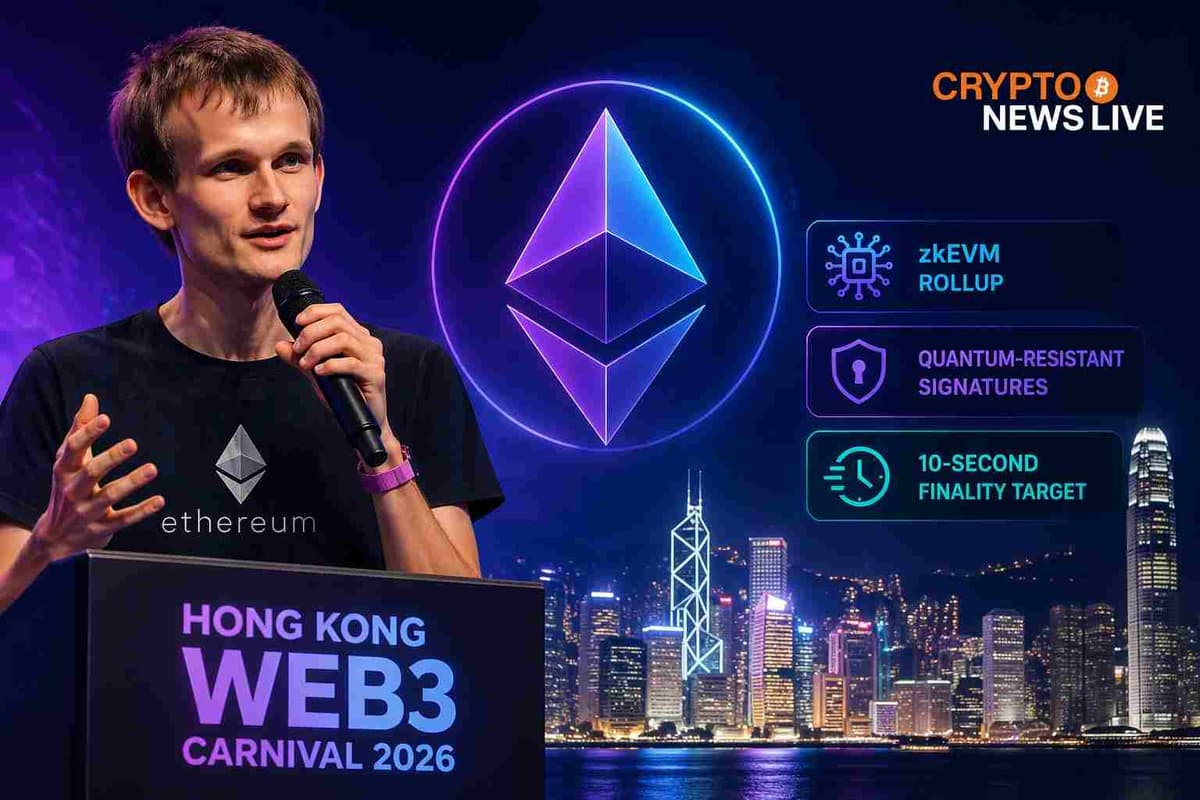
Ethereum co-founder Vitalik Buterin took the stage at the 2026 Hong Kong Web3 Carnival on April 20 and outlined what he called Ethereum’s core purpose and the technical steps planned over the next five years. The speech, delivered at the opening ceremony of the Hong Kong Convention and Exhibition Centre, covered zkEVM deployment, quantum security upgrades, and a target finality window of 10 to 20 seconds.
Buterin described Ethereum as serving two distinct functions. The first is a public bulletin board where applications post data that anyone can read and verify. The second is a shared computational layer, where digital objects controlled by code — tokens, DAOs, ENS names — exist and interact. He said these two properties together are what separate Ethereum from chains that optimize purely for transaction speed.
Why Copying Ethereum at Scale Solves Nothing
The framing matters for developers assessing Layer 2 options. Buterin said, according to his full speech published by PANews:
“If you simply copy Ethereum, scale it up 100 times, make it more centralized, and that’s it, it’s pointless.”
His position is that meaningful L2 solutions must add off-chain components that extend Ethereum’s capabilities rather than replicate the base layer with looser consensus. Prediction markets, electronic voting systems, and privacy protocols all require on-chain and off-chain parts working together. That architecture, he said, is what makes a Layer 2 actually useful.
The short-term roadmap has three pillars. First, continue raising the gas limit. Second, roll out zkEVM, which lets Ethereum verify complex computations without requiring every node to re-execute them. Third, prepare for post-quantum cryptography. PeerDAS, introduced in last year’s hard fork, already expanded data publishing capacity but Buterin said more work remains.
The Quantum Signature Problem Nobody Is Talking About
The quantum resistance section of the speech contained some of the most specific technical disclosures of the event. Buterin said current Ethereum signatures are 64 bytes and cost 3,000 Gas on-chain. A quantum-resistant signature, by contrast, runs between 2,000 and 3,000 bytes and costs 200,000 Gas. That is a 66-fold increase in size and roughly a 66-fold increase in on-chain cost.
Two signature types are being evaluated. Hash-based signatures and lattice-based signatures. Both are quantum-resistant and have existed in cryptography research for two decades. The constraint has never been theoretical, it has been efficiency. Buterin said the plan is to add vectorization support directly into the EVM, applying the same hardware optimization logic used to accelerate AI inference on conventional processors. The goal is to bring quantum-resistant signature costs down to levels that do not make ordinary transactions economically unworkable.
EIP-8141, the Account Abstraction proposal referenced in the speech, plays a role here. Under that model, a transaction becomes a sequence of calls — one for verification, one for execution — which lets the protocol natively support smart contract wallets, third-party payment delegation, and multiple signature schemes including quantum-resistant ones, without requiring a hard fork for each change.
zkVM, Finality, and the 2028 Timeline
Ethereum’s long-term security architecture rests on combining Bitcoin’s longest-chain rule with Byzantine Fault Tolerance. Buterin said this gives the network finality within one to three block slots, targeting a 10 to 20 second window. Under attack conditions where up to 49% of nodes fail, the chain retains full safety. At 33% node availability, some security guarantees still hold.
The zkVM rollout has a staged schedule. This year the target is making the zero-knowledge virtual machine secure enough for a small portion of the network. By 2028, the share of nodes using zkVM verification grows to the point where the chain can process more transactions without reducing decentralization. Buterin added that the goal is full verifiability on phones and IoT devices, meaning no large compute resource would be required to confirm chain state independently.
Artificial intelligence is also being incorporated into the verification process. Buterin said the team is using AI to generate formal code proofs, producing mathematical demonstrations that running Ethereum software actually has the properties it claims. He said progress in this area over the past two years would not have been possible without recent AI developments.
Security First, Speed Second
Buterin was direct that Ethereum is not designed to compete with high-frequency trading platforms on throughput. The chain’s design priority is security, followed by decentralization, with speed treated as a consequence of improving those two properties rather than a standalone goal.
The Block Access List, gas repricing proposals, and ePBS — the separation of block proposers and builders — are all part of the near-term efficiency push. ePBS increases block verification time slightly but improves node resilience and state download performance. Taken together, these proposals are designed to make raising the gas cap safer, not just faster.
For anyone building decentralized applications, finance tools, identity systems, or prediction markets on Ethereum, Buterin’s message from Hong Kong was that the protocol’s five-year direction is fixed around verifiability and security. zkEVM is the next major milestone. Quantum resistance and full zkVM coverage by 2028 are the targets after that.