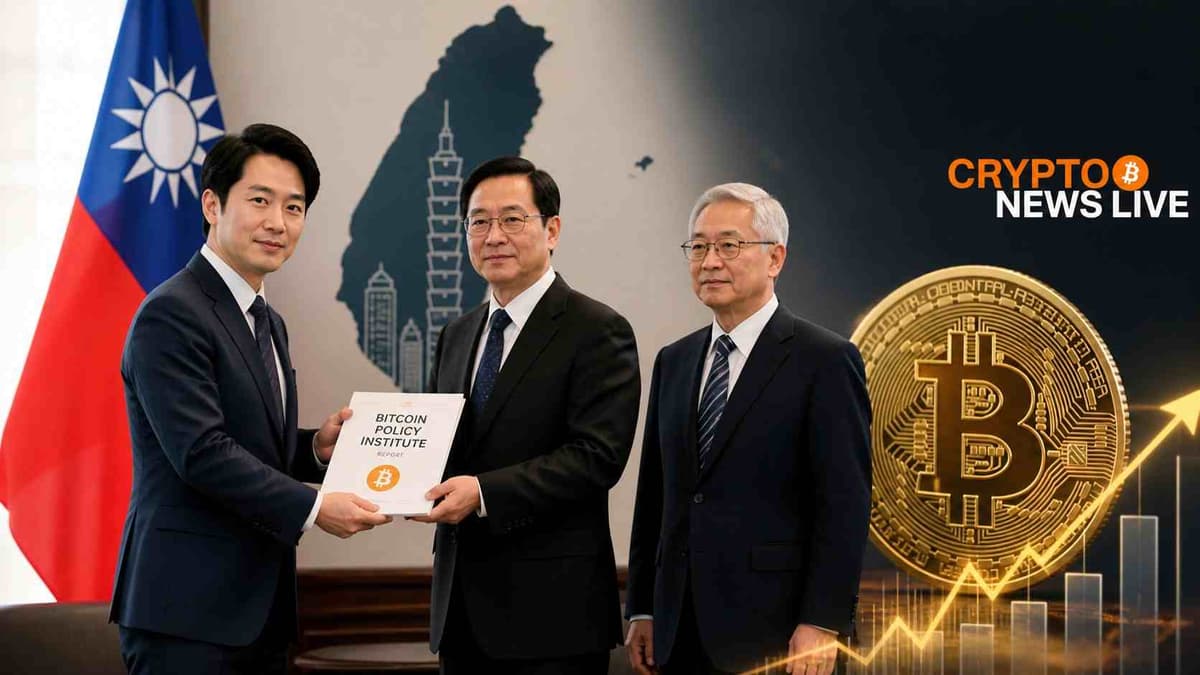
Taiwan’s Bitcoin reserve conversation moved beyond committee rooms on April 29. Legislator Dr. Ko Ju-Chun walked a Bitcoin Policy Institute report directly to Premier Cho Jung-tai and Central Bank of China Governor Yang Chin-long during a formal interpellation session at the Legislative Yuan. This was not a press release or a social media call. It happened inside a government chamber, on record, in front of the two officials with the actual authority to move on it.
Ko urged the executive branch to consider moving a share of Taiwan’s $602 billion in foreign exchange reserves into Bitcoin as a strategic national holding. He also put a one-month deadline on the CBC to produce a fresh report covering stablecoins and broader digital asset reserve questions.
Taiwan’s Dollar Overexposure Is the Real Argument
The BPI report, written by BPI Fellow Jacob Langenkamp and published in March 2026, lays out what Ko presented as the core vulnerability. More than 80% of Taiwan’s reserves sit in U.S. dollar-denominated assets. Since 2008, the Federal Reserve has expanded its monetary base by 526%. U.S. debt-to-GDP now exceeds 120%. Taiwan’s semiconductor-driven exports produced a record $157 billion trade surplus in 2025, and yet the bulk of those earnings flow back into dollar assets that carry those exact risks.
Langenkamp put it plainly in the report:
“In a scenario where physical gold is stranded and dollar reserves face restrictions, Bitcoin remains fully accessible without physical transport.”
That argument carries a specific weight for Taiwan. Gold transport in a Taiwan Strait blockade scenario is not a theoretical concern. It is the kind of risk that defense and monetary planners actually model. The BPI report frames Bitcoin as the only reserve asset that cannot be physically seized or frozen through a SWIFT-style restriction.
The CBC Already Has Bitcoin — Just Not by Choice
What most coverage skips is this: Taiwan’s central bank already holds Bitcoin. The CBC committed to a digital asset sandbox using 210 seized Bitcoin following its December 2025 review. That same review concluded Bitcoin was unsuitable for reserves because of volatility, liquidity, and custody concerns. Ko’s April 29 session does not erase that conclusion. But it creates a formal legislative record that pushes back on it.
Sam Lyman, head of research at the Bitcoin Policy Institute, said the research is now reaching the highest levels of government in multiple countries.
“Dr. Ko’s decision to present this report directly to the premier and central bank governor shows the seriousness with which Taiwan’s lawmakers are treating Bitcoin as a strategic holding,” Lyman said. “Our job is to put the facts in front of the people who make these calls.”
Ko is not a fringe voice here. He serves as vice co-chair of the Legislative Yuan’s US-Taiwan Caucus and founded the Emerging Technology Exchange Association. He first raised the BPI findings with CBC Governor Yang during a March 30 session. The April 29 session was the first time the report landed formally in front of the premier.
The Numbers Behind the Proposal
An initial allocation of roughly $2.5 billion has been floated in the report. That represents under 0.5% of Taiwan’s total FX reserves. It is a small number against a $602 billion pool, but the BPI frames it as a starting point rather than a ceiling. Taiwan would join 29 countries that had gained Bitcoin exposure by January 2026, a count the U.S. Strategic Bitcoin Reserve executive order accelerated.
The Fed’s monetary base expansion of 526% since 2008 is not a number Ko invented. It comes from the Langenkamp report itself, published at btcpolicy.org. For institutions holding the bulk of their reserves in dollar assets, that figure is the entire case in one statistic.
Neither the premier’s office nor the CBC has announced any decision or commitment following the April 29 session. The central bank’s next move, including whether it meets Ko’s one-month deadline on the stablecoin and digital asset report, will be the clearest signal of where this is actually heading.