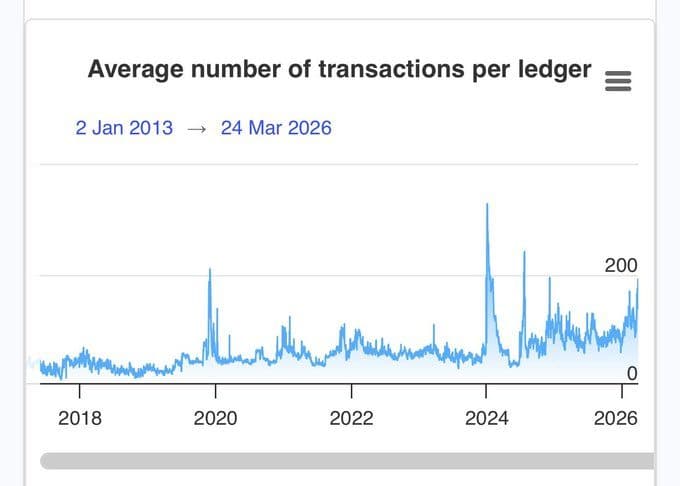
The XRP Ledger is doing something it almost never does. Transactions per ledger crossed and held above 200, a level that has appeared only a handful of times across the network’s entire history.
According to Vet_X0 on X, the surge was driven mostly by arbitrage bots competing aggressively for ledger inclusion. That competition pushed automatic fee escalation to as high as 230 XRP per transaction during the high-load window, specifically between 1 and 9 AM UTC on March 24. XRPL’s consensus protocol kept closing ledgers through the entire episode without disruption.
How Validators Actually Control the Fee
David Schwartz, former CTO of Ripple and known on X as JoelKatz, laid out two things about fee escalation that most people miss. If the volume of transactions requested even slightly exceeds what the network can clear, fees can climb without a ceiling. A network capped at 200 TPS will raise the fee to whatever level cuts demand back down to 200 or fewer.
The second piece involves the validators themselves. Schwartz noted on X the network will not run as fast as the quickest validator or as slow as the slowest. A majority of validators must agree, and depending on how the negative UNL functions, that threshold can rise to 80 percent.
How those validators are provisioned matters more than most realize. A server barely keeping pace under normal conditions can fall behind entirely when transaction volume doubles, even without any fee escalation in play. Schwartz said triggering escalation too early unnecessarily caps TPS, while triggering it too late can render many nodes non-functional when someone floods the network.
ScamDetective5 on X pressed Schwartz on the actual mechanics behind how validators negotiate the clearing rate.
Each Validator Does Its Own Math
Schwartz responded directly, explaining that every validator independently calculates how many transactions can reliably fit in a ledger based on what previous ledgers actually showed. From that baseline, an exponential fee curve kicks in for anything beyond that number.
The cutoff, as a rough approximation, is set at the point where half the validators agree. If the last several ledgers averaged 200 transactions and the network is running smoothly, validators will generally start pushing the required fee above the minimum once that number gets crossed.
Slow or contested consensus rounds change the picture. If a round drags to 12 seconds, every validator sees it and lowers the transaction target for the next ledger, shifting the curve’s inflection point. Transactions that are valid but not yet included stay in a queue, ordered by fee with ties broken by arrival time. The ledger fills from the top of that queue until it hits a transaction unwilling to pay the current rate. Then validators vote individually, and majority rule decides what gets in.
The March 24 activity adds to a very short list of moments where XRPL saw this level of sustained throughput. The network held together. The fees did the job they were designed to do.