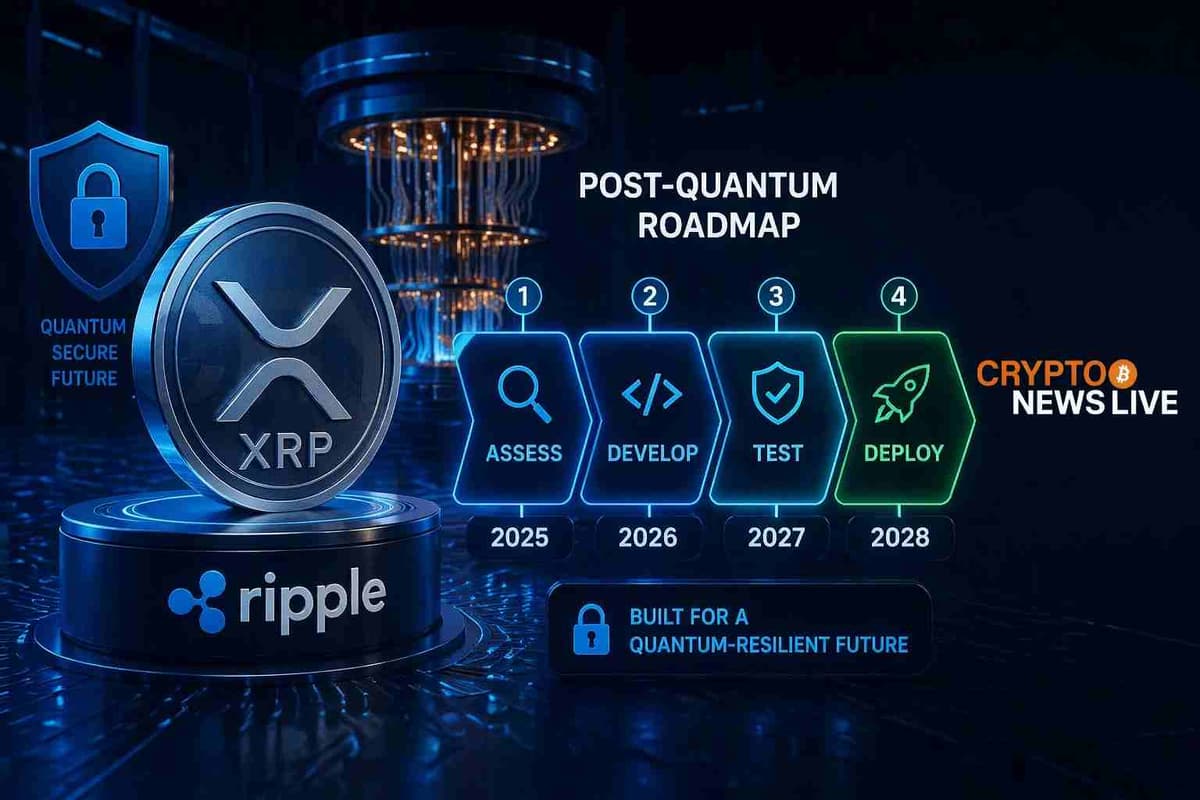
Ripple has published a four-phase roadmap to bring post-quantum cryptography to the XRP Ledger, with a hard target of full transition by no later than 2028. The plan, detailed on April 20 by Ripple’s Senior Director of Engineering Ayo Akinyele, addresses a threat that has shifted from theoretical to credible following recent findings from Google Quantum AI.
The Google research showed that the elliptic curve cryptography underpinning most blockchains today, including XRPL, could eventually be broken by sufficiently advanced quantum hardware. Akinyele’s team did not treat that finding as distant. Work is already underway.
Why Dormant Accounts Face the Sharpest Risk
The threat carries a specific weight for accounts that have signed transactions on XRPL in the past. Every signed transaction makes a public key visible on-chain. In a post-quantum environment, that exposed key is the entry point. The longer a wallet has been dormant since its last transaction, the longer that public key sits in the open.
Ripple’s roadmap names this “harvest now, decrypt later.” Bad actors can collect those visible keys today and wait for quantum hardware to become capable enough to reverse-engineer the private key behind them. It is not an attack that requires quantum capability right now. It just requires patience.
That is what makes the 2028 timeline meaningful. It is not a distant bureaucratic deadline. It is Ripple’s answer to a window of exposure that is already open.
Native Key Rotation Gives XRPL a Head Start
XRPL already supports native key rotation at the protocol level. Account holders can move away from a compromised or vulnerable key without abandoning their account or manually migrating assets to a new wallet address. Most other networks, including Ethereum, do not have this at the protocol layer. Any equivalent migration on Ethereum would require users to move funds manually to entirely new accounts.
Ripple’s cryptography team, which includes Dr. Murat Cenk, Dr. Tamas Visegrady, Dr. Oleg Burundukov, and Dr. Aanchal Malhotra, alongside engineer Denis Angell who is already running prototypes on AlphaNet using ML-DSA, is treating the migration as an architectural problem, not a software patch.
The four phases break down as follows. Phase 1 is the emergency contingency, what Ripple calls Q-Day readiness. If classical cryptography breaks before the planned transition is complete, XRPL would enforce a hard shift. Classical public-key signatures would stop being accepted by the network. Users would migrate to quantum-safe accounts, and Ripple is exploring PQ-based zero-knowledge proofs as a way to prove ownership of existing keys without exposing them during that migration.
Testing Starts in the First Half of 2026
Phase 2, covering the first half of 2026, begins full assessment of how post-quantum cryptography affects XRPL’s transaction performance, storage, and bandwidth. Post-quantum schemes come with real tradeoffs. Larger key sizes and signature lengths have implications at ledger scale, and the team is running NIST-recommended algorithms through real XRPL workload conditions to measure the cost.
Ripple is working with Project Eleven on this phase. Project Eleven is building a hybrid post-quantum signing proof-of-concept, running validator-level tests, Devnet benchmarking, and a post-quantum custody wallet prototype. That collaboration is designed to compress Phase 2’s timeline.
Phase 3, set for the second half of 2026, moves into hybrid deployment. Post-quantum signature schemes run alongside existing elliptic curve signatures on Devnet first. Developers test performance and usability without touching the live network. Ripple is also exploring post-quantum-friendly primitives for zero-knowledge proofs and homomorphic encryption, which feed into the network’s tokenization and privacy capabilities for Confidential Transfers on MPTs.
Phase 4 is full production deployment. A new amendment to the XRPL ecosystem is proposed, the network transitions to PQC-based signatures at scale, and validator operators are brought up to the reliability requirements XRPL holds for fast deterministic settlement. Ripple has milestones set for the first half of 2026 and says full transition will happen no later than 2028.
One Design Principle Running Through All Four Phases
Ripple is not locking XRPL to a single post-quantum algorithm. The approach is built around what the team calls cryptographic agility, supporting multiple NIST-standardized schemes so the network can adjust as the post-quantum standards landscape continues to evolve. NIST finalized its first post-quantum cryptography standards in 2024, and the field is still maturing.
The roadmap does not treat this as a single upgrade. Storage, performance, throughput, usability, and protocol design are all in scope. For any institution holding XRP long-term, or any developer building on XRPL’s tokenization layer, those are the dimensions that determine whether a migration is smooth or disruptive.
The quantum threat is not arriving tomorrow. But the public keys from every transaction signed on XRPL are already out there, and they are not going anywhere.