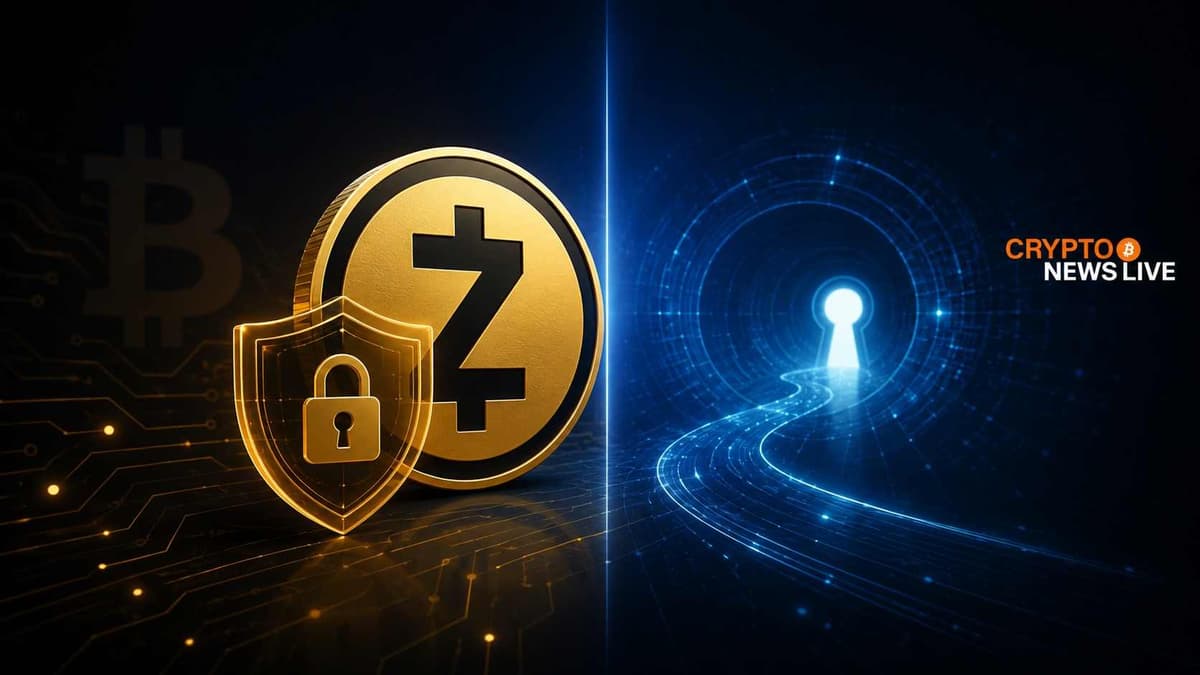
Zcash quantum resistance is moving from roadmap language into deployable infrastructure, with quantum-recoverable wallets now confirmed in active development. Delphi Digital published a detailed research report this week naming ZEC as Bitcoin’s private, sovereign complement, and the timing lands against a backdrop of real adoption numbers that most coverage has missed entirely.
The shielded supply on Zcash has grown from roughly 11% of circulating coins at the start of 2025 to approximately 30% today. That is nearly 4.9 million ZEC sitting in encrypted addresses, up from figures that barely moved for eight years before that.
What Delphi Digital Actually Said
According to Delphi Digital on X, “Quantum-recoverable wallets are coming to Zcash,” with the firm citing its earlier February coverage of Zcash’s quantum resistance roadmap as the foundation for why the asset functions as Bitcoin’s private complement. The full report is available at Delphi Digital’s research portal.
The report was posted on X by Delphi Digital, offering the first 100 readers free access. That framing signals how the firm views the report’s weight.
Delphi Digital’s core argument tracks closely with what the Zcash development community has been building toward for two years. Quantum recoverability is described as an escape hatch, a protective mechanism that preserves user funds if quantum computing capabilities advance faster than current timelines suggest.
Why the Sequencing of Quantum Upgrades Matters
Zcash is addressing quantum risk in a specific order. Privacy protection comes first, then recoverability, then full post-quantum soundness of the proof system itself. The recoverable wallet infrastructure is already designed. Integration is underway now.
This order is deliberate. Retroactive de-anonymization is the more immediate concern for users transacting today. Zcash’s shielded transactions use what cryptographers call information-theoretic hiding for the sender, receiver, and amount fields. A quantum computer cannot extract what isn’t mathematically present in the transaction data to begin with.
That separates Zcash from obfuscation-based privacy systems, where the underlying data exists but is mixed with decoys or computational noise. Those systems carry exposure if cryptographic hardness assumptions break down. Zcash’s shielded history does not carry that same exposure.
Shielded Pool Growth Is the Number to Watch
The shielded supply figure deserves more attention than it usually gets. Before 2025, it took Zcash roughly eight years to push shielded holdings past 11% of supply. That number tripled inside twelve months.
ZEC volume on Near Intents, a non-custodial cross-chain tool, hit $285 million in the last 30 days alone, running close to 82% of Bitcoin’s volume on the same platform. All-time ZEC volume there sits at $1.3 billion against Bitcoin’s $1.5 billion. Those numbers come directly from Near Intents data cited in the Delphi Digital report.
The October 2025 Near Intents integration appears to be the inflection point. Before that, ZEC volume on the platform was negligible.
Bitcoin’s Transparency Problem Is Not Getting Solved
Bitcoin’s protocol has no active development path toward native privacy. The institutional structure built around it, ETF approvals, government treasury holdings, Blackrock allocation, was constructed on the assumption that the ledger stays fully auditable. That is not changing.
Nearly 9% of all BTC now sits in ETFs or government wallets, according to figures cited in the Delphi Digital research. The asset that was designed to exist outside institutional reach has been absorbed into it.
Zcash’s optional transparency model, combined with the SEC closing its two-year investigation into the Zcash Foundation in January 2026 with no enforcement action, has left it as the only credible privacy asset still listed on Coinbase, Gemini, and Kraken. Monero has been removed from all three.
The Grayscale application to convert its Zcash Trust into a spot ETF on NYSE Arca, filed in November 2025, is pending. The trust holds approximately $137 million in ZEC, representing close to 5% of circulating supply.
Cypherpunk Technologies, a Nasdaq-listed company, holds 290,063 ZEC after a $58.88 million private placement led by Winklevoss Capital. Zooko Wilcox and Josh Swihart joined as Strategic Advisors in December 2025, the company confirmed.
VanEck CEO Jan van Eck went on CNBC earlier this year and said Bitcoin OGs are “looking at Zcash” because of unresolved questions about quantum computing and privacy inside the Bitcoin protocol. That came from the CEO of the firm that filed for the first Bitcoin ETF in 2017.
The Tachyon upgrade, expected at the protocol level by end of 2026, bundles the scaling improvements and quantum privacy protections into a single deployment. Proof aggregation in Tachyon is projected to reduce private transaction size to roughly 200-500 bytes, comparable to a standard Bitcoin transaction.
The quantum-recoverable wallet integration is the next visible milestone before that.
Disclaimer: This article is for informational purposes only and does not constitute financial or investment advice. Cryptocurrency investments carry significant risk. Always conduct your own research before making any investment decisions.