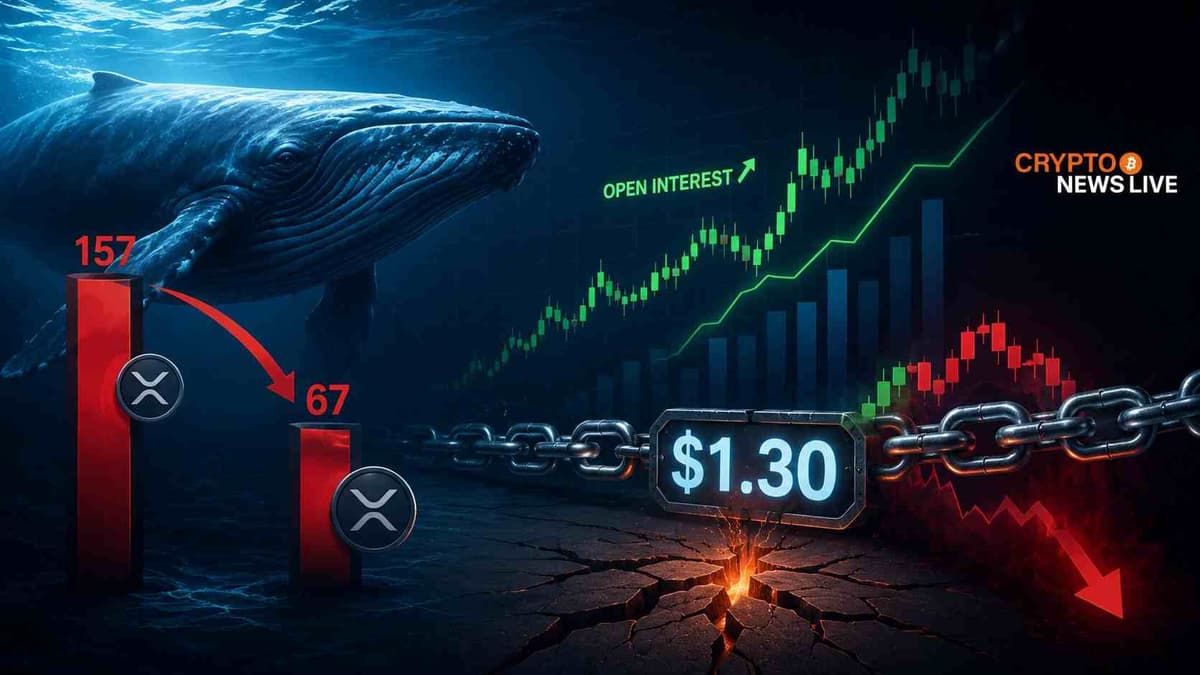
Large XRP transactions on the network have fallen off a cliff. Nine days. 57.3% gone.
Between May 13 and May 21, whale-scale moves worth over $1 million dropped from 157 transactions to just 67, per Santiment data tracked by crypto analyst Ali Martinez. For a retail XRP holder trying to read where the price heads next, that number matters more than most headlines right now.
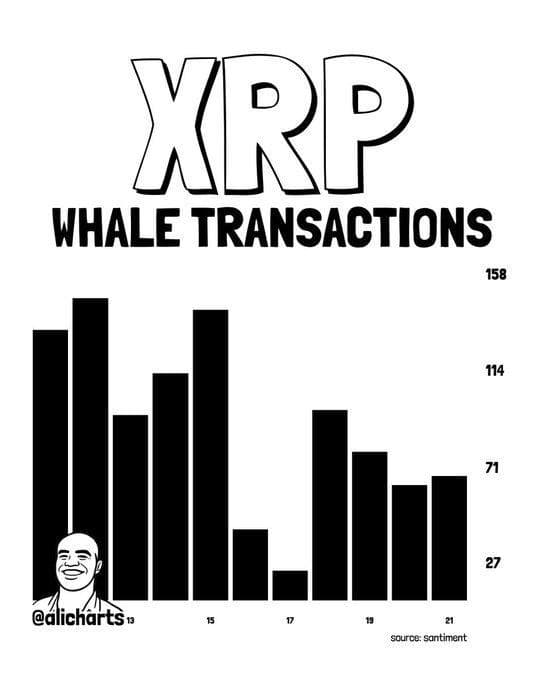
XRP Whale Transactions, May 13-21 | Source: Santiment via @alicharts on X
“In the last 9 days, whale activity on the $XRP network has dropped from 157 large transactions worth over $1 million to just 67 today, representing a 57.3% decline. When large-scale transaction volume thins out like this, it tells me the market could be entering a compression phase. Whales have stepped back to let the current price range settle, which naturally reduces immediate volatility and allows the order books to mature.”
Compression phases are not inherently bearish. But they do create conditions where the next directional move, whenever it comes, tends to carry more force than usual.
The $1.30 Line Nobody Wants to Talk About
The chart tells a story that sits uncomfortably between two outcomes. XRP formed a symmetrical wedge pattern between February and May 2026, with descending resistance pressing down from above and ascending support holding from below. The price is converging toward an apex.
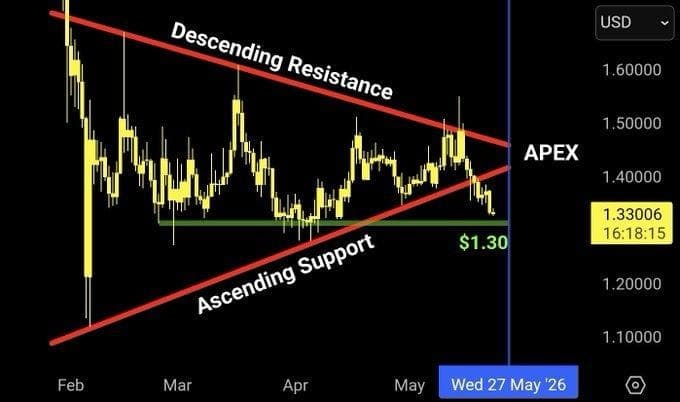
XRP Wedge Pattern with $1.30 Support | Source: @ChartNerdTA on X
“Signs of $XRP weakness confirmed: $1.30 is the critical guardrail for relief after the $1.50 post-clarity markup high. The longer we remain below $1.50, the larger the likelihood of dropping back down to the lower $1 level.”
XRP was trading around $1.33 at the time of the chart. The ascending support at $1.30 is not just a technical line on a chart.
It is the floor where the entire short-term thesis either holds or collapses.
Open Interest Is Rising. That Is Not Simple Good News
Here is where things get complicated. Open Interest on XRP-USDT perpetuals on Binance climbed to 433,771,255.81, up 0.12% at the time of publication, per CryptoQuant data. Rising OI alongside price support has historically pointed toward bullish momentum building in futures.
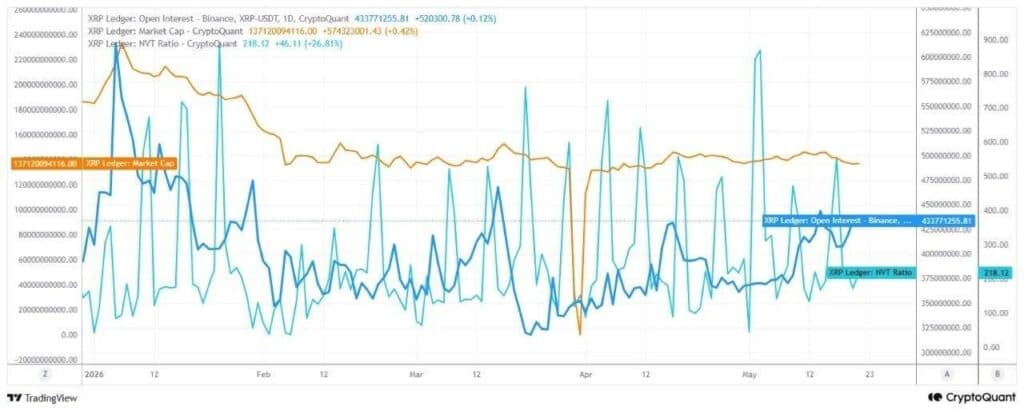
XRP Open Interest, Market Cap and NVT Ratio | Source: CryptoQuant
But CryptoQuant’s analysis adds a layer that most bullish reads skip over. The Network Value to Transactions Ratio on XRP sits at 218.12, up 26.81% and producing irregular spikes. A high NVT Ratio signals that the token’s market value is growing faster than actual on-chain transaction activity.
In plain terms: price may be climbing, but real network usage is not keeping up. Rallies built on that kind of gap tend to be volatile and short.
CryptoQuant’s assessment of the combined setup pointed to one likely scenario: an upside squeeze first, then a sharply elevated risk of correction afterward. If OI keeps rising while XRP fails to print new highs, long squeeze risk grows. Sudden downside wicks become a real probability, not a tail risk.
What Whale Pullback and Rising OI Together Actually Mean
The unusual part of this setup is the combination. Whale transaction volume dropping 57.3% while OI climbs is not a typical signal. Large transaction volume pulling back means the biggest holders are not moving coins aggressively. They are sitting still.
At the same time, futures positioning is growing. That suggests the action is moving from spot into derivatives. Speculation is building, but without the spot backing from large holders that would give a rally genuine legs.
Market cap has held relatively stable, with XRP Ledger Market Cap sitting at 137,120,094,116 at time of publication, up 0.42% per CryptoQuant. Large holders are not dumping. But they are not driving price either. The order book is maturing, as Martinez described it, waiting for something to break the pattern.
That something is most likely either a confirmed hold above $1.50 or a break of $1.30.